
A rehosted public-health epidemiology database will land on Amazon EC2 with Amazon EBS. On-premises SAN metrics show sustained 12,000 IOPS and 250 MiB/s during month-end reporting. How should architects size the block storage?
Select an answer to reveal the explanation.
Short Explanation
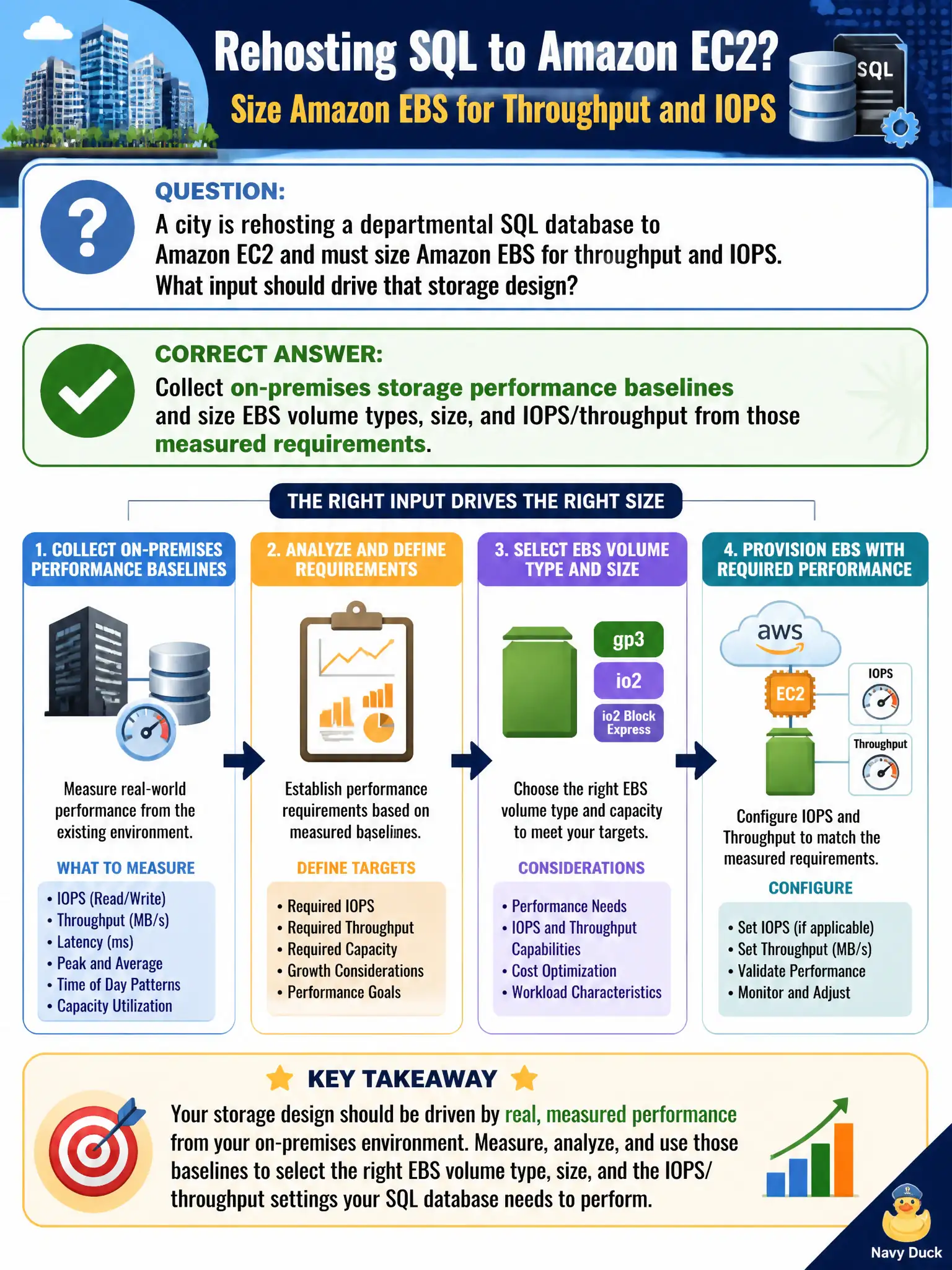
The SAN already told you how hard the database hits the floor. Bring those IOPS and throughput numbers to EBS instead of picking a tiny default and hoping. S3 and instance store don't magically become a measured database disk.
Full Explanation
A rehosted public-health epidemiology database landing on Amazon EC2 with Amazon EBS should size volume type, size, and provisioned IOPS/throughput from the measured on-premises performance baseline—here sustained 12,000 IOPS and 250 MiB/s during month-end reporting—rather than guessing a default disk. Evidence-based EBS selection prevents silent month-end meltdown for epidemiology reports. Choosing the smallest gp2 volume available because AWS will automatically match the SAN fails because AWS does not auto-match on-prem SAN performance. Using instance store only so IOPS cannot be specified fails durability and intentional provisioning for a database of record. Placing the database data files on Amazon S3 Standard and expecting POSIX IOPS fails protocol and latency expectations for a relational data directory. Exam caveat: size EBS from measured baselines, not smallest-default myths. Operational check: map baseline IOPS/throughput to gp3/io2 settings, select instance types that support the bandwidth, load-test month-end reports, enable monitoring alarms, and document the sizing worksheet for the health department. Document the decision in the municipal architecture decision record and re-verify controls after the first production wave so auditors see continuous improvement, not one-time tribal knowledge.