
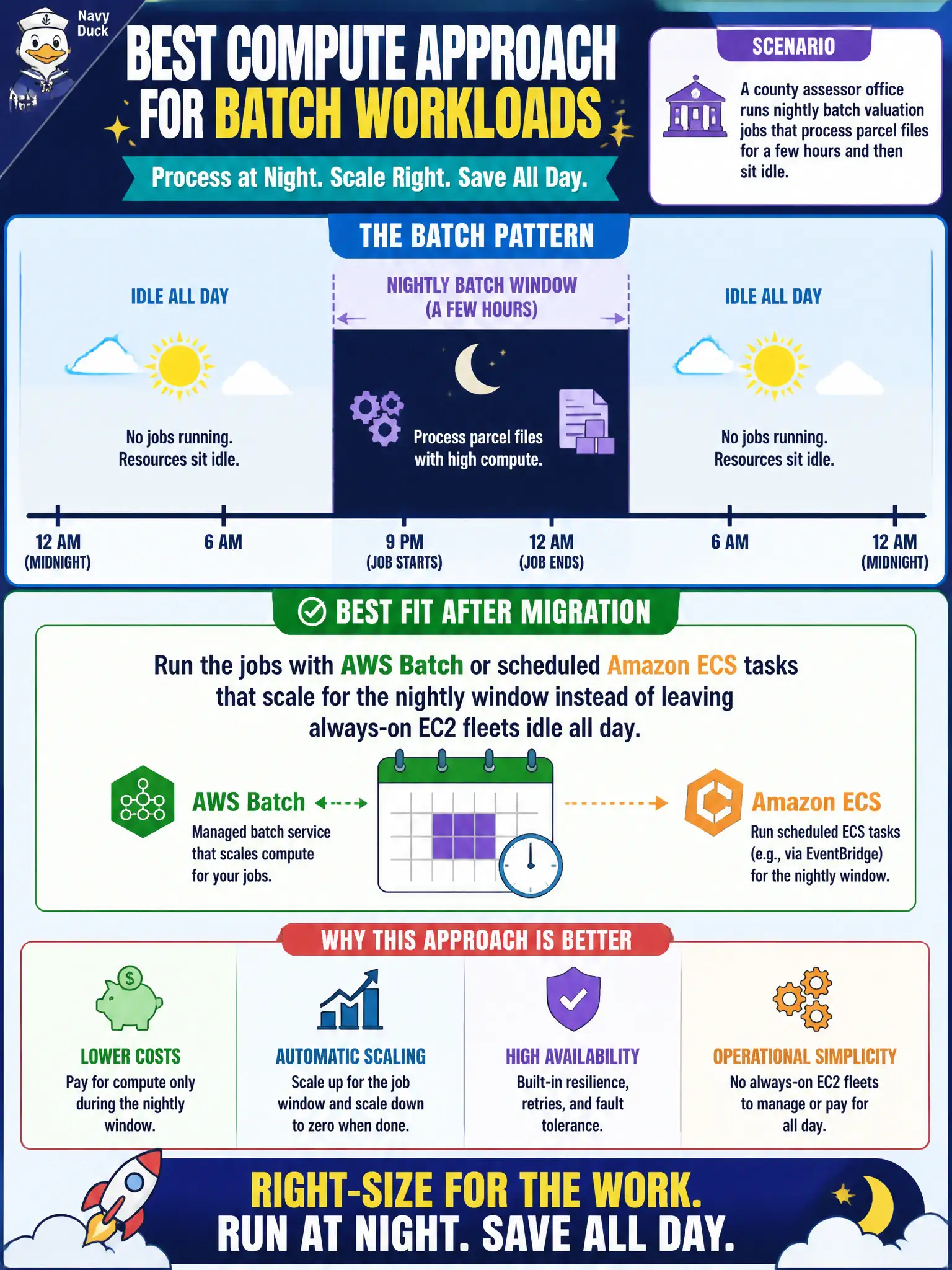
The county assessor office runs a six-hour nightly valuation batch that currently occupies a farm of always-on on-premises servers idle all day. After migration, which compute platform selection best fits that batch shape?
Select an answer to reveal the explanation.
Short Explanation
A nightly job is a night-shift crew, not a receptionist paid around the clock. Batch or scheduled ECS tasks clock in, finish the valuations, and leave. Always-on EC2 for an idle farm is a habit, and Lambda's short timeout isn't a six-hour shift.
Full Explanation
The county assessor office running a six-hour nightly valuation batch on a farm of always-on on-premises servers idle all day should, after migration, use AWS Batch or scheduled Amazon ECS tasks that run the nightly valuation jobs and scale to zero afterward, rather than always-on EC2. That matches the batch shape of assessor workloads and stops paying for idle daylight capacity. A cluster of unreserved EC2 instances left at 100 percent for 24 hours to simplify scheduling fails FinOps for a night-only job. AWS Lambda functions with 15-minute timeouts as the only engine for the six-hour job fail duration limits for long valuation runs. Amazon CloudFront as the compute runtime for the valuation executable fails conceptually—CloudFront is CDN, not batch compute. Exam caveat: long nightly batches fit Batch/scheduled ECS, not Lambda-only or always-on farms. Operational check: containerize valuation jobs, schedule Batch/ECS at night, alarm on job failure before morning assessment desks open, measure idle daytime cost eliminated, and keep artifacts in S3 for auditors. Document the decision in the municipal architecture decision record and re-verify controls after the first production wave so auditors see continuous improvement, not one-time tribal knowledge.