
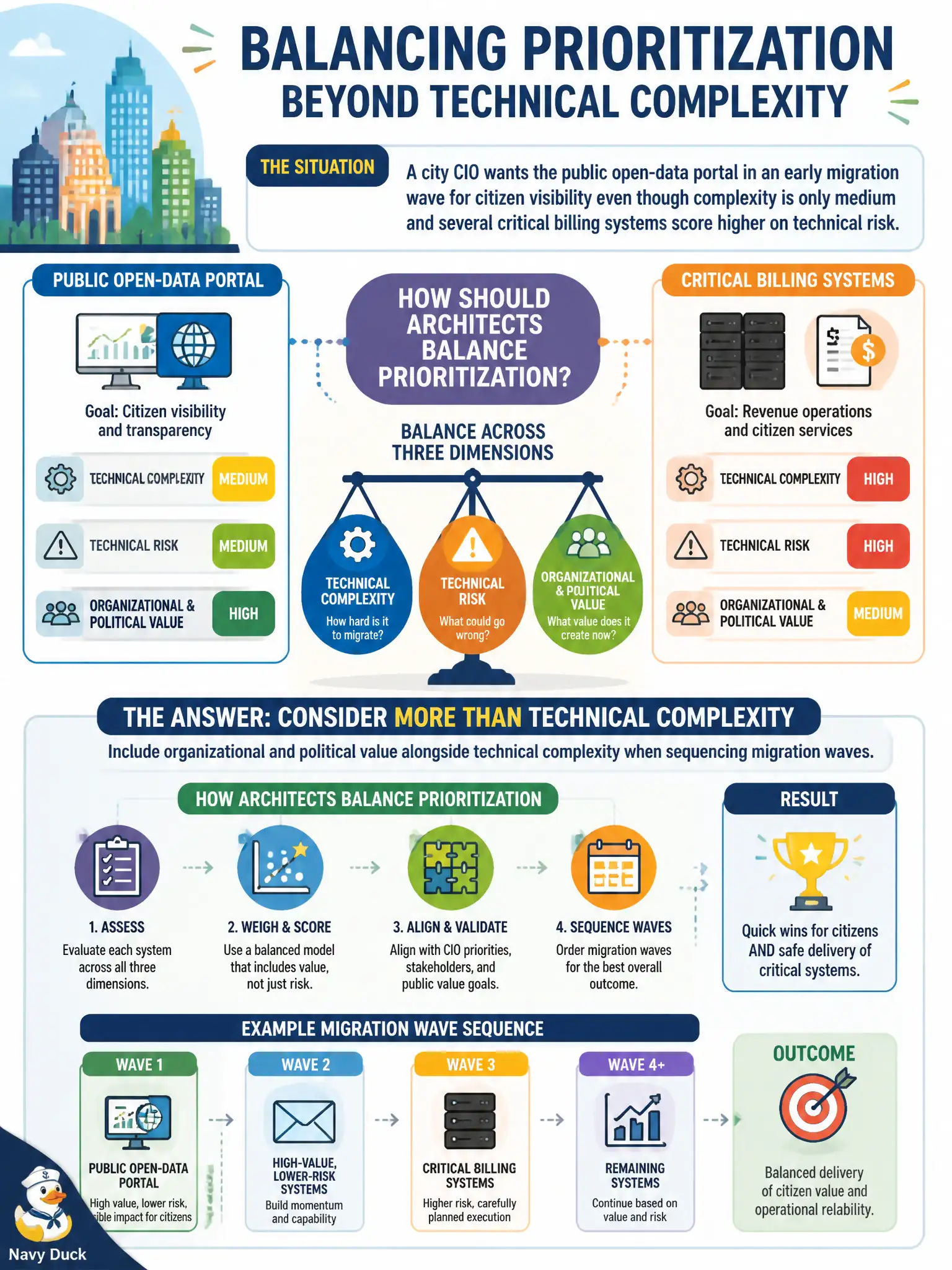
A city CIO wants the public open-data portal in an early migration wave for citizen visibility even though complexity is only medium and several critical billing systems score higher on technical risk. How should architects balance prioritization?
Select an answer to reveal the explanation.
Short Explanation
Waves are not a pure geek leaderboard. If the mayor needs a visible win, the open-data portal can ride an early wave even when billing systems look hairier on paper—balance politics and tech, don't pretend only rack metrics matter.
Full Explanation
A city CIO who wants the public open-data portal in an early migration wave for citizen visibility—even when complexity is only medium and billing systems score higher on technical risk—illustrates that prioritization is not purely technical. Include organizational and political value alongside technical complexity when sequencing migration waves so civic visibility goals and risk management coexist. Always migrating the highest technical-complexity systems first regardless of public visibility goals fails by ignoring legitimate organizational value and front-loading maximum difficulty before the program has rehearsal experience. Blocking the open-data portal until every backend database has completed a full rehost fails as unnecessary serialization that delays a medium-complexity citizen win. Using only CPU utilization rankings from the data center to set the entire wave order fails because utilization is not a proxy for political value, dependency risk, or readiness. Exam caveat: portfolio sequencing weighs business and political value with technical risk, not a single infrastructure metric. Operational check: score value, risk, and readiness explicitly; place open-data early if readiness passes; keep high-risk billing on a later gated wave; publish the dual-criteria rationale to the CIO and finance so wave disputes cite the model, not anecdotes.