
A licensing review shows one candidate app can use License Included on AWS economically, while another has complex BYOL constraints that raise three-year TCO if moved early. How should licensing factor into early-candidate selection?
Select an answer to reveal the explanation.
Short Explanation
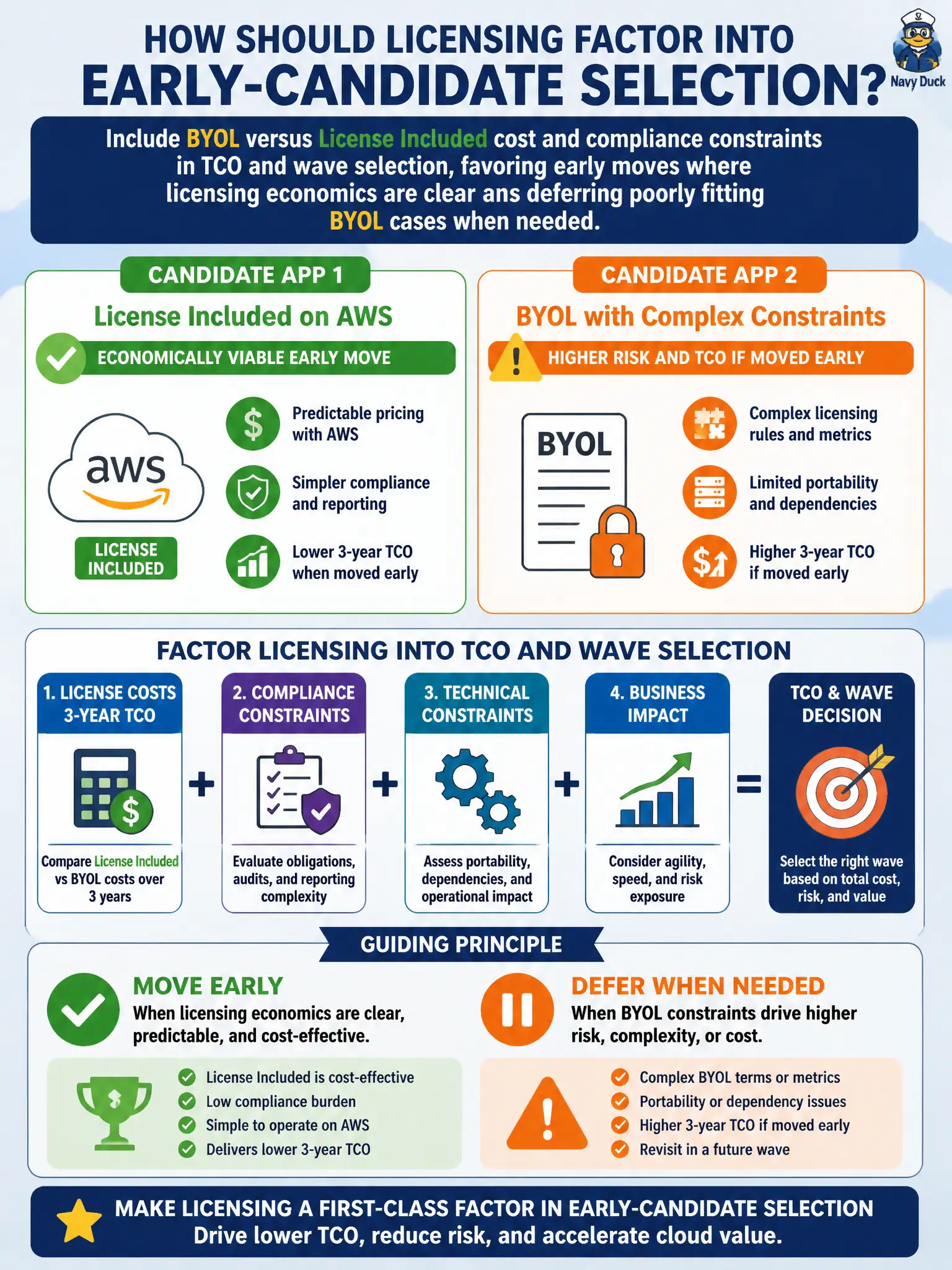
Licensing can flip a ‘yes’ to a ‘not yet.’ Bake BYOL versus License Included into TCO and wave picks—clear economics go early; thorny BYOL can wait. CPU hours alone are not the whole story.
Full Explanation
Licensing review that shows one candidate can use License Included economically while another has complex BYOL constraints raising three-year TCO must influence early-candidate selection. Include BYOL versus License Included cost and compliance constraints in TCO and wave selection, favoring early moves where licensing economics are clear and deferring poorly fitting BYOL cases when needed. That keeps the municipal business case honest for finance and software asset management. Ignoring licensing because TCO models only include EC2 CPU hours fails by omitting a dominant Windows and database cost driver that can erase projected savings. Always choosing BYOL for every Windows workload because included licensing is never allowed in government fails on policy myth—License Included is often valid for government and sometimes cheaper than BYOL. Purchasing Dedicated Hosts for all candidates regardless of license edition to standardize selection fails by over-applying Dedicated Hosts where edition and tenancy do not require them, inflating cost without compliance need. Exam caveat: licensing economics are part of wave selection, not an afterthought bolted on after cutover. Operational check: classify each app License Included versus BYOL with SAM, model three-year cost and compliance, prioritize clear economics for early waves, park hostile BYOL cases, and require license sign-off before purchase orders.