
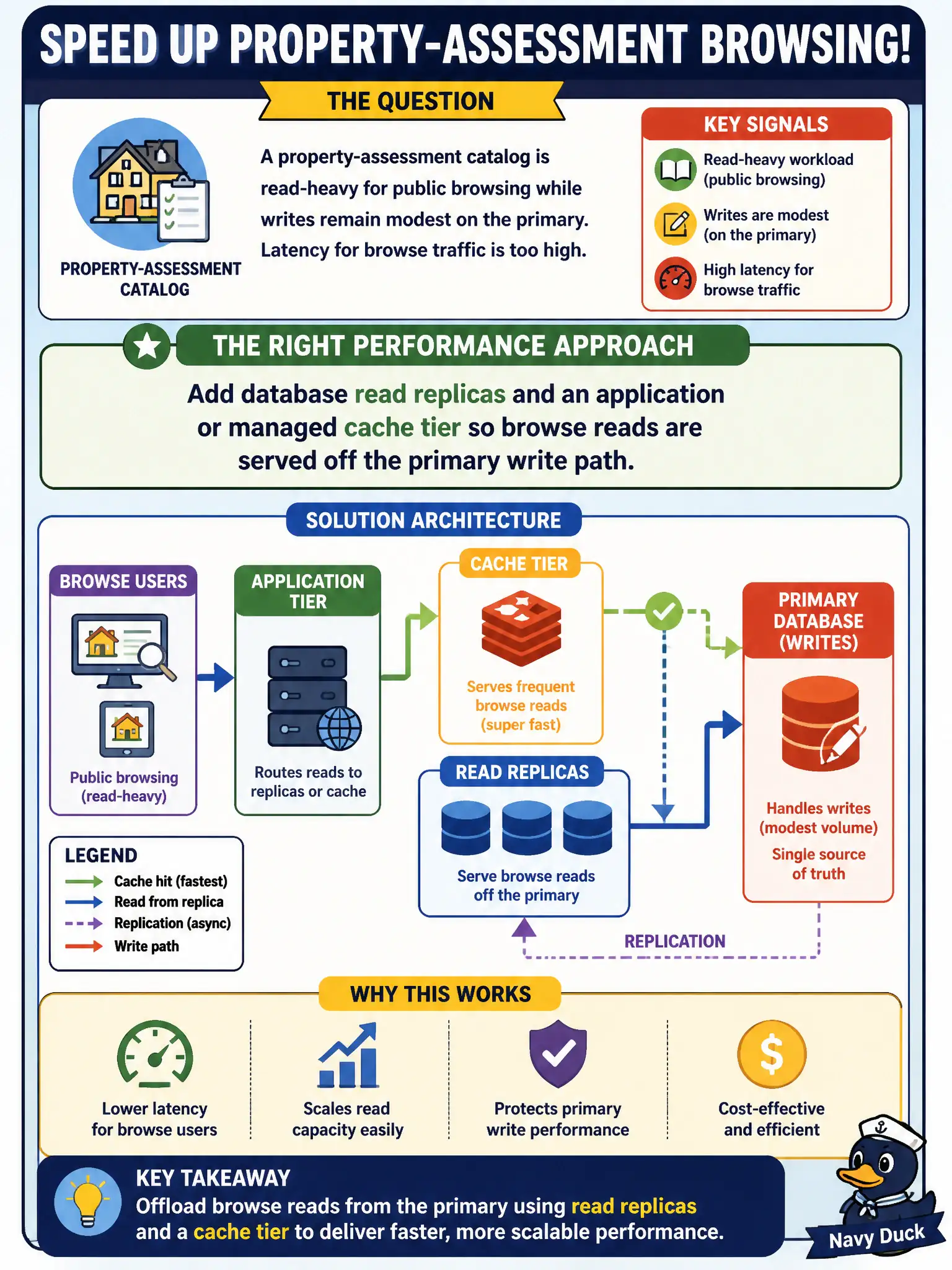
A property-assessment catalog is read-heavy for public browsing while writes remain modest on the primary. Latency for browse traffic is too high. Which performance approach fits?
Select an answer to reveal the explanation.
Short Explanation
Browsers shouldn’t all pile onto the one writer. Spin read replicas and a cache so the assessment catalog stays snappy while writes keep a quieter primary.
Full Explanation
A property-assessment catalog that is read-heavy for public browsing with modest writes suffers when every browse hits the primary writer. Adding database read replicas and an application or managed cache tier serves browse reads off the primary write path and improves latency. Forcing all browse traffic through the single primary with no replicas or cache preserves the bottleneck. Increasing only storage size on the primary without addressing read fan-out does not fix CPU or connection saturation from reads. Disabling indexes and full-table-scanning every catalog request worsens performance. Exam caveat: replicas lag and caches can serve stale assessments—define acceptable staleness for public browse versus staff write confirmation. Operational check: enable replicas and cache, shift browse traffic, compare primary CPU and browse p95 latency before and after, and verify a fresh write becomes visible within the published lag/TTL policy. In municipal cloud governance, record the owners, success metrics, and rollback or restore contacts beside this technical choice so the next incident, budget review, or audit does not rediscover the decision from scratch under time pressure. In municipal cloud governance, record the owners, success metrics, and rollback or restore contacts beside this technical choice so the next incident, budget review, or audit does not rediscover the decision from scratch under time pressure.