
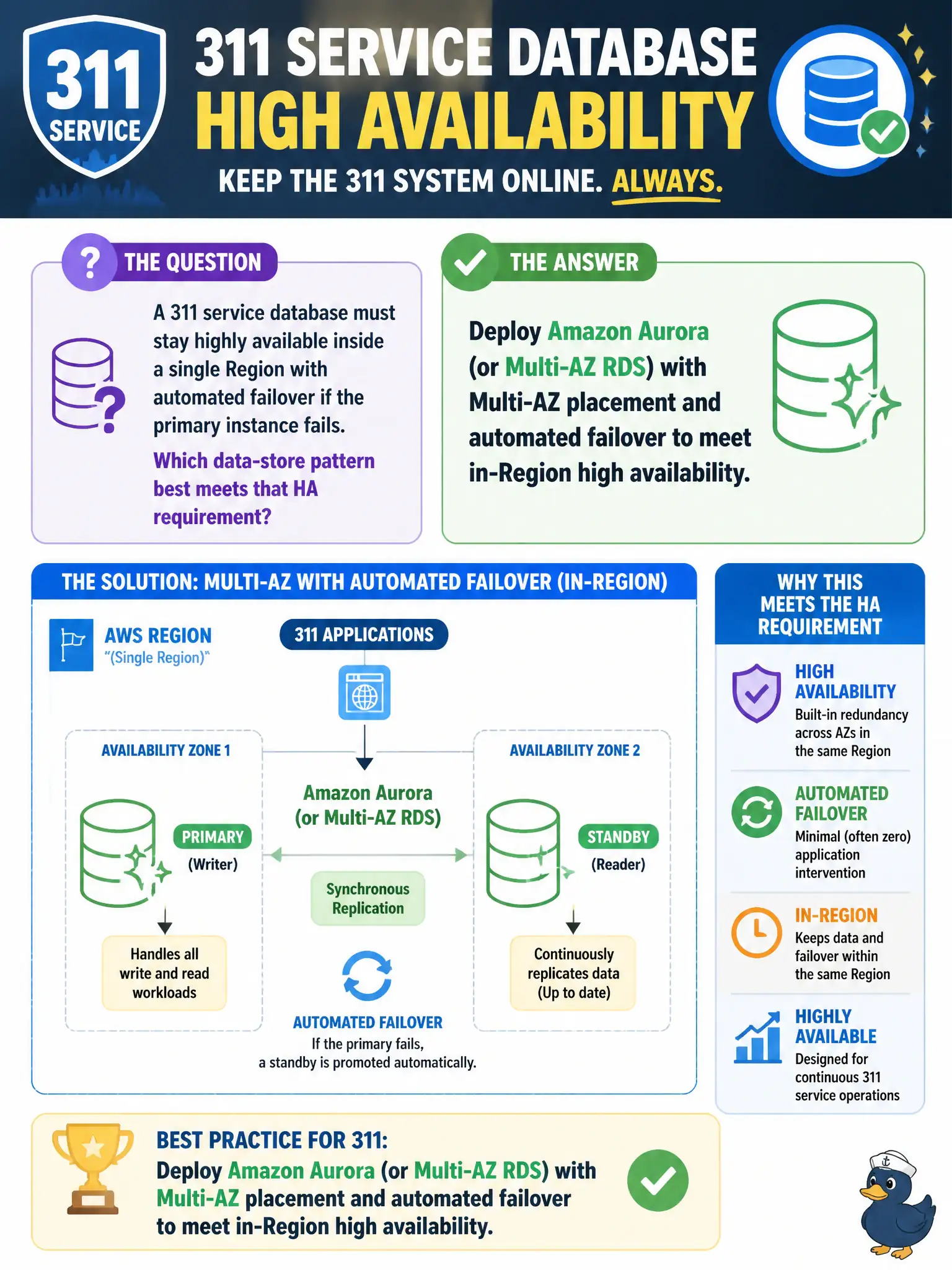
A 311 service database must stay highly available inside a single Region with automated failover if the primary instance fails. Which data-store pattern best meets that HA requirement?
Select an answer to reveal the explanation.
Short Explanation
Multi-AZ Aurora is the 311 desk that keeps a backup clerk warm in another building in the same city—if the primary desk fails, calls still get answered without waiting for another Region.
Full Explanation
A new multi-account digital services OU needs preventive guardrails that stop risky API actions, not only detective alerts after the fact. Service control policies (SCPs) attached at OU or organization level enforce those preventive constraints—for example denying unapproved Regions or disabling root user access keys—while accounts retain identity within the allowed boundary. Relying only on after-the-fact chat notifications without SCPs allows prohibited actions to succeed first. Granting every account full AdministratorAccess without SCPs removes organization-level brakes. Documenting prohibited actions in a wiki with no policy enforcement fails technical prevention. Exam caveat: SCPs do not grant permissions; they filter what IAM allows, and the management account is not constrained the same way—protect it carefully. Operational check: attach a deny-unapproved-Region SCP to a pilot OU, attempt a forbidden Region launch, confirm denial, and verify approved Region workloads still deploy. In municipal cloud governance, record the owners, success metrics, and rollback or restore contacts beside this technical choice so the next incident, budget review, or audit does not rediscover the decision from scratch under time pressure.