
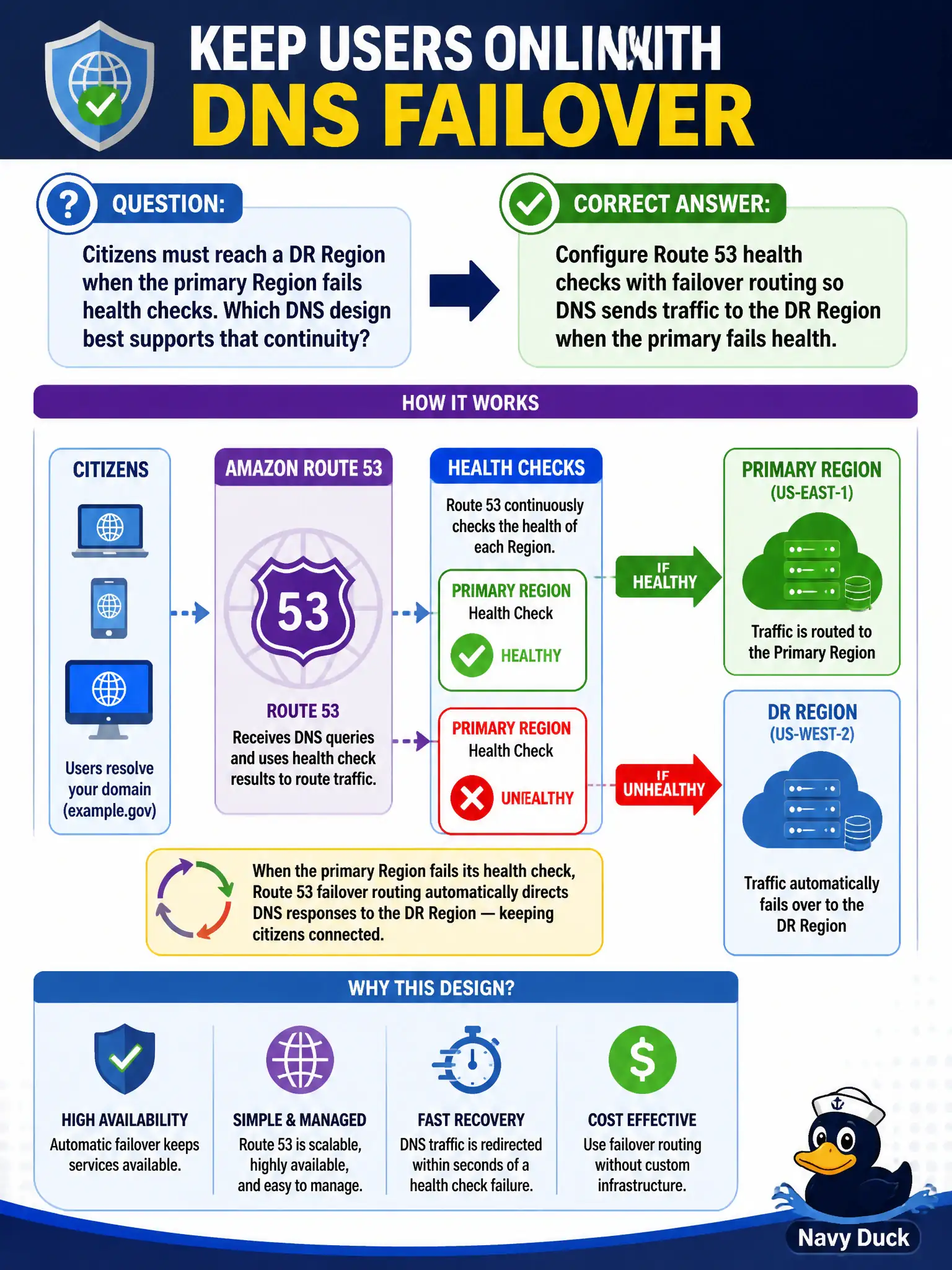
Citizens must reach a DR Region when the primary Region fails health checks. Which DNS design best supports that continuity?
Select an answer to reveal the explanation.
Short Explanation
DNS is the city’s traffic cop. Route 53 health checks watch the primary; when it fails, failover routing points citizens at the DR Region without a week-long wait for a manual edit.
Full Explanation
Citizen continuity across Regions depends on DNS that detects primary failure and shifts traffic to a DR endpoint without waiting for manual edits. Route 53 health checks with failover routing send users to the DR Region when the primary fails health—the standard active-passive pattern for public municipal endpoints. Static hosts files on citizen devices cannot scale or react to health. Hard-coding one Region IP in a mobile app while disabling DNS caching still fails when that Region is down. Manual zone apex edits after a week of outage ignore RTO targets. Exam caveat: failover DNS only helps if the DR stack is ready; health checks should target meaningful application health, and TTL plus client caching influence cutover speed. Operational check: fail a primary health check in a drill, observe Route 53 failover to DR, measure citizen-visible recovery time, and restore primary routing afterward with lessons captured. In municipal cloud governance, record the owners, success metrics, and rollback or restore contacts beside this technical choice so the next incident, budget review, or audit does not rediscover the decision from scratch under time pressure. In municipal cloud governance, record the owners, success metrics, and rollback or restore contacts beside this technical choice so the next incident, budget review, or audit does not rediscover the decision from scratch under time pressure.