
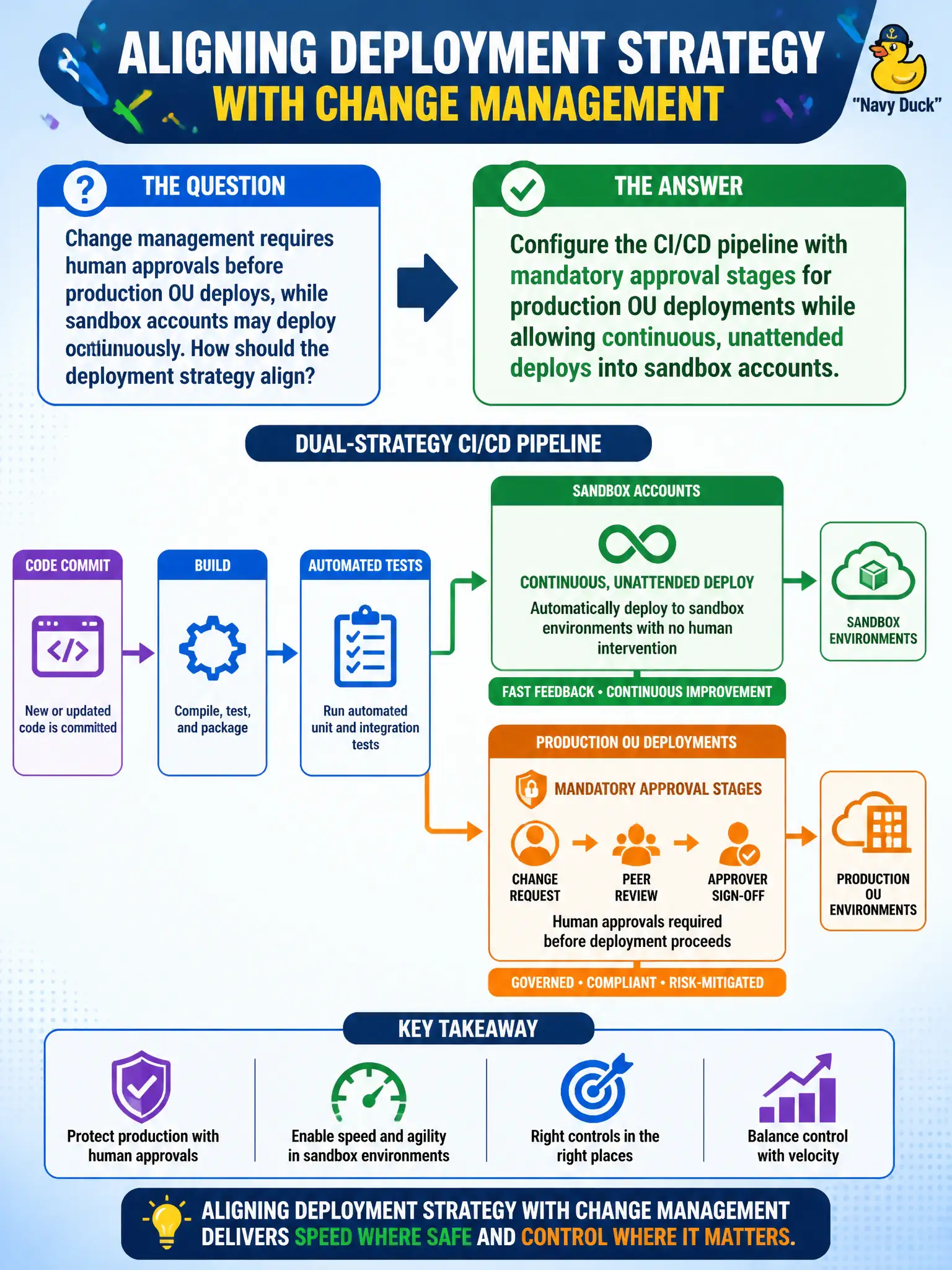
Change management requires human approvals before production OU deploys, while sandbox accounts may deploy continuously. How should the deployment strategy align?
Select an answer to reveal the explanation.
Short Explanation
Sandbox can sprint; production needs a hall pass. Put approval gates on the prod OU pipeline and leave the sandboxes continuous—same toolchain, different risk dial.
Full Explanation
Change management should match risk across a municipal AWS Organization: production organizational units that serve citizens need human approval before promotion, while sandbox accounts can iterate continuously for learning and vendor experiments. Configuring the CI/CD pipeline with mandatory approval stages for production OU targets and unattended continuous deploy into sandboxes implements that dual-track policy in one toolchain with clear audit evidence. Identical unattended continuous deploy to production and sandbox ignores production risk and public-service audit expectations. Blocking all sandbox deploys freezes learning environments and pushes experimentation into uncontrolled channels outside the pipeline. Requiring wet-signature paper tickets for every sandbox commit while leaving production ungated inverts risk controls and slows the wrong tier. Exam caveat: approvals must bind to environment or OU conditions in the pipeline—not merely a social convention—so a mis-targeted promote cannot skip the gate. Operational check: attempt a production OU deploy without approval and confirm it pauses; push the same artifact to a sandbox account and confirm it proceeds; review the approval audit trail for the production run.