
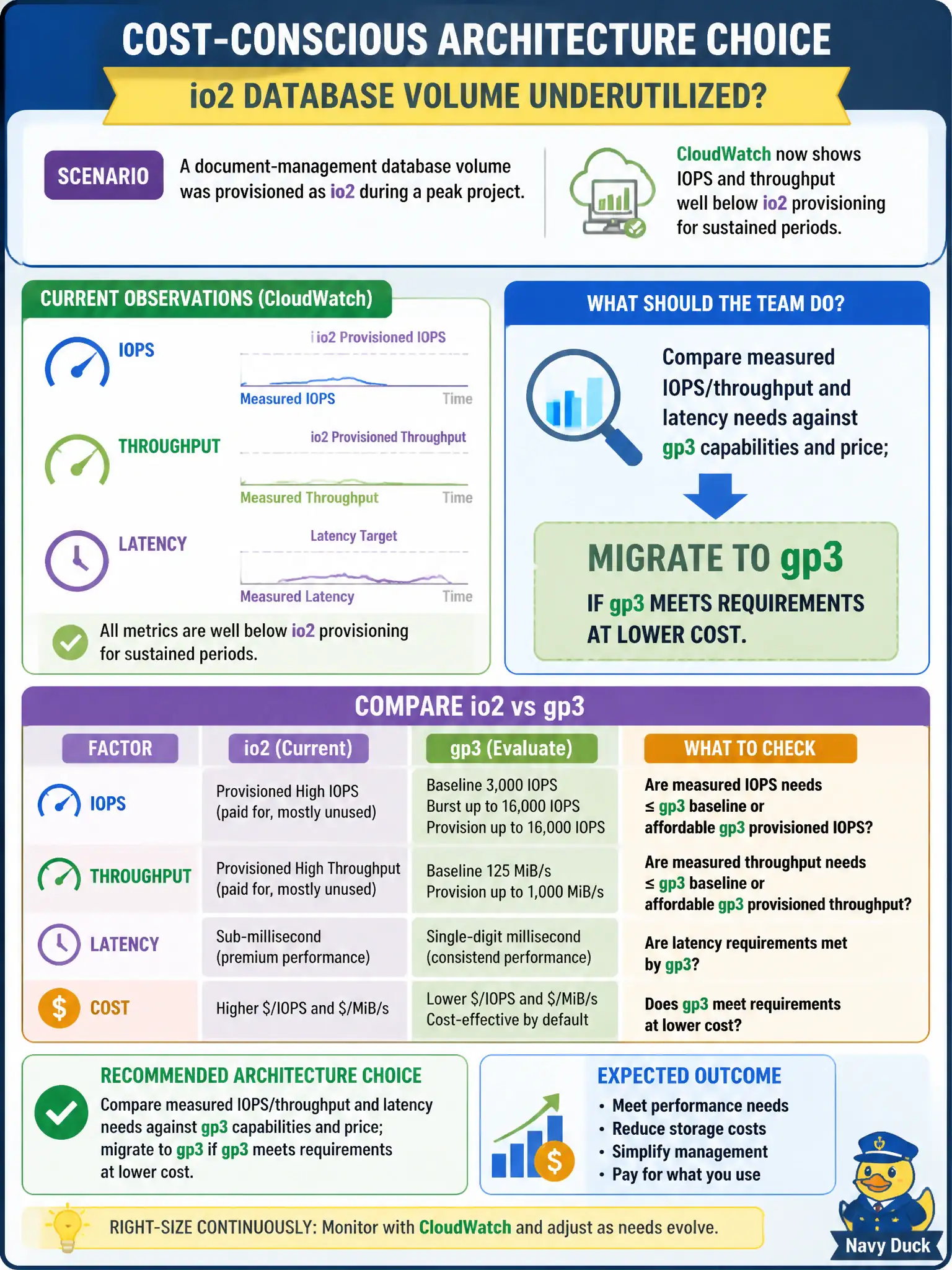
A document-management database volume was provisioned as io2 during a peak project. CloudWatch now shows IOPS and throughput well below io2 provisioning for sustained periods. Which cost-conscious architecture choice should the team make?
Select an answer to reveal the explanation.
Short Explanation
io2 was the racing slick for a peak that ended. If metrics say you’re cruising, price out gp3 against real IOPS needs and move if it fits. Striping Cold HDD under a document DB is how you invent a new outage.
Full Explanation
A document-management database volume provisioned as io2 for a peak project but now showing IOPS and throughput well below io2 provisioning should be cost-rightsized by comparing measured needs and latency against gp3 capabilities and price, then migrating to gp3 if gp3 meets requirements at lower cost. That is the architecture choice continuous improvement expects for municipal document platforms after the peak ends. Keeping io2 indefinitely because provisioned IOPS volumes cannot be changed after creation fails on fact and concept: volume types and provisioned settings can be modified within supported paths, and 'cannot change' is not a reason to overpay forever. Attaching multiple Cold HDD (sc1) volumes in a RAID-0 stripe for a transactional document database fails because sc1 targets infrequent throughput-oriented workloads, not transactional latency-sensitive databases. Disabling EBS encryption so volume type selection no longer affects price fails because encryption is a security control with negligible relevance to the io2-versus-gp3 cost decision and must not be sacrificed for price. Exam caveat: after peak projects, re-evaluate io2 versus gp3 from CloudWatch; do not leap to cold HDD or disable encryption. Operational check: chart VolumeConsumedReadWriteOps and throughput versus provisioned, model gp3 baseline plus provisioned IOPS/throughput price, schedule a volume modification or migration with snapshots, validate document API latency SLOs, and lock encryption remains enabled for records compliance.