
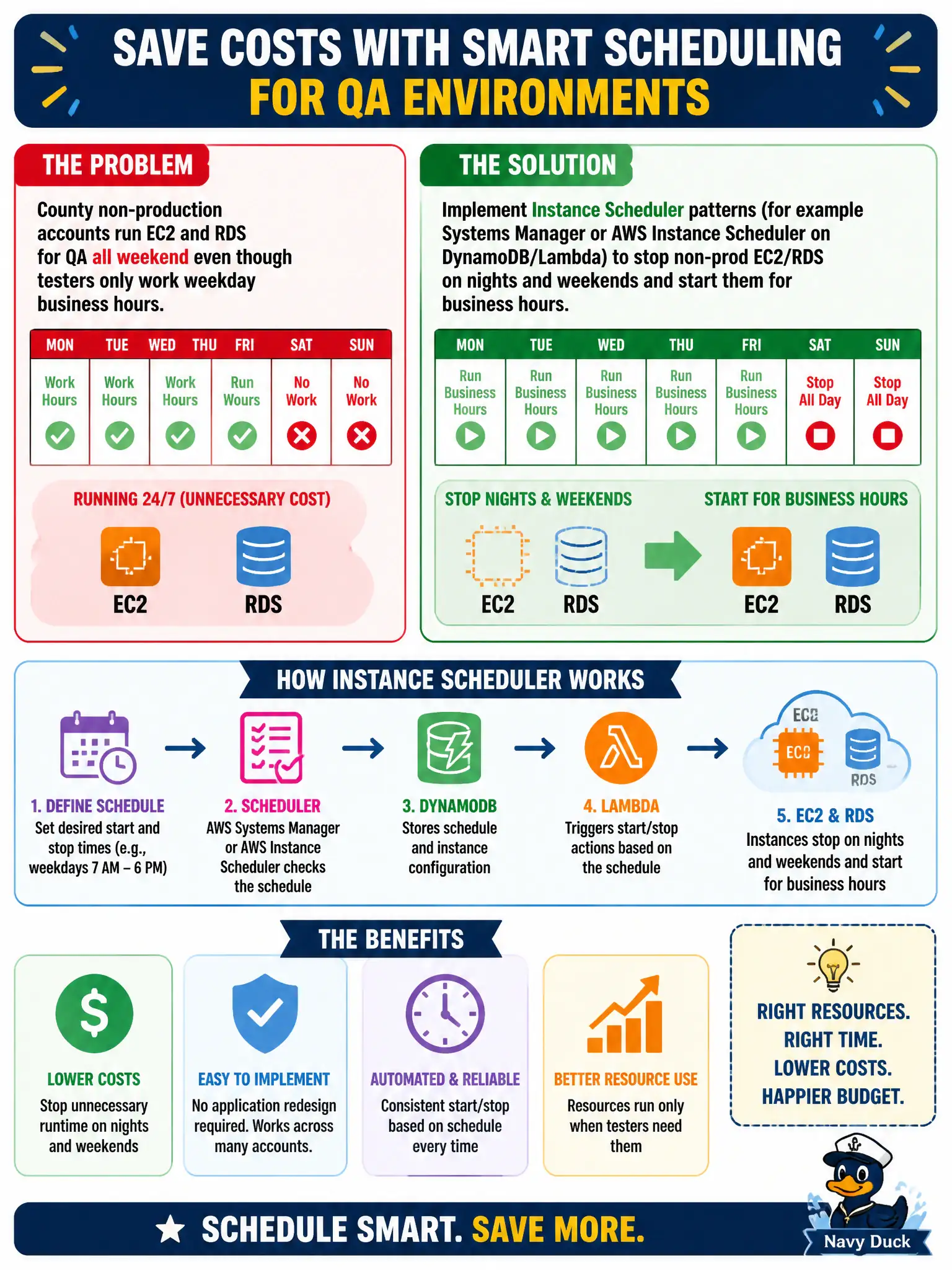
County non-production accounts run EC2 and RDS for QA all weekend even though testers only work weekday business hours. Leadership wants scheduled stop/start without redesigning every application. Which approach best uses scheduling to reduce cost?
Select an answer to reveal the explanation.
Short Explanation
QA that runs Saturday for nobody is burning the county’s overtime budget. Instance Scheduler stop/start on nights and weekends is the boring, correct win. Bigger RIs for idle QA just discounts the waste.
Full Explanation
County non-production accounts that run EC2 and RDS for QA all weekend while testers only work weekday business hours should use scheduling to reduce cost without redesigning every application. Implement Instance Scheduler patterns—Systems Manager or AWS Instance Scheduler on DynamoDB/Lambda—to stop non-prod EC2/RDS on nights and weekends and start them for business hours. That matches QA capacity to civic working time and frees appropriation for production citizen services. Deleting all non-production Auto Scaling groups so instances cannot run after hours fails because it destroys the scaling mechanism QA needs during business hours rather than scheduling stop/start. Purchasing denser Reserved Instances for QA so stopped hours still receive maximum discount credit fails conceptually: commitments on idle non-prod amplify waste instead of eliminating off-hours runtime. Migrating every QA database to a separate commercial cloud overnight for free idle time fails as theater—it adds complexity and does not implement AWS-native scheduling. Exam caveat: prefer scheduled stop/start for non-prod over commitment shopping or deleting ASGs. Operational check: tag non-prod resources, deploy the scheduler with weekday calendars, exclude any always-on dependencies explicitly, validate start before tester shifts, and chart weekend EC2/RDS hours trending to near zero in Cost Explorer.