
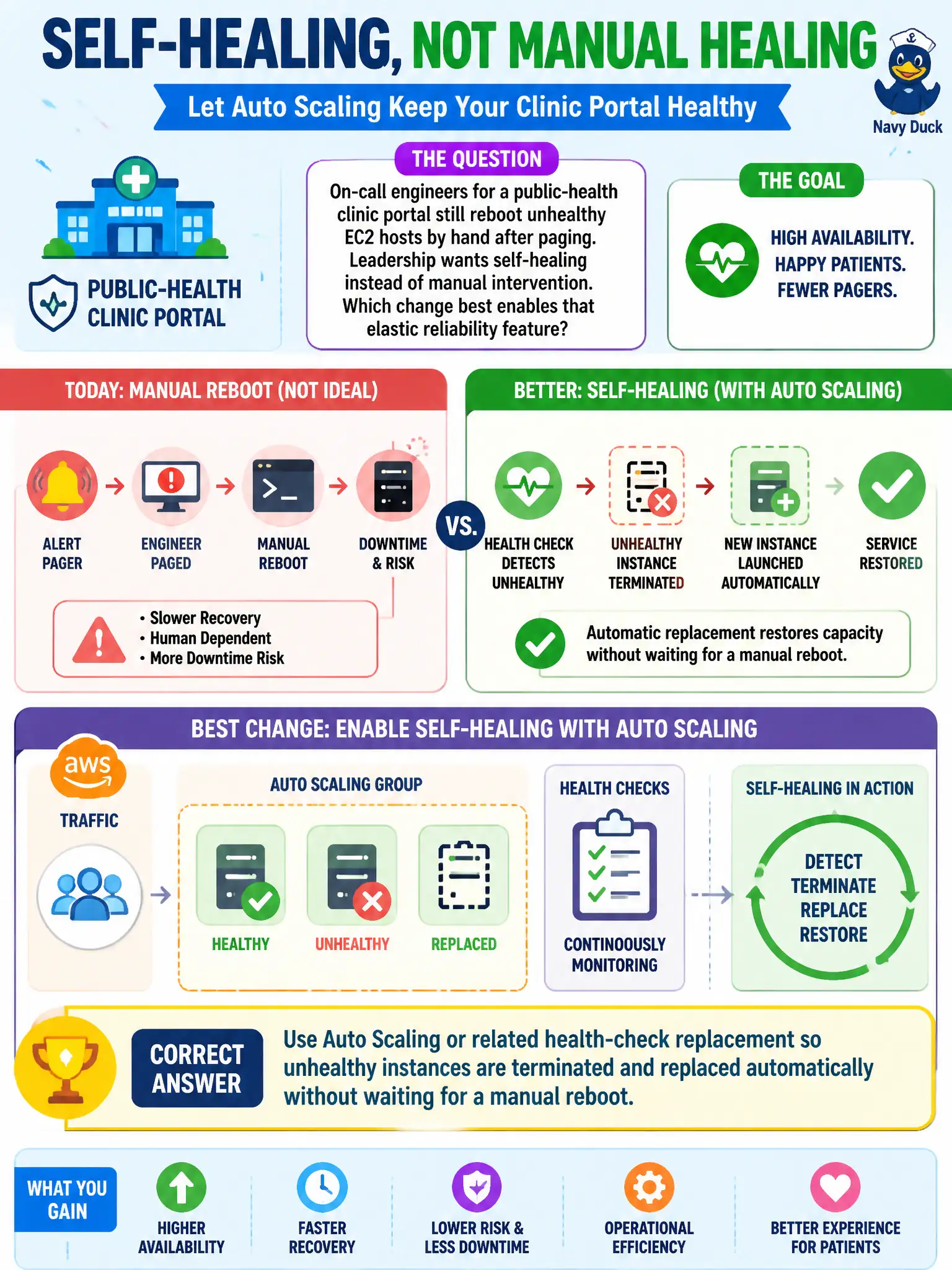
On-call engineers for a public-health clinic portal still reboot unhealthy EC2 hosts by hand after paging. Leadership wants self-healing instead of manual intervention. Which change best enables that elastic reliability feature?
Select an answer to reveal the explanation.
Short Explanation
Paging a human to press reboot is last century for a clinic portal. Let health checks kick bad hosts out and spin fresh ones—self-healing beats heroics at 2 a.m.
Full Explanation
On-call engineers for a public-health clinic portal who still reboot unhealthy EC2 hosts by hand after paging are doing work Auto Scaling should own. Using Auto Scaling or related health-check replacement so unhealthy instances are terminated and replaced automatically enables elastic self-healing without waiting for a manual reboot. That change works because instance replacement is a standard reliability feature when health checks and capacity policies are correct. Lengthening page escalation so engineers have more time to SSH before replacement fails by optimizing for slower human toil. Disabling Auto Scaling health checks to prevent unexpected instance termination fails conceptually by removing the self-healing mechanism. Pinning sessions to specific hosts and documenting reboot runbooks as the primary HA strategy fails elastic design and recreates manual dependency. Exam caveat: ensure ELB/ASG health checks reflect application health, not only EC2 status, and that replacement capacity exists in other AZs before terminating sick hosts. Operational check: enable ASG health checks tied to the target group, inject an application failure on one host in nonprod, confirm replacement without engineer SSH, and retire the manual reboot page as the primary path.