
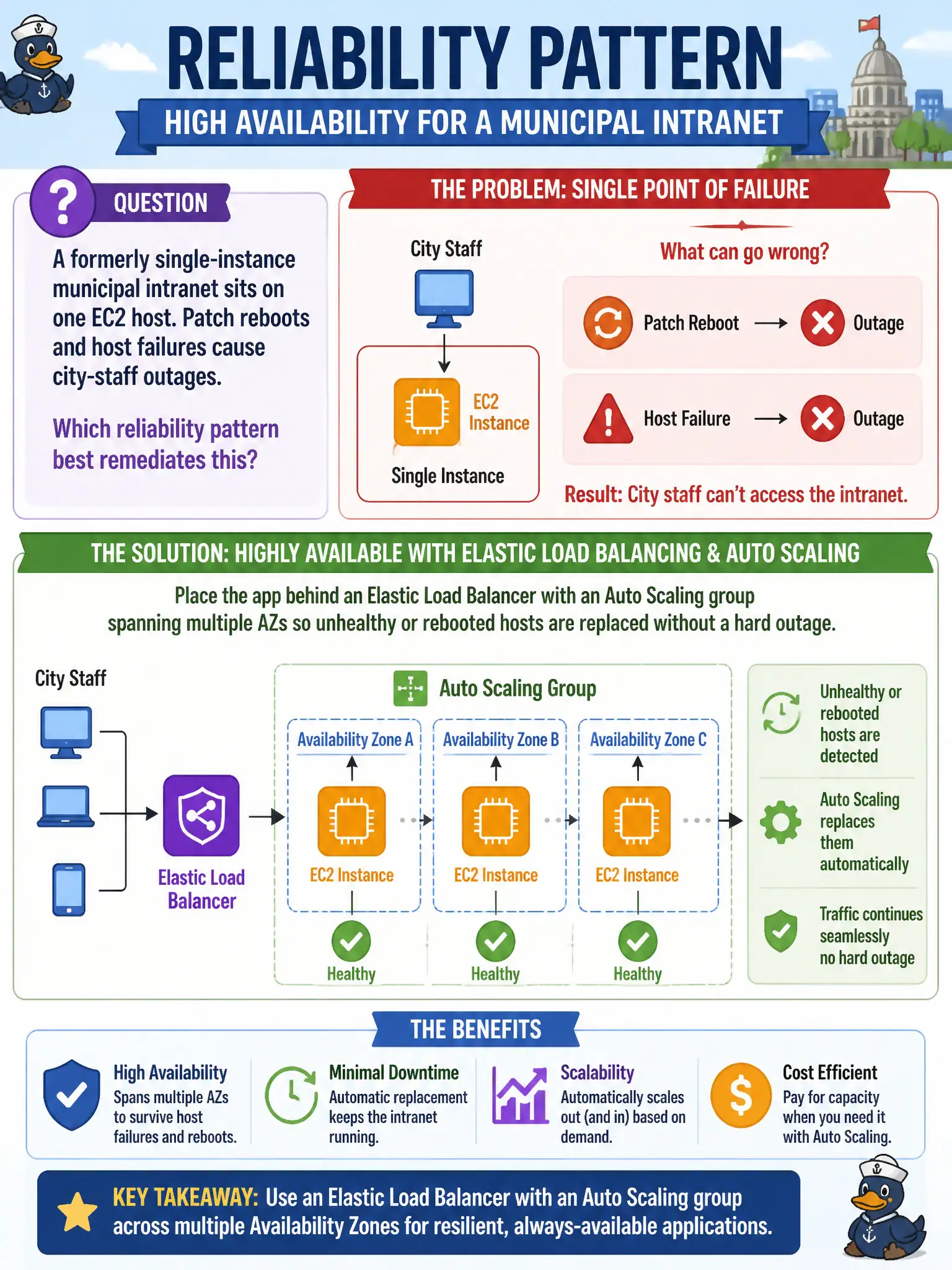
A formerly single-instance municipal intranet sits on one EC2 host. Patch reboots and host failures cause city-staff outages. Which reliability pattern best remediates this?
Select an answer to reveal the explanation.
Short Explanation
One intranet box is a single snow day away from every clerk staring at a blank screen. Put an ELB in front and stretch an ASG across AZs so patching and failures do not take City Hall offline.
Full Explanation
A formerly single-instance municipal intranet on one EC2 host suffers staff outages on every patch reboot or host failure. Placing the app behind an Elastic Load Balancer with an Auto Scaling group spanning multiple AZs remediates this by replacing unhealthy or rebooted hosts without a hard outage. That reliability pattern works because health checks remove bad targets while capacity in other AZs continues serving city staff. Keeping the single instance and adding a larger EBS volume fails conceptually: bigger disks do not provide compute redundancy for the web tier. Replacing the load balancer idea with a single Elastic IP moved manually during incidents fails as slow, error-prone failover. Running two instances in the same AZ without health checks fails by sharing the AZ blast radius and lacking automated removal of bad hosts. Exam caveat: the app must be stateless or use external session state; sticky in-memory sessions on one host undermine ASG replacement benefits. Operational check: deploy ALB+ASG across two AZs, terminate one instance during a drill, confirm staff sessions continue via remaining capacity, and schedule patching via instance refresh instead of overnight single-host reboots.