
A legacy courts case-management database on RDS was snapshotted manually only on Fridays. A midweek corruption event proved point-in-time recovery was unavailable. Which reliability improvement best closes that gap?
Select an answer to reveal the explanation.
Short Explanation
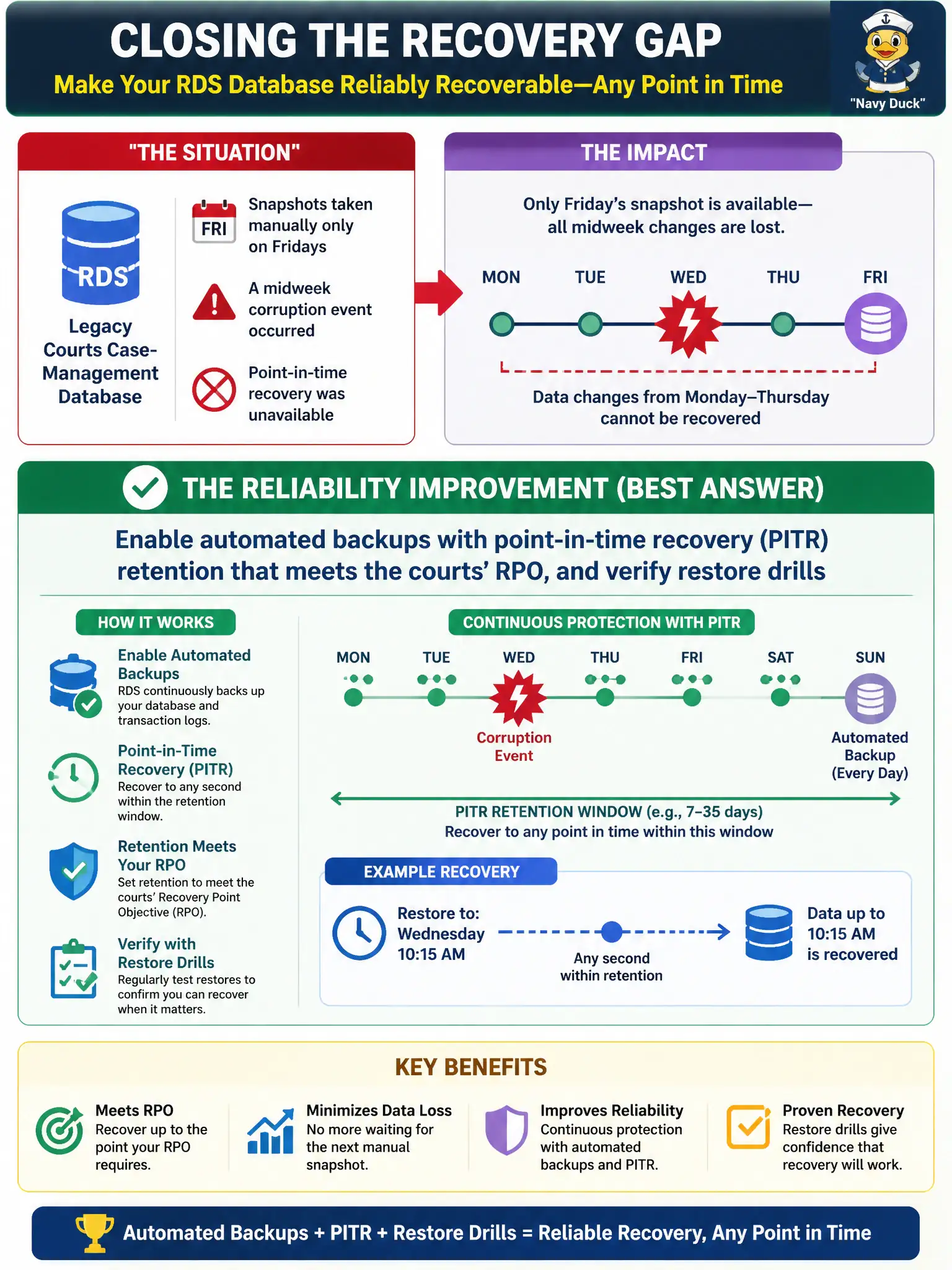
Friday-only snapshots are like backing up the courthouse filing room once a week and hoping nothing spills on Tuesday. Turn on automated backups with PITR so you can rewind to just before the mess.
Full Explanation
A legacy courts case-management database on RDS snapshotted manually only on Fridays left midweek corruption without point-in-time recovery. Enabling automated backups with PITR retention that meets the courts’ RPO, and verifying restore drills, closes that reliability gap. That improvement works because continuous backup windows allow restore to a time just before corruption rather than the prior Friday snapshot. Keeping Friday-only manual snapshots and increasing EBS volume size on the primary fails conceptually: larger disks do not create finer recovery points. Disabling Multi-AZ so backup windows never overlap with failover fails by trading away AZ resilience for a misunderstanding of backup behavior. Storing database credentials in a public S3 bucket to speed emergency restores fails security and does not improve PITR. Exam caveat: PITR retention must match RPO and legal needs; also test restores into a nonprod instance—enabled backups without restore drills remain unproven. Operational check: enable automated backups with retention ≥ RPO, perform a point-in-time restore drill for a midweek timestamp, validate application connectivity to the restored instance, and update the courts DR runbook with measured restore duration.