
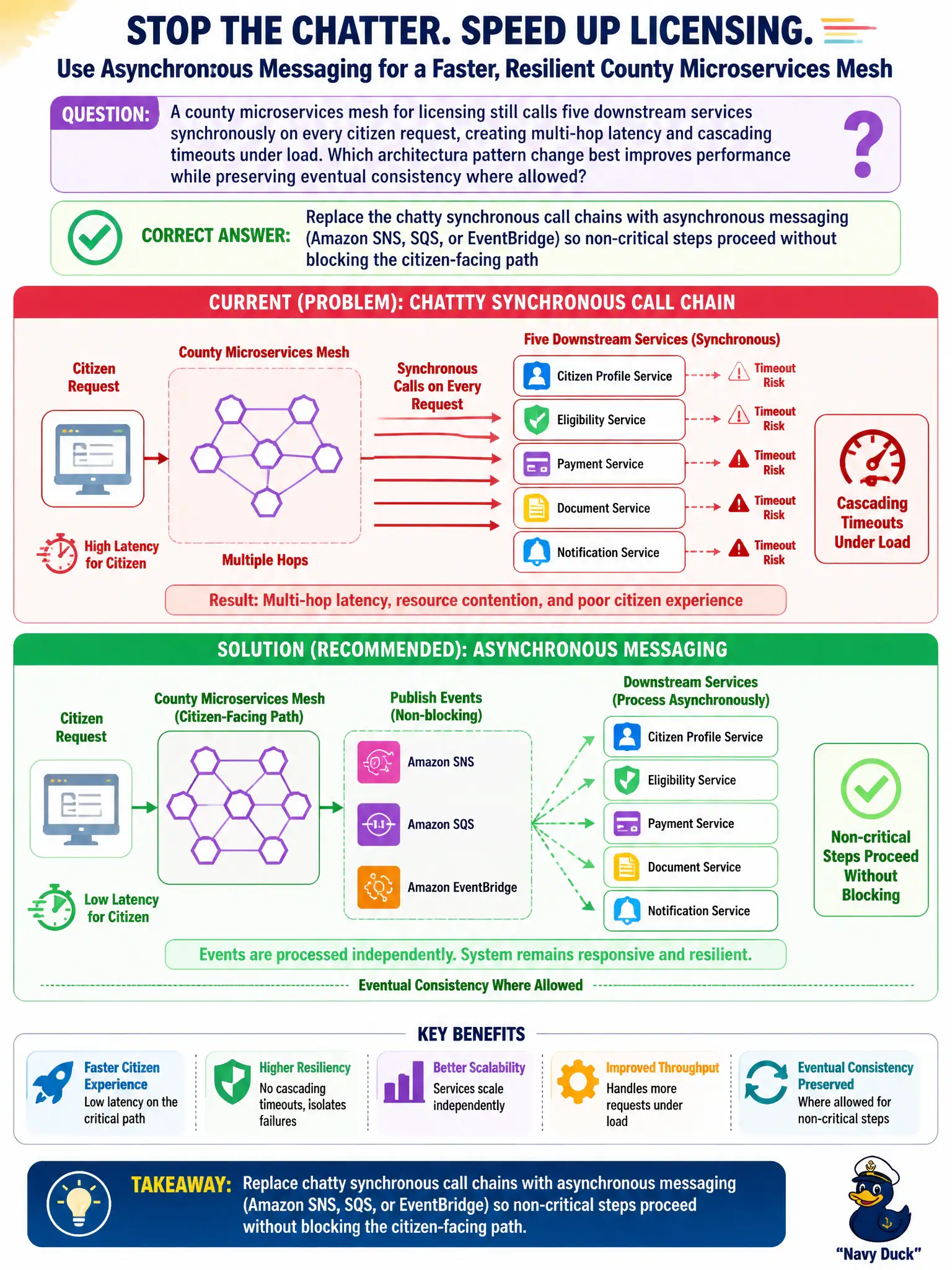
A county microservices mesh for licensing still calls five downstream services synchronously on every citizen request, creating multi-hop latency and cascading timeouts under load. Which architecture pattern change best improves performance while preserving eventual consistency where allowed?
Select an answer to reveal the explanation.
Short Explanation
Think of five clerks who each wait for the next clerk before speaking to the citizen—painful. Put non-critical steps on a message bus so the front desk can answer while the back office catches up. Async messaging cuts that latency chain.
Full Explanation
A county licensing microservices mesh that synchronously calls five downstream services on every citizen request accumulates multi-hop latency and cascading timeouts under load. Replacing chatty synchronous call chains with asynchronous messaging via Amazon SNS, SQS, or EventBridge lets non-critical steps proceed without blocking the citizen-facing path while preserving eventual consistency where allowed. That architecture pattern change improves performance because the user journey returns when critical work completes, and secondary work fans out without holding request threads. Adding a second synchronous hop through a shared EC2 bastion for every call fails by inserting more latency and a SPOF. Collapsing all services into one monolith on a single large instance in one AZ fails availability and scalability even if it removes some network hops. Disabling timeouts so slow downstream calls never fail the front door fails conceptually by turning latency into unbounded hangs. Exam caveat: not every step can be async—payments authorization or immediate entitlement checks may remain synchronous; classify critical versus deferrable work explicitly. Operational check: map the five hops, move non-critical licensing side effects to EventBridge/SQS, measure p99 of the citizen path before/after under load, and verify eventual processors meet their own SLAs.