
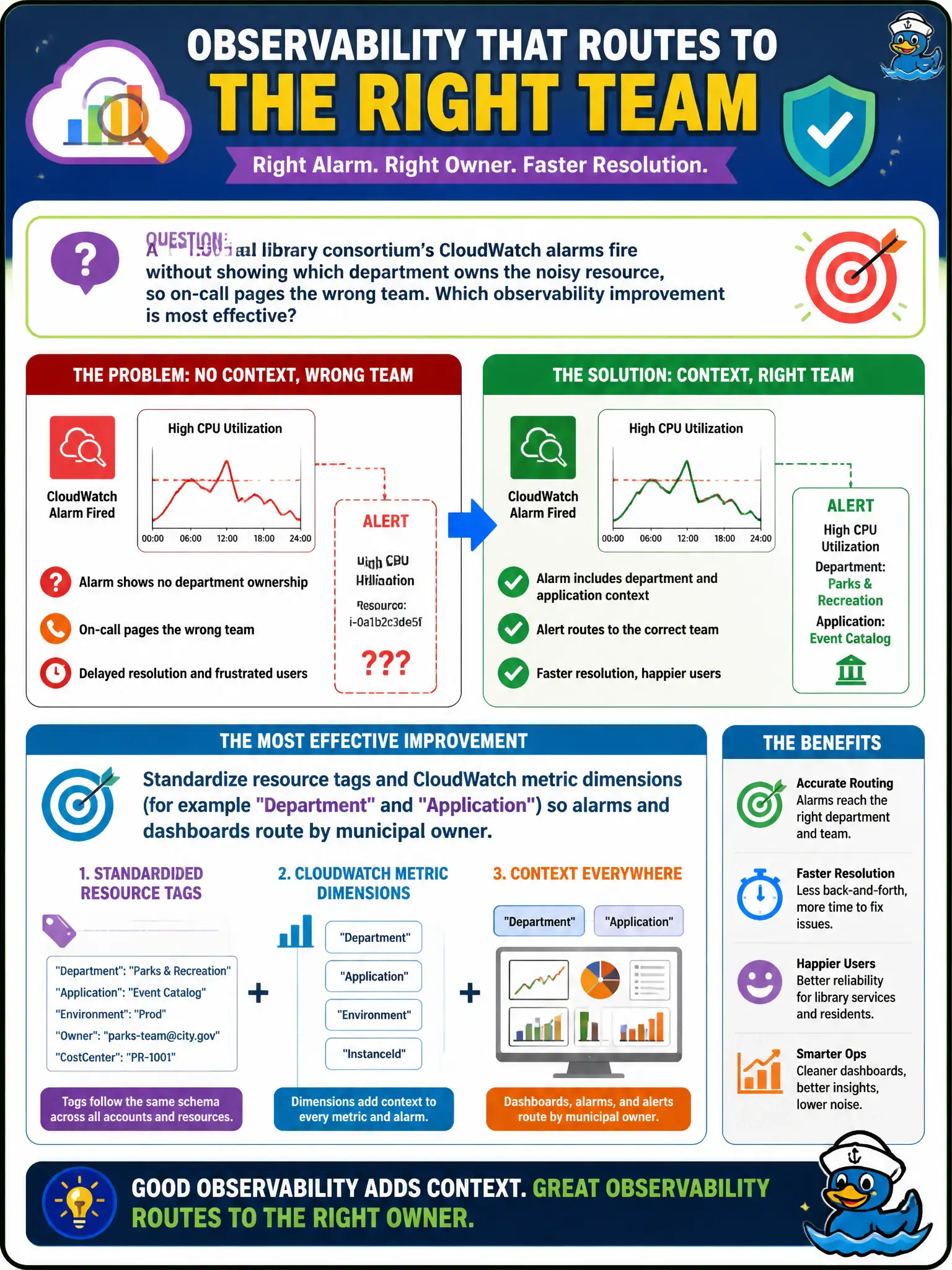
A regional library consortium’s CloudWatch alarms fire without showing which department owns the noisy resource, so on-call pages the wrong team. Which observability improvement is most effective?
Select an answer to reveal the explanation.
Short Explanation
Alarms without department tags are like 911 calls with no address—somebody shows up, just not the right somebody. Standard tags and metric dimensions make dashboards and pages speak 'parks' versus 'courts.' Consistency is what turns monitoring from noise into ops signal.
Full Explanation
CloudWatch alarms that omit which department owns a noisy resource cause regional library consortium on-call to page the wrong team. Standardizing resource tags and CloudWatch metric dimensions—such as Department and Application—lets alarms and dashboards route by municipal owner with enrichment in the page. That observability improvement is most effective because ownership metadata turns alerts into actionable assignments instead of guessing games. Deleting all custom metrics and relying only on the Management Console homepage fails as insufficient situational awareness for multi-team estates. Forwarding every alarm to a single shared SMS list with no enrichment fails conceptually by maximizing noise and minimizing routing accuracy. Renaming EC2 Name tags ad hoc during incidents instead of enforcing a taxonomy fails because emergency renames do not create durable routing dimensions. Exam caveat: tagging must be enforced at launch; dimensions alone cannot invent missing tags on historical resources—plan a backfill for critical alarms. Operational check: enforce Department/Application tags via policy, update alarm descriptions and metric math to include dimensions, send a test page that shows owner metadata, and measure wrong-team pages over the next month.