
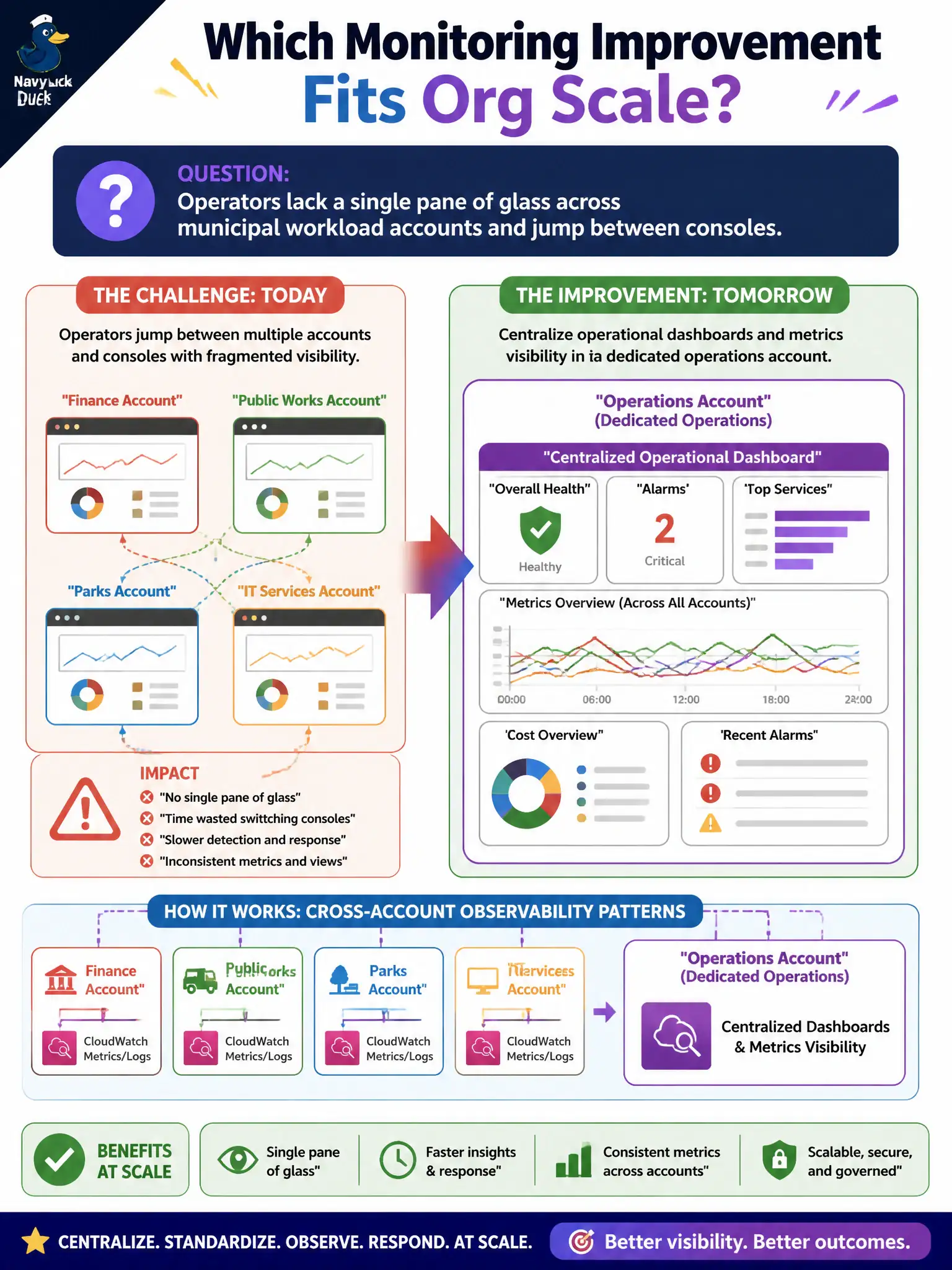
Operators lack a single pane of glass across municipal workload accounts and jump between consoles. Which monitoring improvement fits org scale?
Select an answer to reveal the explanation.
Short Explanation
One ops balcony beats twenty locked rooms—park shared dashboards in the ops account and look across workload accounts from there. Spreadsheets and management-account-only blinders miss the real fires.
Full Explanation
Operators jumping between consoles across municipal workload accounts lack situational awareness at org scale. Centralizing operational dashboards and metrics visibility in a dedicated operations account—using cross-account CloudWatch observability patterns—gives a single pane of glass for on-call without serial account hopping. That improvement fits because multi-account excellence requires shared observability with account and application dimensions, not fragmented local views. Requiring each team to use only disconnected weekly spreadsheets fails as a stale, non-real-time ops view. Prohibiting cross-account metric sharing so every incident needs sequential logins fails conceptually by design friction during the moments speed matters most. Monitoring only the Organizations management account while ignoring workload-account application metrics fails because citizen impact lives in workload accounts. Exam caveat: central ops accounts need tight IAM and data classification—observability aggregation is not an excuse for blanket admin into every account. Operational check: enable cross-account observability to an ops account, build a dashboard for the top two citizen services with account labels, run a game-day where on-call uses only that pane, and retire spreadsheet status updates for those services.