
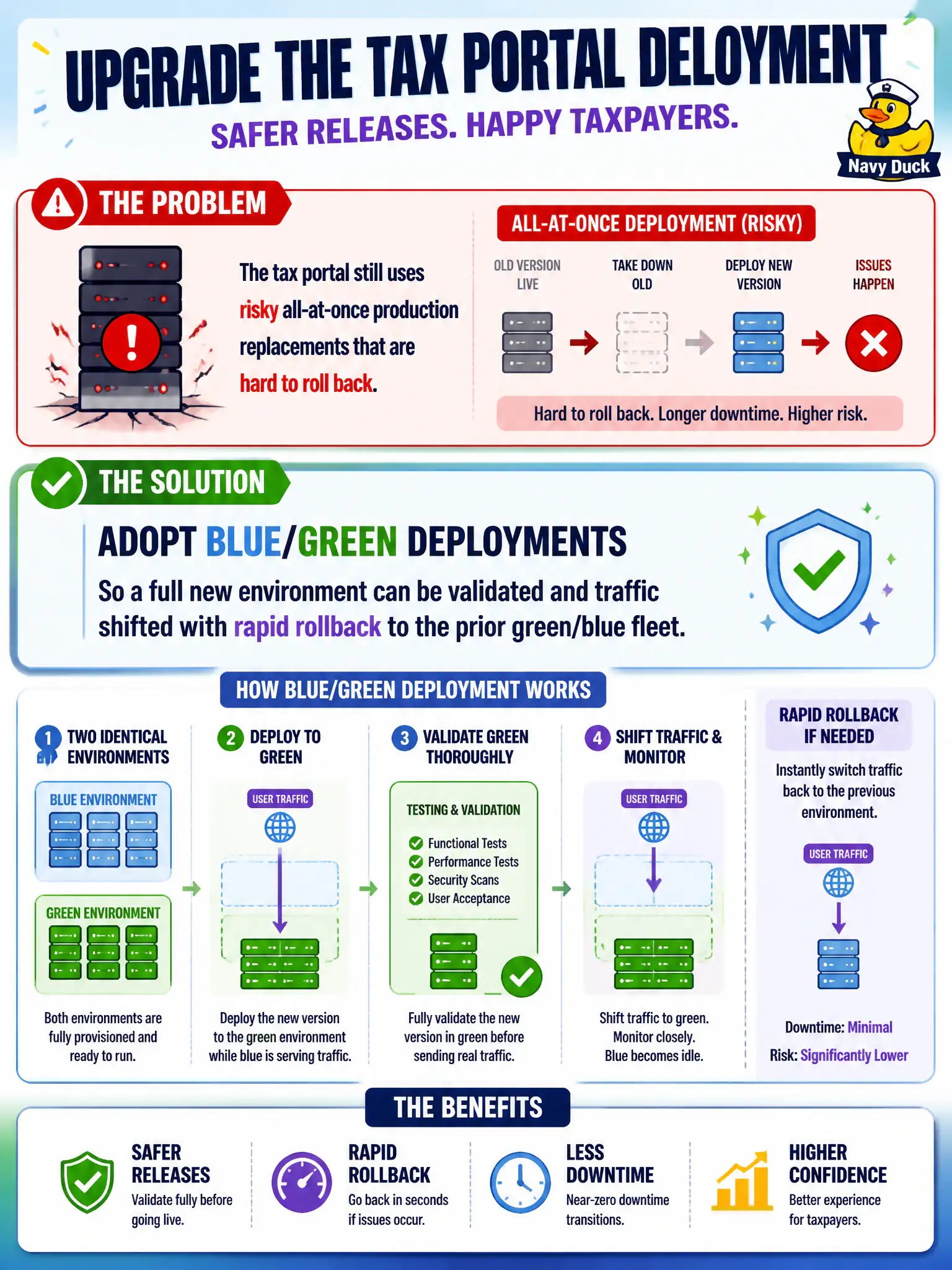
The tax portal still uses risky all-at-once production replacements that are hard to roll back. Which deployment strategy improvement should be introduced?
Select an answer to reveal the explanation.
Short Explanation
All-at-once is jumping without a rope—blue/green lets the new tax portal warm up beside the old one, then flip (and flip back). Citywide shutdowns and hand-patched load balancers are not strategies.
Full Explanation
Risky all-at-once production replacements on a tax portal make rollback hard and outages long. Adopting blue/green deployments stands up a full new environment, validates it, shifts traffic, and enables rapid rollback to the prior fleet when health checks fail. That strategy improves operational excellence because blast radius is controlled and the previous environment remains a fast back-out path. Keeping all-at-once in-place overwrites with no standby environment fails by destroying the easy rollback target mid-change. Deploying by stopping all instances citywide for a full business day fails as an unacceptable outage model for resident tax services. Pushing unversioned changes directly onto live ALB nodes’ operating systems by hand fails conceptually—load balancers are not ad-hoc app hosts and hand edits are unreproducible. Exam caveat: blue/green needs compatible data migrations and enough capacity for dual environments during cutover; schema changes that break both colors simultaneously defeat rollback. Operational check: implement blue/green for the tax portal in nonprod, fail a synthetic health check on purpose, confirm traffic reverts within the target rollback minutes, then promote the same pattern to production.