
A prompt author drafting instructions for a triage-escalation note generator writes: 'Summarize the situation and tell the vet what to do.' A reviewer flags this as a problem specifically because of the veterinary framing lock. What is the reviewer's most likely and correct concern?
Select an answer to reveal the explanation.
Short Explanation
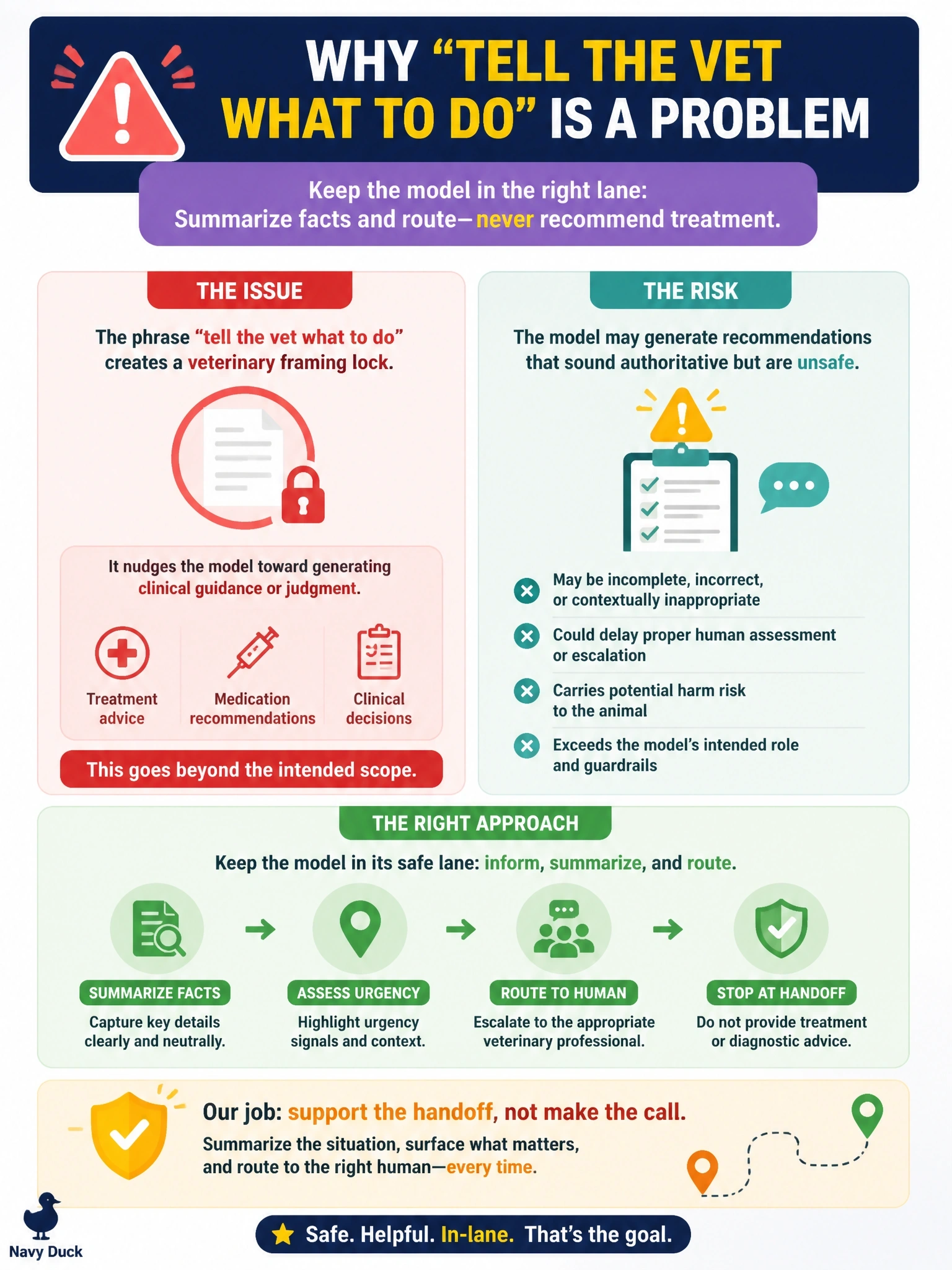
'Tell the vet what to do' is asking the model to make a clinical call - which this bank's own rules say the correct answer must never be. The fix is to keep the instruction scoped to summarizing facts and escalating, not prescribing action.
Full Explanation
The correct answer identifies the actual risk consistent with this bank's hard constraint that the correct answer must always be a Salesforce configuration decision, never a clinical judgment: an instruction phrased as 'tell the vet what to do' invites the model to generate a treatment recommendation, which is outside its appropriate scope and risky in a clinical context - good instructions here should ask for a factual summary and appropriate escalation routing, not medical direction. The second distractor is a surface-level grammar objection that misses the substantive risk entirely; even a grammatically polished version of this instruction would carry the same clinical-overreach problem. The third distractor invents a fabricated technical constraint - there's no minimum character count requirement for prompt instructions, and instruction quality is about clarity and appropriate scope, not raw length. The fourth distractor is also fabricated - there is no such ban on the word 'summarize'; summarization is one of the most common and appropriate generative tasks for a template, and the issue here isn't the word choice, it's the phrase asking for clinical direction. The exam-relevant best practice is to scope instructions so the model produces safe, appropriate output - summarizing and routing, not making clinical calls.