
Six months after a prescription-refill prompt template went live, a compliance review asks the team to demonstrate that the template's behavior can be monitored and its usage over time can be audited. Which capability directly supports this ask?
Select an answer to reveal the explanation.
Short Explanation
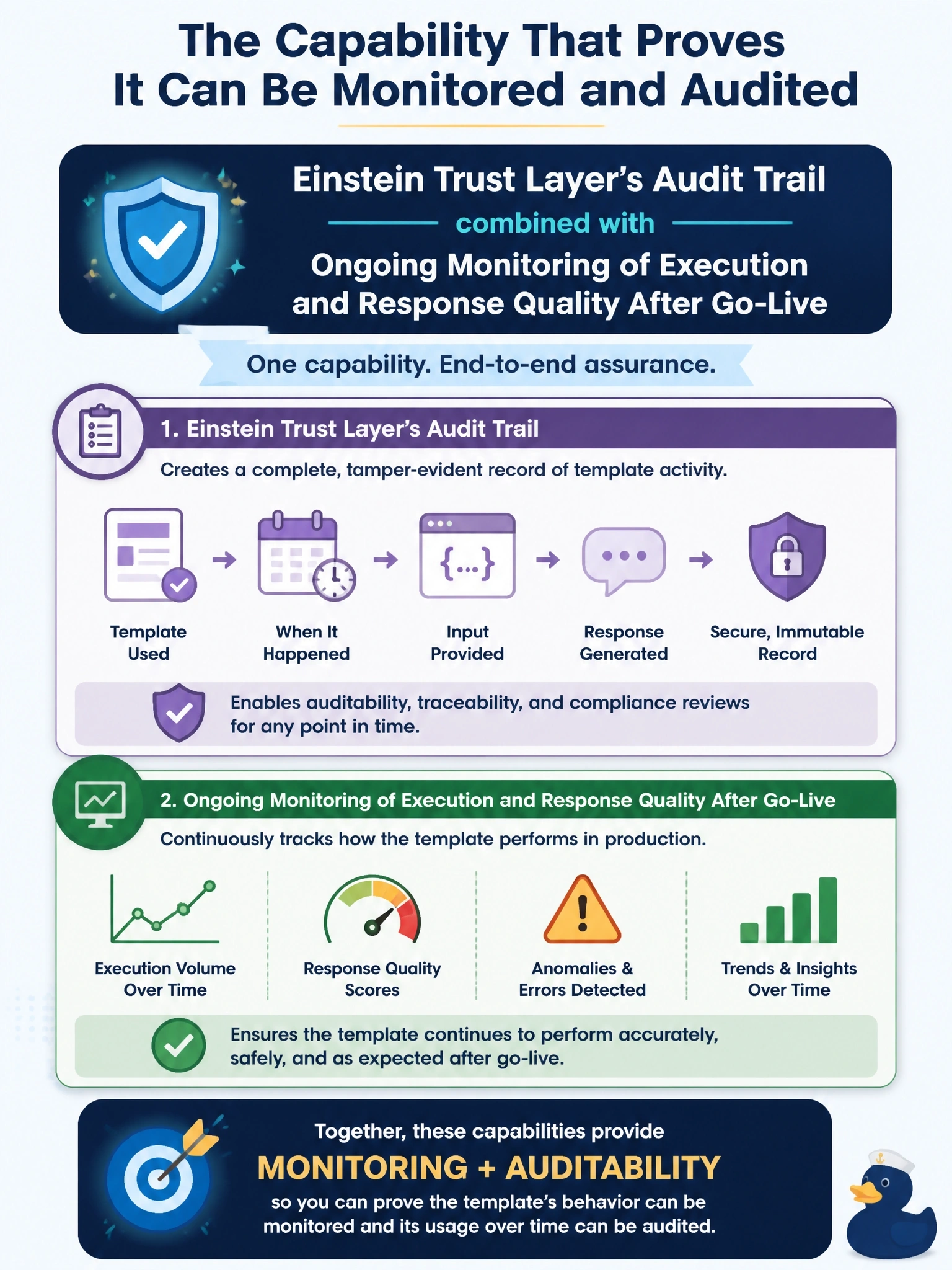
For ongoing accountability, you need records of what happened after launch, not just evidence of what was tested beforehand. The Einstein Trust Layer’s audit trail plus ongoing monitoring gives you post-launch visibility into usage and response quality over time.
Full Explanation
The Einstein Trust Layer’s audit trail, combined with ongoing monitoring of the template’s execution and response quality after go-live, directly supports the compliance review. The audit trail preserves a record of prompt and response activity for review, while monitoring usage and response quality helps the team manage a live feature over time. Re-running the original Testing Center test cases can support pre-launch validation, but it does not document six months of actual live usage or demonstrate ongoing behavior without retained execution records. The imagePrompt field documents original design intent; it does not record what happened during real executions. Deleting old execution logs would remove historical evidence that may be needed for review, undermining rather than supporting auditability. An exam caveat is that passing tests before launch is not a substitute for monitoring a live feature: testing and auditing serve different purposes. As a practical check, confirm that execution records are retained and that the team reviews usage and response quality over time. The key is the pairing of an audit trail with ongoing post-launch monitoring.