
A newly onboarded prompt author grounds a template entirely on Data 360 retrievers for a question that could be answered directly and more reliably from a single CRM field on the Case record itself. What is the concern with this choice?
Select an answer to reveal the explanation.
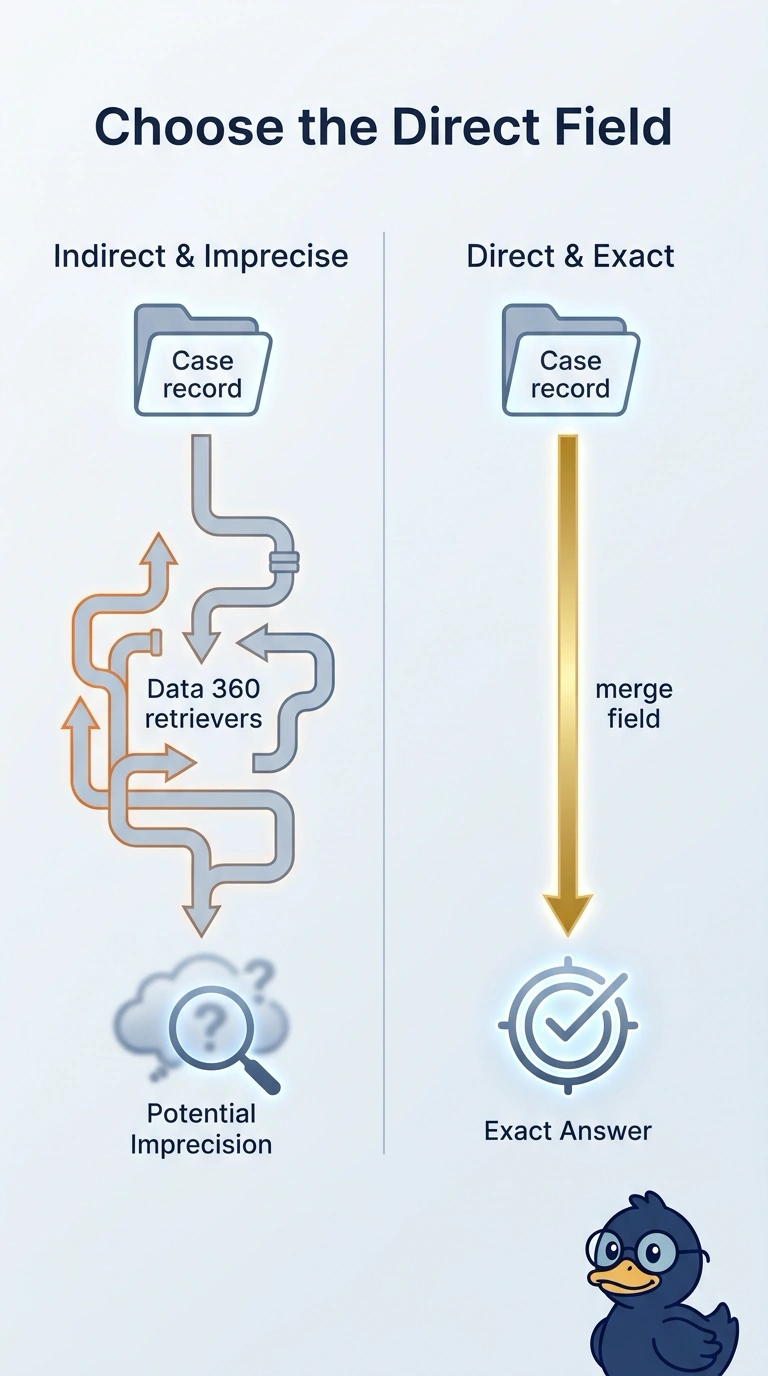
Short Explanation
When a Case already holds the exact answer in one field, you can reference that merge field directly. A retriever adds unnecessary indirection and the risk of an imprecise match, so simpler grounding is the better fit here.
Full Explanation
When the exact answer is already stored in a known Case field, a direct merge-field reference provides the value simply and precisely. Grounding the template entirely on Data 360 retrievers instead adds an unnecessary search step and the possibility of retrieving a near match, so the concern is choosing a less direct method when a reliable field reference fully meets the need. The claim that retrievers should always be preferred because they provide the most accurate grounding is wrong: no retrieval method is universally best, and a known, structured field is a better fit when it contains the required answer. The claim that Data 360 retrievers cannot access any Case-related data is also wrong; the issue is not that retrievers lack all Case access, but that they are unnecessary for this particular question. The claim that retrievers must always be paired with an ensemble configuration is wrong as well, because a retriever can be configured on its own. An exam caveat is that retrievers can be useful when the answer depends on finding relevant information, but that does not make them the right choice for every prompt. In practice, check whether one specific CRM field already contains the answer; if it does and meets the requirement, use that field directly.