
An architect is deciding between an individual retriever and an ensemble retriever for a template that must draw from both the clinic policy knowledge base and the discharge-instruction PDF library simultaneously to answer a single pet-owner question. Which choice is correct, and why?
Select an answer to reveal the explanation.
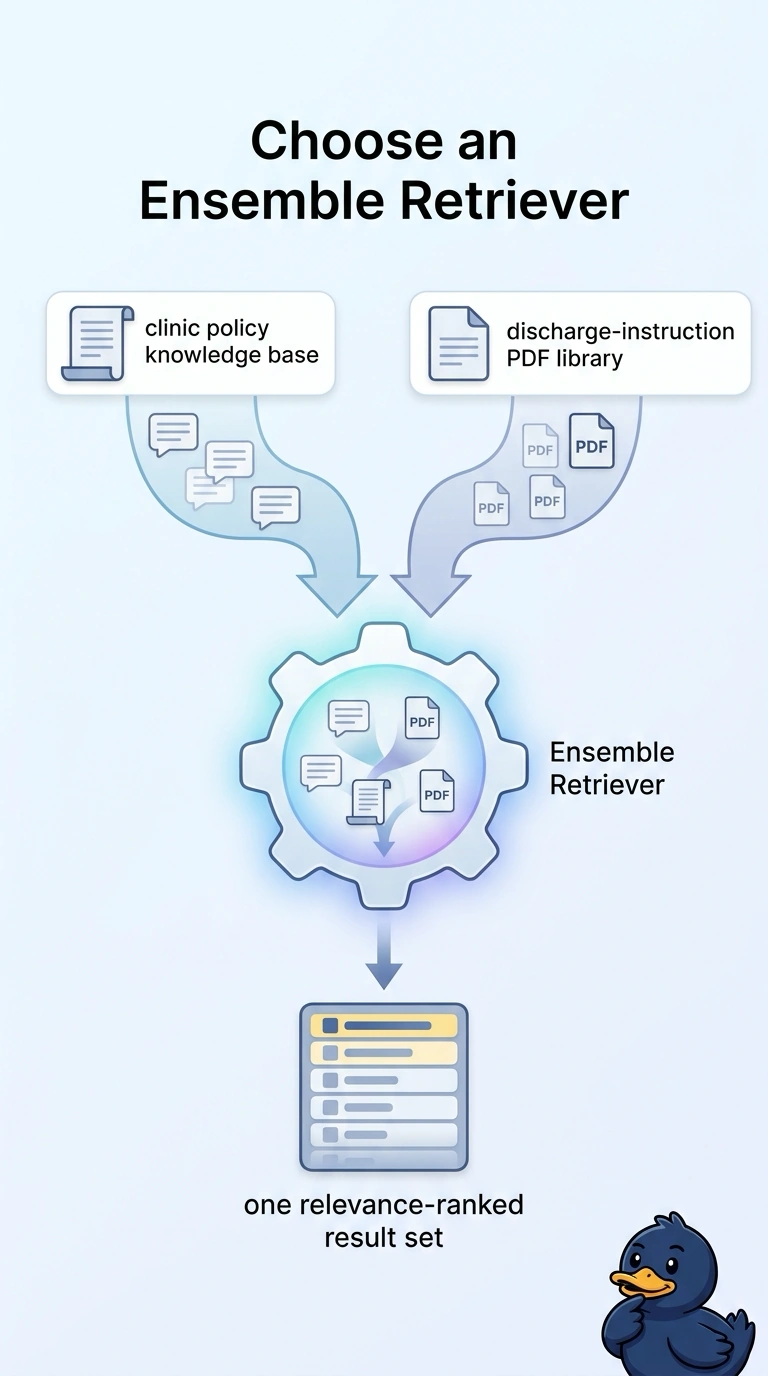
Short Explanation
When one answer may need information from both the clinic policy knowledge base and the discharge-instruction PDFs, an ensemble retriever is built for that job. You get results from multiple sources combined into one relevance-ranked set, rather than having to choose just one source.
Full Explanation
An ensemble retriever is correct because it combines and ranks results from multiple underlying retrievers or data sources into one result set, matching the need to draw on both the clinic policy knowledge base and the discharge-instruction PDF library for a single pet-owner question. The claim that an individual retriever is safer because ensembles work only with structured CRM records is wrong: ensembles are not restricted to structured CRM data, and they can combine multiple sources, including the unstructured sources described here. The claim that Data 360 retrievers cannot be used inside a single prompt template is also wrong; retrievers are a supported grounding technique for prompt templates. Running an individual retriever twice in sequence is not the equivalent solution: ensemble retrievers are not deprecated, and sequential runs do not provide the same single-pass, relevance-ranked blending across sources. Exam caveat: choose an ensemble when one answer may plausibly require content from more than one retriever or source, rather than merely because multiple sources exist. As a practical check, confirm both sources are connected through the intended retrievers and inspect whether the combined results rank relevant material from each source for the question.