
When the GP clinic's agent hands a referral to the specialty hospital's agent via the agent-to-agent protocol, the specialty agent needs enough conversation history to avoid re-asking the pet owner questions already answered - but the GP clinic doesn't want to expose its entire case record. Which statement correctly describes the hand-off behavior?
Select an answer to reveal the explanation.
Short Explanation
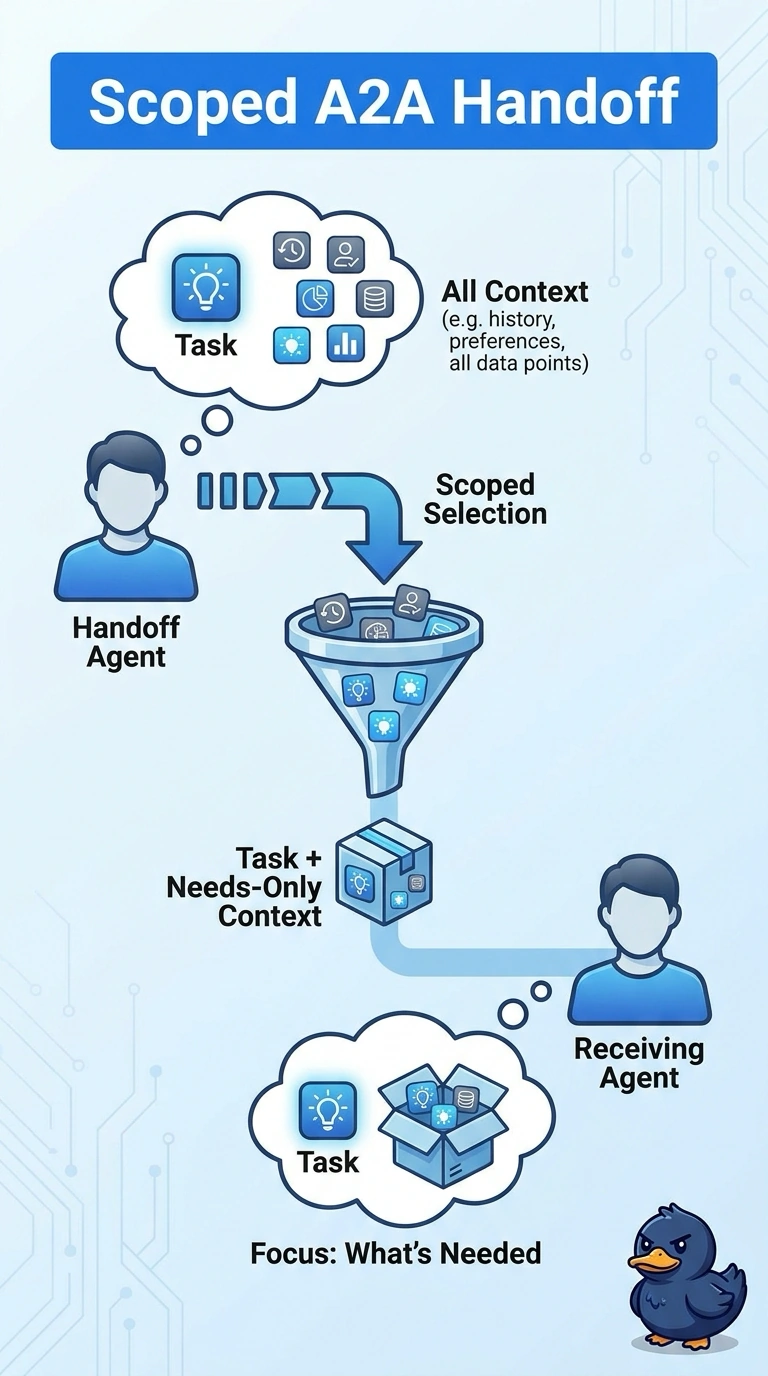
It's a warm hand-off at the front desk, not photocopying the whole patient file: the GP agent briefs the specialist agent on what matters for this referral, not everything Meridian has ever recorded about the pet.
Full Explanation
The agent-to-agent protocol carries a defined task and the context the delegating agent chooses to pass, scoped to what the receiving agent needs to continue the work - it is neither an automatic full-record dump nor a hard reset to zero context. That is what lets the specialty hospital's agent avoid re-asking already-answered questions while the GP clinic still controls what leaves its side of the hand-off.
'The full Case record and complete field history are always shared automatically' is the closest-looking trap because it sounds like a generous, helpful default, but it describes bulk, ungoverned data exposure that the delegating agent has no say over - the opposite of the scoped hand-off A2A actually provides. 'No context can pass' overcorrects the other direction and would make the specialty agent worse than useless for referrals, forcing the owner to repeat their whole history. Routing the raw transcript through a Data 360-only object misdescribes the mechanism entirely; A2A is a direct agent-to-agent exchange, not a detour through the Data Library.
Exam takeaway: A2A hand-offs are scoped and chosen by the delegating agent, not automatic bulk record transfers.