
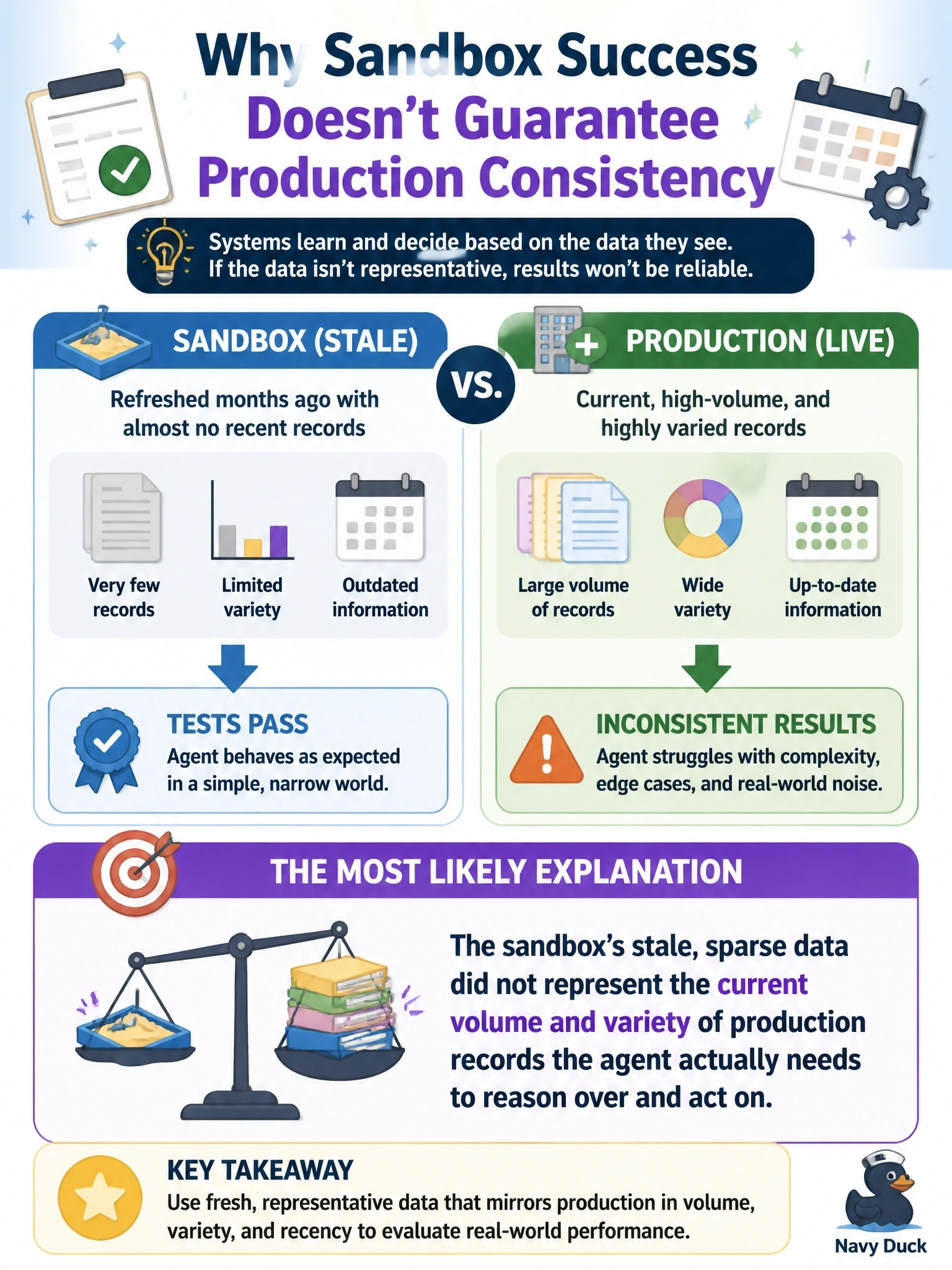
Wraithmoor Veterinary Group tests its new referral-booking agent in a sandbox that was refreshed months ago and contains almost no recent specialty-hospital records. Test cases pass cleanly, but the agent behaves inconsistently once deployed to production. What is the most likely explanation?
Select an answer to reveal the explanation.
Short Explanation
A sandbox with stale, thin data will happily pass tests, it just isn't testing against anything close to what production actually looks like. Clean tests on unrepresentative data buy you false confidence, not real coverage.
Full Explanation
An agent's behavior depends heavily on the underlying data it retrieves and reasons over, so a sandbox that is stale and sparse relative to current production volume and variety can pass every written test case while still failing to represent how the agent will actually behave once it meets the real breadth of production records. This is a classic pitfall: the tests are not wrong, but the environment they ran against does not reflect reality closely enough to catch every real-world issue. Testing Center results are not inherently invalid just because they ran in a sandbox; sandbox testing is the standard, expected practice before production deployment, so blanket distrust of sandbox results is the wrong lesson to draw. The Einstein Trust Layer's core protections, such as masking and zero-retention behavior, are not designed to behave inconsistently between sandbox and production, so that is not a credible explanation for this symptom. Referral-booking agents, like any other agent, absolutely can and should be tested in a sandbox before going live; the issue here is the quality and freshness of that sandbox's data, not whether sandbox testing itself is possible.