
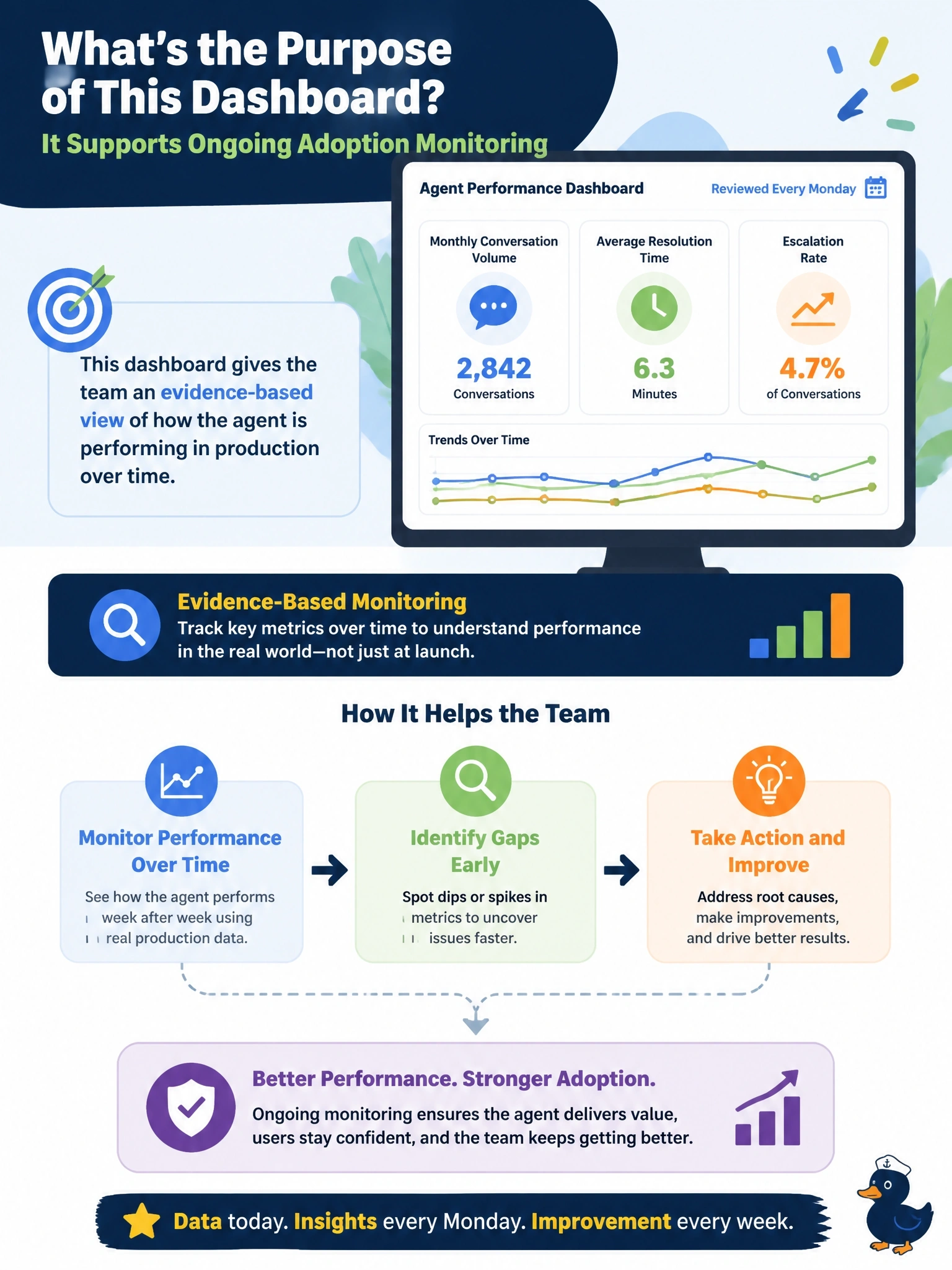
Ironwood Veterinary Partners tracks its Employee agent's monthly conversation volume, average resolution time, and escalation rate on a dashboard the operations manager reviews every Monday. What lifecycle purpose does this dashboard primarily serve?
Select an answer to reveal the explanation.
Short Explanation
A weekly dashboard isn't a trophy case, it's a smoke detector. It exists so the team notices drifting resolution times or a creeping escalation rate long before owners start complaining loudly.
Full Explanation
Tracking conversation volume, resolution time, and escalation rate on an ongoing dashboard is a textbook example of managing and monitoring adoption: it gives the team continuous, evidence-based visibility into how the agent is actually performing in production, so declining trends or emerging gaps (like the rising escalation pattern seen in similar scenarios) can be caught and acted on quickly. It does not replace Testing Center — pre-deployment validation and post-deployment monitoring are complementary lifecycle stages, not substitutes for each other; production metrics can reveal problems, but Testing Center is still where fixes get validated before redeployment. Nothing about adoption monitoring is a one-time compliance checkbox with an expiration date; ongoing agents need ongoing monitoring for as long as they are live, not just in their first year. While cost justification might be a secondary interest of finance stakeholders, that is not the primary lifecycle purpose of an operations dashboard tracking usage and quality signals — its core job is performance visibility and continuous improvement.