
Pinebridge Veterinary Alliance's specialist deploys an updated Service agent to production on a Friday afternoon without re-running the full Testing Center suite, reasoning the changes were 'small.' Over the weekend, several owners report the agent giving nonsensical replies to lab-result questions. What lifecycle discipline would most directly have caught this before it reached owners?
Select an answer to reveal the explanation.
Short Explanation
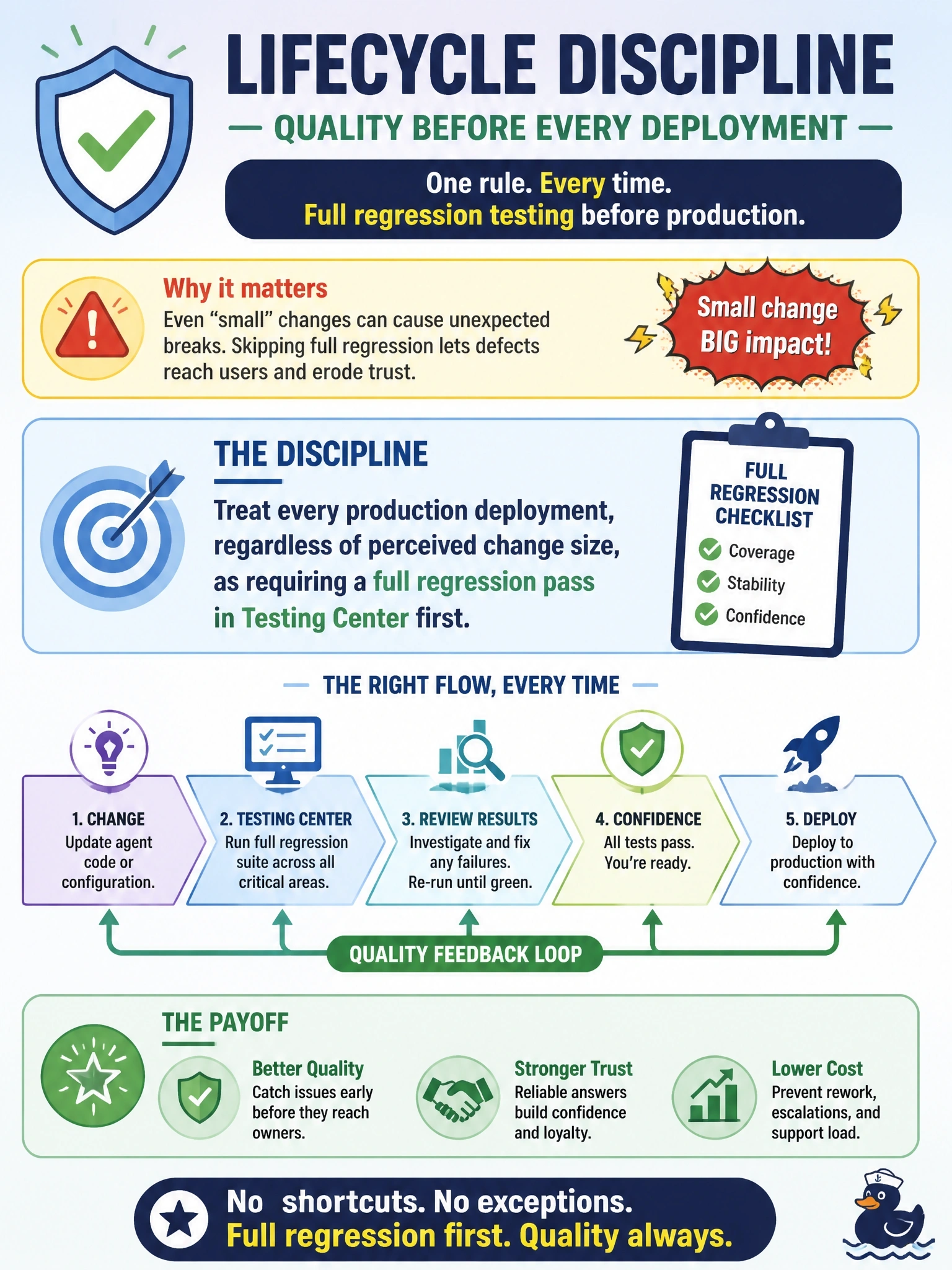
'Small change' is often famous last words. Treat every deployment, no matter how minor it looks, as earning a full regression pass, because the agent doesn't know the difference between a small edit and a big one.
Full Explanation
The lifecycle discipline that would have caught this is simple and non-negotiable: every production deployment, regardless of how small the change looks, should be preceded by a full regression pass in Testing Center. A 'small' instruction tweak or action change can still shift reasoning-engine behavior in ways that are not obvious from reading the diff, exactly as happened here with lab-result questions. Waiting for owner complaints turns real pet owners into the quality gate, which is the failure mode this discipline exists to prevent, not a substitute for it. Restricting deployments to weekdays addresses staffing convenience, not whether the change was actually validated, and does nothing to catch a classification or response regression. Reducing the number of topics to shrink the blast radius sacrifices real functionality the agent needs and does not address the root cause, which is skipping validation rather than having too many topics. The exam's consistent expectation is: test before every deploy, not just the first one.