
Ridgeline wants an agent to answer a question that might require both clinic policy documents and lab-result interpretation guides. Which configuration best supports this?
Select an answer to reveal the explanation.
Short Explanation
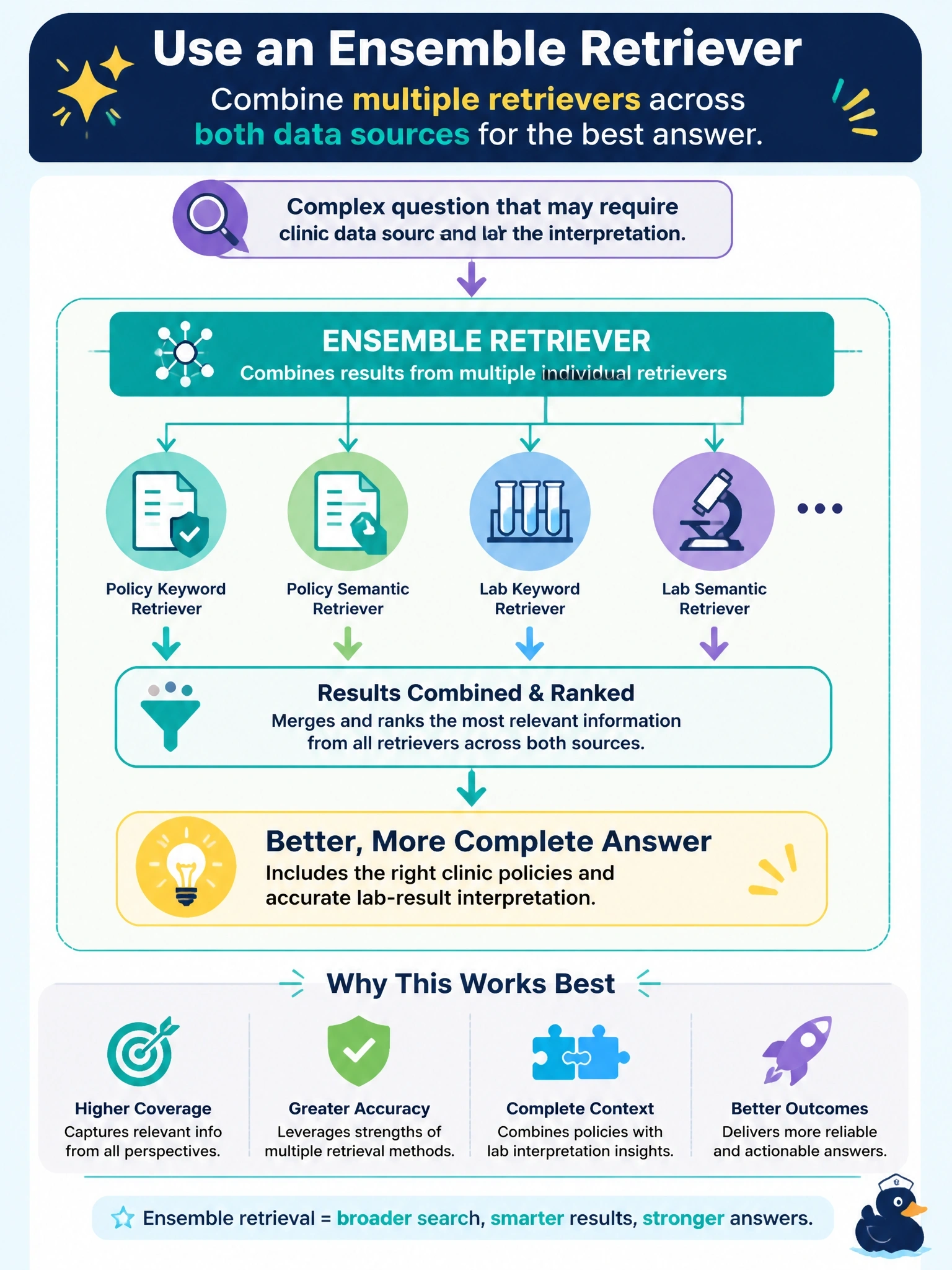
When one question might need two different bookshelves, you don't force the owner to pick a shelf — you send a retriever to each and let an ensemble bring back the best of both.
Full Explanation
An ensemble retriever combines results from multiple individual retrievers, each potentially pointed at a different data source or configured with a different search type, and merges their outputs into a single relevant result set for grounding. This is exactly the scenario Ridgeline faces — a question that could touch both clinic policy and lab-guide content benefits from querying both sources rather than picking one. Restricting to a single retriever risks missing relevant content whenever the question spans both domains, which is a real accuracy gap, not a simplification worth making. Forcing the pet owner to choose between two separate agents adds friction and defeats the purpose of a conversational agent that should route intelligently behind the scenes. Pasting the full text of two documents into static instructions is neither scalable nor how grounding is meant to work — it bypasses chunking, indexing and relevance ranking entirely, and would bloat every prompt regardless of whether the content is actually needed. For the exam, remember: ensemble retrievers are the tool for scenarios needing breadth across sources, while individual retrievers suit a narrowly scoped, single-source lookup.