
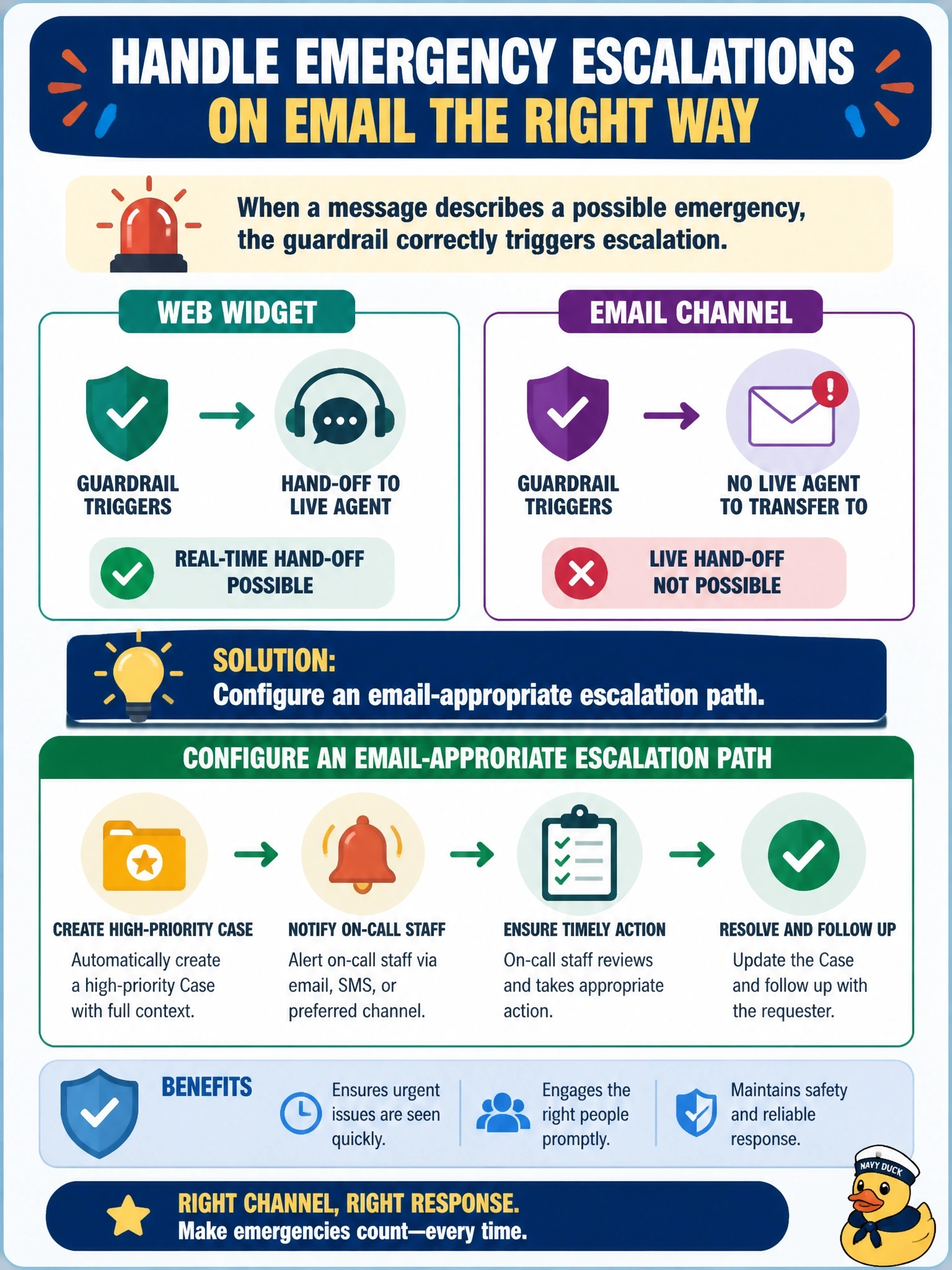
A guardrail correctly triggers escalation when an owner describes a possible emergency, and on the web widget this hands the conversation to a live human agent. The same guardrail fires on the email channel, where there is no live agent to transfer to. What should the specialist configure for this case?
Select an answer to reveal the explanation.
Short Explanation
You can't transfer a phone call that isn't happening. Over email, escalation has to mean "create the case and page someone," not "hand off mid-conversation," because there is no live conversation to hand off.
Full Explanation
Escalation behaviour has to be configured per channel's realities: on a synchronous channel a live hand-off makes sense, but on an asynchronous channel like email there is no ongoing session to transfer, so the specialist must configure an appropriate equivalent, such as creating a high-priority Case and alerting on-call staff, so the guardrail's intent, getting a human involved fast, is still achieved. Removing the guardrail is the wrong move and the most dangerous option, since it means a genuine emergency description over email would get no escalation at all, defeating the entire purpose of the safety configuration. Leaving it unconfigured and hoping the agent "figures out" a fallback contradicts the exam's emphasis on deterministic, explicitly configured behaviour rather than hoping the model improvises correctly in a high-stakes situation. Disabling the email channel entirely throws away a legitimate, widely used channel over a solvable configuration gap, and the premise that guardrails only work in real-time channels is false; guardrails are topic-level constraints that apply regardless of channel, only their downstream action may need to be adapted.