
Pet owners log into the group's self-service portal, built on Experience Cloud, to chat with the agent about their own pets only. What governs whether an owner can only see their own pet's records through that portal-embedded agent, rather than any pet in the org?
Select an answer to reveal the explanation.
Short Explanation
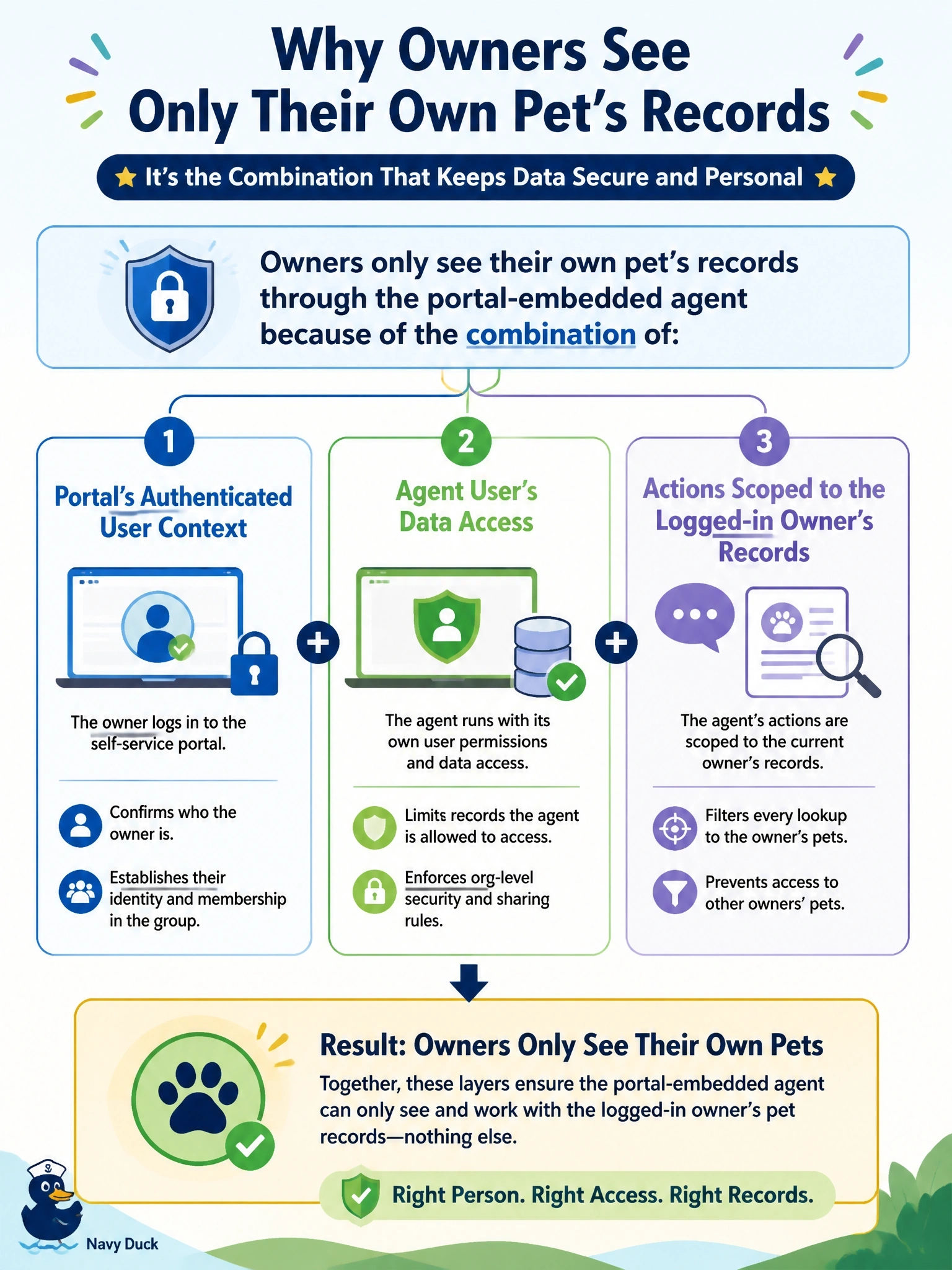
The portal login tells the agent whose pet it's allowed to talk about; the Agent User's own access is the other half of the lock. Both have to line up, or an owner could end up reading a stranger's pet's chart.
Full Explanation
A digital experience deployment is authenticated: the pet owner logs into the Experience Cloud site with their own identity, and a well-designed action uses that context, such as the running user or an owner-scoped input, together with the Agent User's own permission and sharing access, to ensure queries return only that owner's records. Both halves matter, which is why the correct option names the combination rather than a single mechanism. Claiming an embedded agent automatically gets org-wide visibility ignores that access is always governed by configured permissions and scoping, not by the mere fact of being on a portal; that misunderstanding is a real way to leak one owner's data to another. The classification description only affects which topic handles an utterance and has no bearing on record-level scoping once an action executes. And treating the channel connection setting as sufficient on its own ignores that connecting a channel is a delivery mechanism, not a security control; the actual data boundary still has to be engineered into the action and the Agent User's access, exactly as with any other channel.