
A pet owner asks the service agent "do you sell dog food subscriptions?" No configured topic covers retail products. What should a well-configured agent do?
Select an answer to reveal the explanation.
Short Explanation
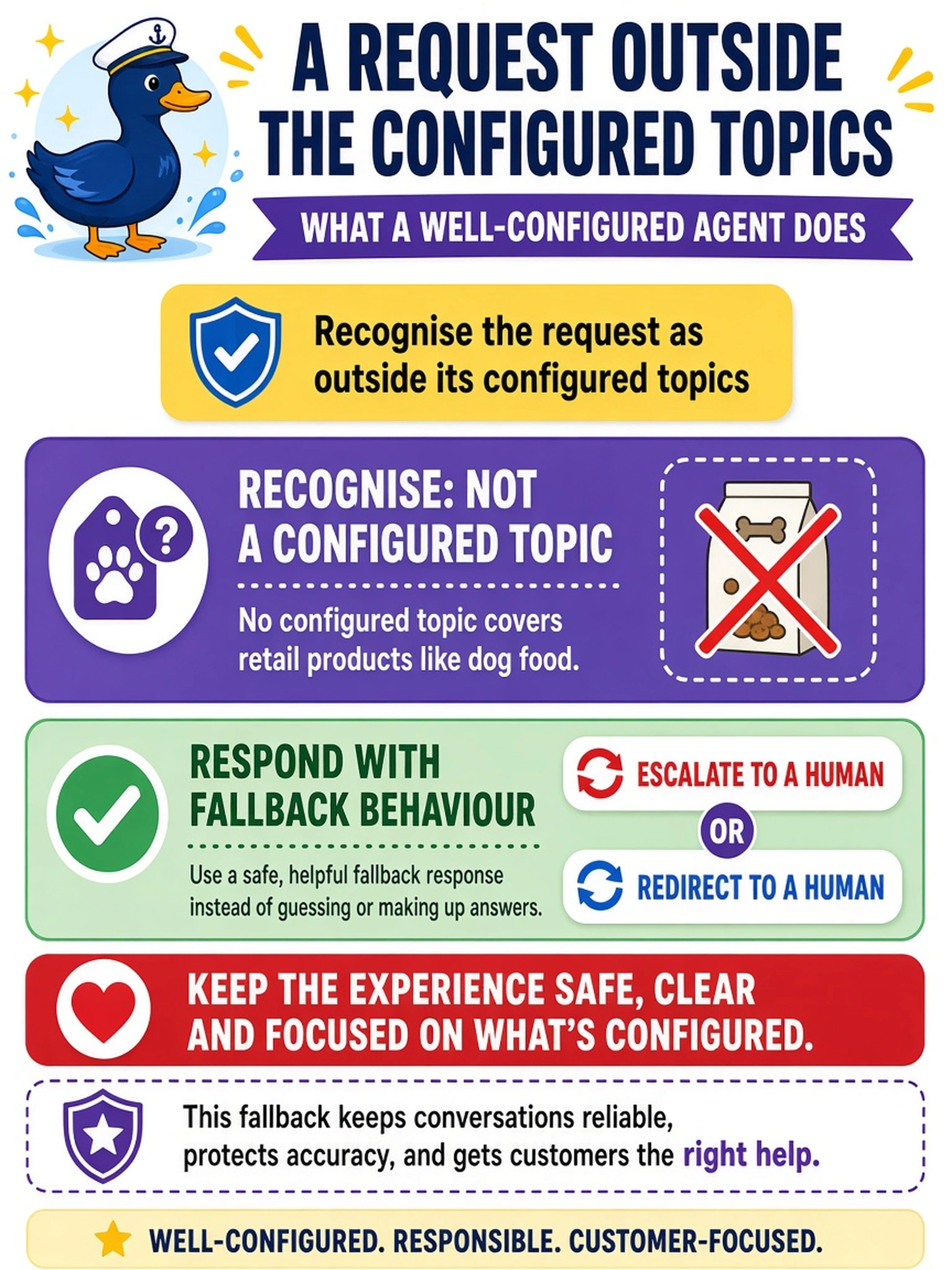
Your agent can only handle the topics you configure. When none matches, use a fallback—such as an escalation or redirect to a human—instead of guessing; plan that response, because owners may ask about dog food.
Full Explanation
An agent’s capability surface is the set of topics you configure. When no topic description matches an utterance, the designed response is the configured fallback: explain that the request is out of scope and escalate or redirect the owner to a human. This is a behavior you own, not an accident, and it keeps out-of-scope requests from producing invented answers. Invoking the closest available action is unsafe: using a refill or booking action for a retail question could write real records, and warning the owner afterward would not undo that. Answering from general knowledge is also ungrounded; although a language model can discuss dog food, the Einstein Trust Layer does not verify claims. It masks sensitive data, scores toxicity, enforces zero retention, and writes an audit trail, but it does not establish that a product claim is true. Silently ending the session avoids an ungrounded answer but creates a poor experience and hides demand signals you could learn from by reviewing unmatched utterances. Exam caveat: an out-of-scope request should not be forced into an unrelated topic or action. Practical check: review unmatched utterances after go-live to decide whether to build a new topic.