
Which statement best describes what the reasoning engine does after a topic has been selected for a pet owner's request to check a claim's status?
Select an answer to reveal the explanation.
Short Explanation
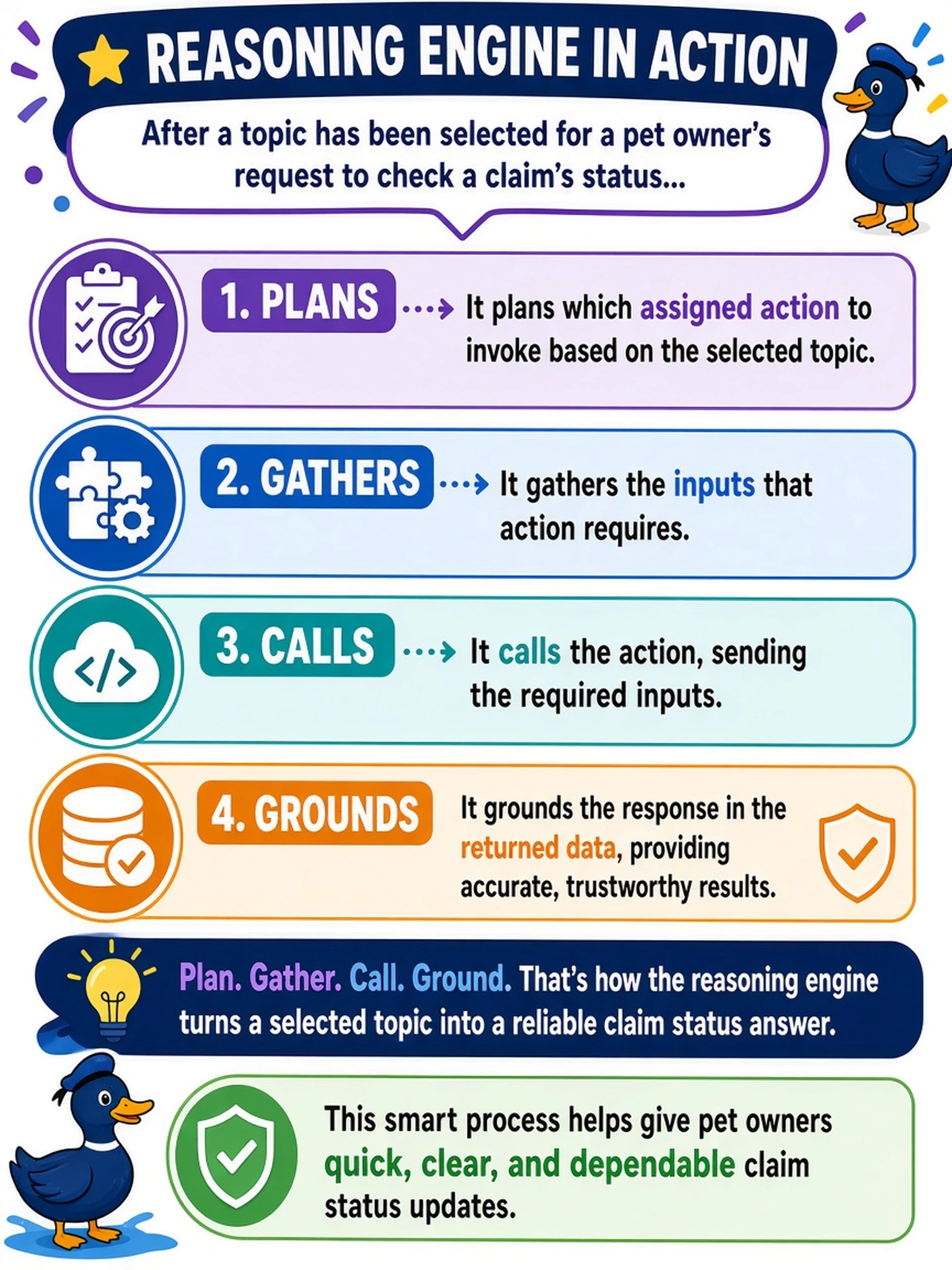
After the door is chosen, the agent reads the room's instructions, decides which tool on the wall it needs, collects whatever the tool asks for, pulls it, and then explains the result in plain English. Plan, gather, invoke, ground. That's the whole loop.
Full Explanation
Once a topic wins classification, the reasoning engine reads that topic's instructions and plans a response. If an assigned action is needed, it determines which one fits, works out which required inputs it already has from the conversation or from variables and which it must ask the user for, invokes the action, and then generates a natural-language answer grounded in the returned data. Running every assigned action in sequence is wrong and would be wasteful and often harmful, since a topic can hold both read and write actions. Sending the raw utterance straight to a Flow misdescribes the architecture in two ways: the engine maps the utterance to typed action inputs rather than passing free text through, and the Flow's output is used as grounding for a generated response rather than returned verbatim. This is the closest-looking trap because a deterministic Flow really does produce the authoritative data, but the agent still phrases the answer. Recency of use is not a selection criterion; action choice is driven by the instructions, the action descriptions, and the current request. Worth remembering: writing a clear description for each action is as important as writing a clear classification description for each topic.