
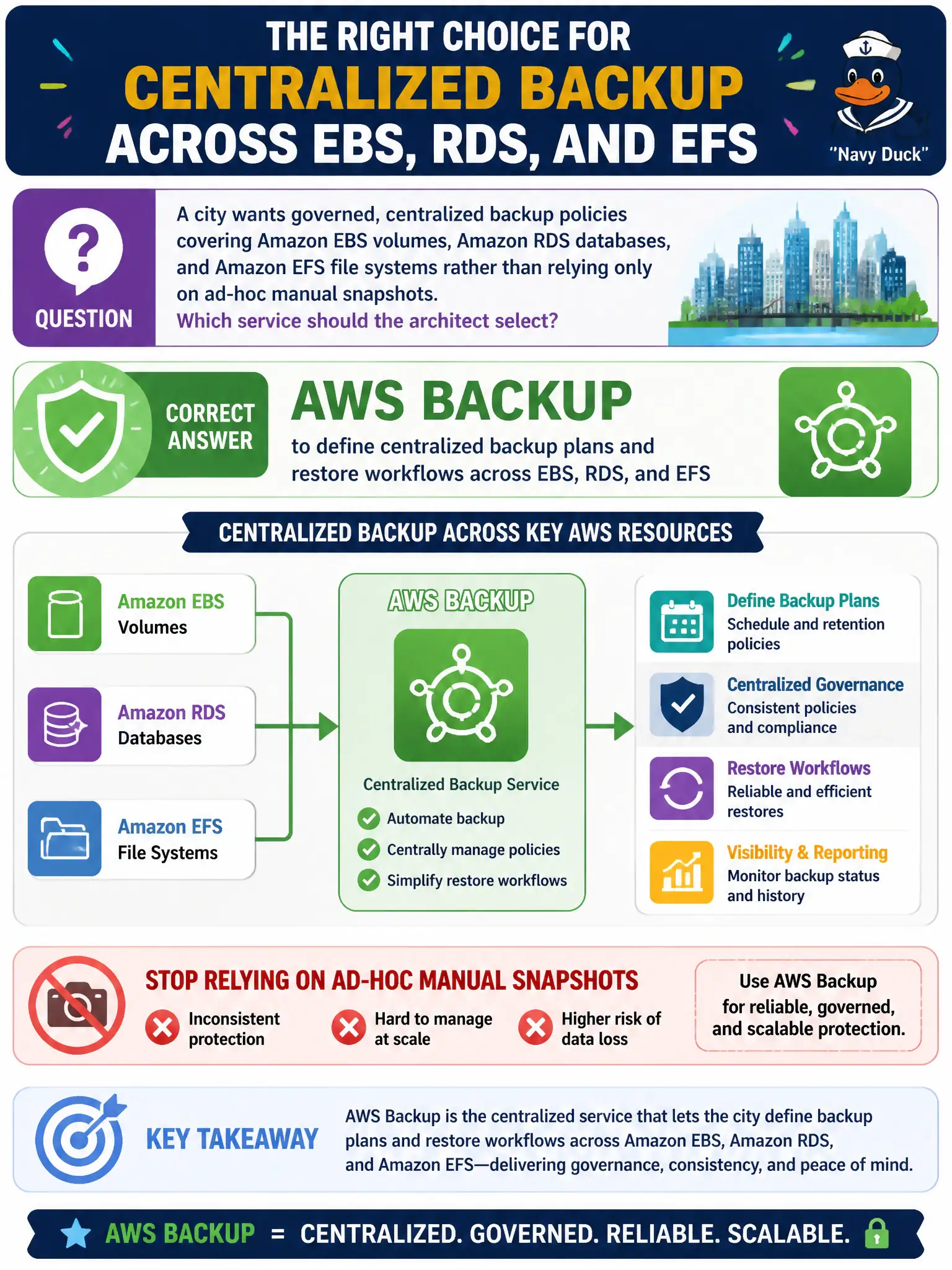
A city wants governed, centralized backup policies covering Amazon EBS volumes, Amazon RDS databases, and Amazon EFS file systems rather than relying only on ad-hoc manual snapshots. Which service should the architect select?
Select an answer to reveal the explanation.
Short Explanation
AWS Backup is the city’s shared backup calendar—one set of policies covering EBS, RDS, and EFS instead of random snapshot buttons. Macie, WAF, and CloudFront are not your enterprise backup plane.
Full Explanation
Governed, centralized backup policies covering Amazon EBS volumes, Amazon RDS databases, and Amazon EFS file systems point to AWS Backup. Backup plans define schedules, lifecycle/cold storage rules, and restore workflows across those resource types so the city is not dependent on ad-hoc console snapshot clicks per team. Centralized vaults, IAM-controlled restore rights, and optional cross-account or cross-Region copies give municipal IT a single operational calendar for recovery objectives.
Amazon Macie fails this selection by purpose—it discovers sensitive data, it does not snapshot block devices on PII detection as a backup service. AWS WAF fails because edge SQL caching is not database backup. Amazon CloudFront fails as a backup vault—edge POP ephemeral storage is not durable enterprise backup for EBS volumes.
Exam caveat: AWS Backup orchestrates backups, but encryption keys, vault lock/immutability settings, and restore testing still need explicit design for ransomware resilience. Operational check: assign tags that select EBS, RDS, and EFS into a Backup plan, run an on-demand job, restore each resource type into an isolated environment, and confirm RPO/RTO assumptions with the operations team.