
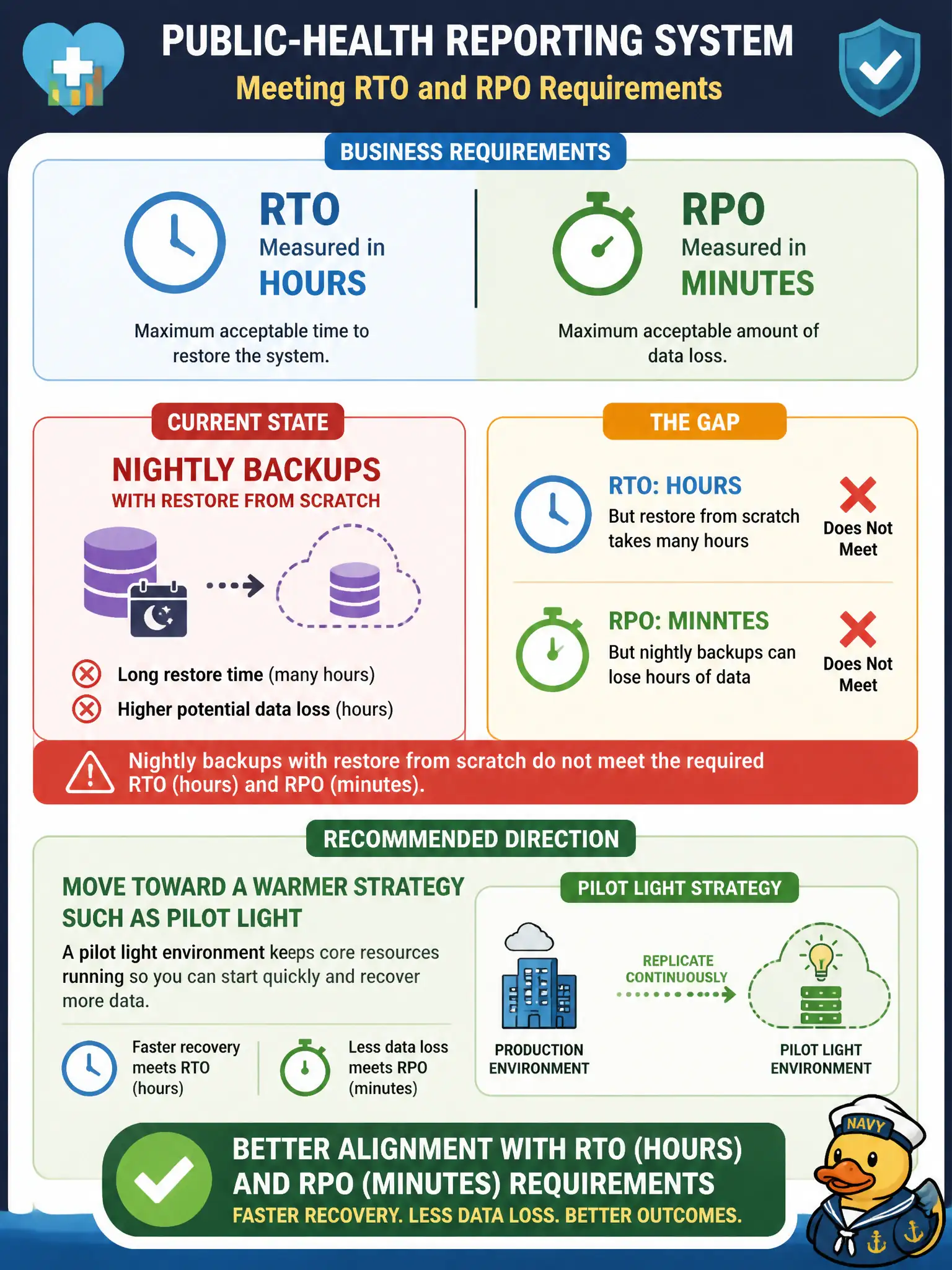
A public-health reporting system requires an RTO measured in hours and an RPO measured in minutes. Leadership currently funds only nightly backups with restore from scratch. Which direction should the architect recommend?
Select an answer to reveal the explanation.
Short Explanation
Nightly backups are a cold attic—fine if you can wait a day, rough if you need hours and near-fresh data. Pilot light keeps a small warm core ready so you are not rebuilding from zero. Match the DR pattern to the numbers, not the other way around.
Full Explanation
A public-health reporting system with an RTO measured in hours and an RPO measured in minutes cannot honestly rely on nightly backups with restore-from-scratch as its only disaster recovery strategy. Nightly backups typically imply up to a day of data loss and a rebuild clock that often exceeds hour-level RTO when infrastructure must be provisioned cold. The architect should move toward a warmer strategy such as pilot light so a minimal continuously maintained core can be scaled out quickly, aligning recovery time and data loss with the stated objectives for civic health reporting.
Keeping backup-only DR and treating RTO and RPO as aspirational fails because published recovery objectives are operational commitments, not slogans. Switching exclusively to tape archives shipped weekly fails both dimensions: weekly media worsens RPO and physical handling worsens RTO relative to cloud warmer patterns. Relying on a single Region with no replicas because backups already prove durability fails conceptually: backups address data survival, not Regional service continuity or minute-level RPO.
Exam caveat: pilot light reduces RTO versus cold backup but still costs more than backup-only; choose warmth based on measured objectives, not fashion. Operational check: map current backup frequency to actual RPO, time a restore-from-scratch against RTO, then implement pilot light (or warmer) with continuous data replication that meets minute-level RPO and rehearse scale-out in the recovery Region.