
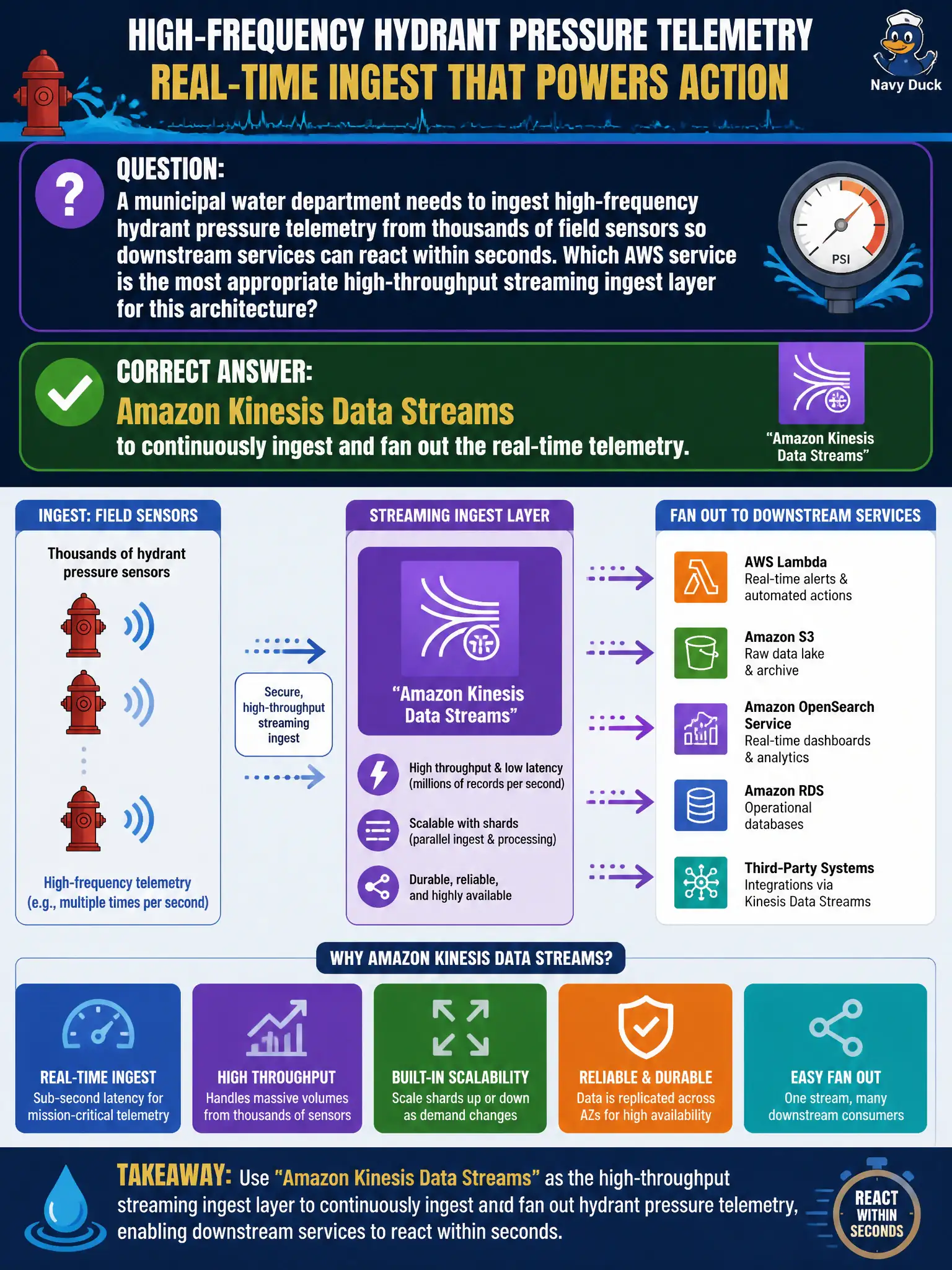
A municipal water department needs to ingest high-frequency hydrant pressure telemetry from thousands of field sensors so downstream services can react within seconds. Which AWS service is the most appropriate high-throughput streaming ingest layer for this architecture?
Select an answer to reveal the explanation.
Short Explanation
Picture fire hydrants chirping pressure readings like a live news ticker—not a nightly dump. Kinesis Data Streams is built for continuous, high-frequency ingest so analytics and alarms can keep up. Hourly SQS polls, nightly S3 drops, and weekly Glue crawls are batch rhythms, not sub-second municipal telemetry.
Full Explanation
Amazon Kinesis Data Streams is the appropriate high-throughput streaming ingest layer for municipal hydrant pressure telemetry because it is built for continuous, ordered (per shard), near-real-time event capture at high ingest rates so downstream consumers can alarm and react within seconds. Field sensors that chirp frequently need a durable stream buffer and fan-out model rather than nightly dumps. Amazon SQS Standard queues polled once per hour by a single EC2 worker create artificial latency and a single-worker bottleneck; hourly polling cannot meet sub-second municipal reaction goals even though SQS is excellent for many decoupling use cases. Amazon S3 multipart uploads written directly from each sensor once per night are a batch landing pattern; they lose the continuous time-series freshness the water department needs for operational response. AWS Glue crawlers scheduled weekly against CSV files on a shared network drive discover schema for analytics lakes; they are not an ingest bus for high-frequency sensor streams. Exam caveat: choose shard count or on-demand mode for peak sensor fan-in, and pair the stream with consumers (Lambda, Firehose, analytics apps) sized for the same peak. Operational check: validate producer retries and partition keys, watch IteratorAge and throughput metrics during a simulated hydrant event spike, and confirm alarms fire from stream consumers rather than from delayed batch jobs.