
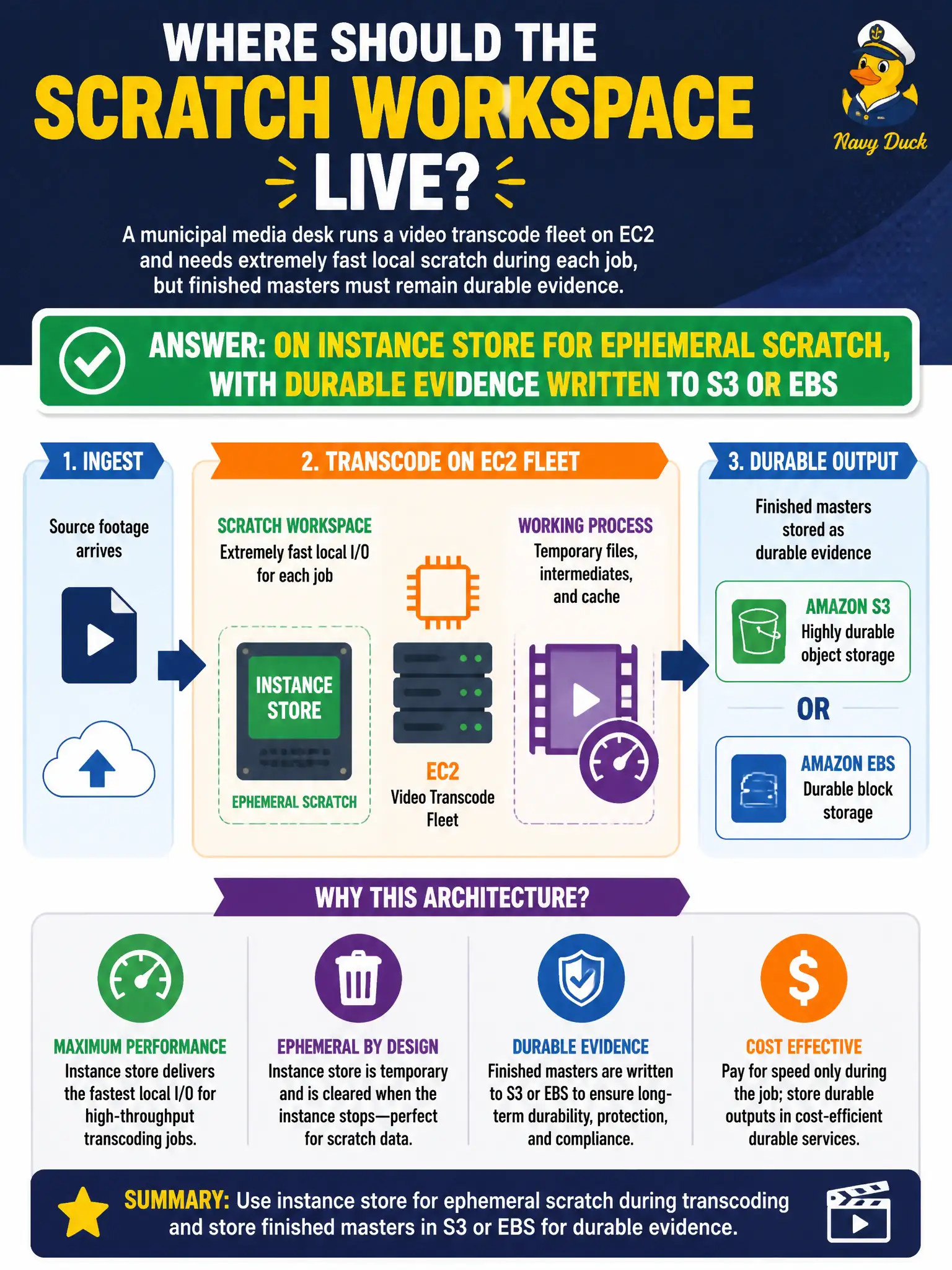
A municipal media desk runs a video transcode fleet on EC2 and needs extremely fast local scratch during each job, but finished masters must remain durable evidence. Where should the scratch workspace live?
Select an answer to reveal the explanation.
Short Explanation
Transcode scratch is like a whiteboard—wipe it when the job’s done. Instance store gives blazing local speed for that temporary work, then you park the finished evidence on durable S3 or EBS. Glacier isn’t a hot scratch path, EFS-as-SoR for originals mixes concerns, and stuffing video into RDS is the wrong tool.
Full Explanation
Video transcode fleets need extremely fast local scratch for intermediate frames, but finished masters are civic evidence that must remain durable. EC2 instance store provides host-local ephemeral block storage with excellent performance for that temporary workspace, while durable evidence is written to Amazon S3 or EBS when the job completes. Separating ephemeral scratch from the system of record is the high-performing, correct durability pattern for a municipal media desk and matches Task 3.1 guidance on when temporary instance storage is appropriate. Using only S3 Glacier Instant Retrieval as the live scratch path for every frame fails because archival or colder object classes are not a substitute for high-speed local scratch during active transcode, and treating Glacier Instant Retrieval as a hot frame workspace mismatches cost and access characteristics for intense temporary I/O. Making a multi-AZ EFS volume also the system of record for originals fails conceptually by mixing shared network file concerns with evidence durability strategy and typically will not match instance-local scratch speed for heavy transcode intermediates. Storing binary video blobs in RDS local storage tables fails because relational databases are the wrong tool for large media scratch and masters; that pattern creates performance, size, and operational problems instead of a clean scratch-plus-durable-object design. Exam caveat: instance store disappears on stop, terminate, or host failure—never treat it as authoritative evidence storage, and design job retry so lost scratch can be regenerated from durable inputs. Operational check: configure transcode workers to use instance store for intermediates, verify masters and checksums land in S3 or EBS before marking a job complete, and alert if a job exits without a durable write confirmation.