
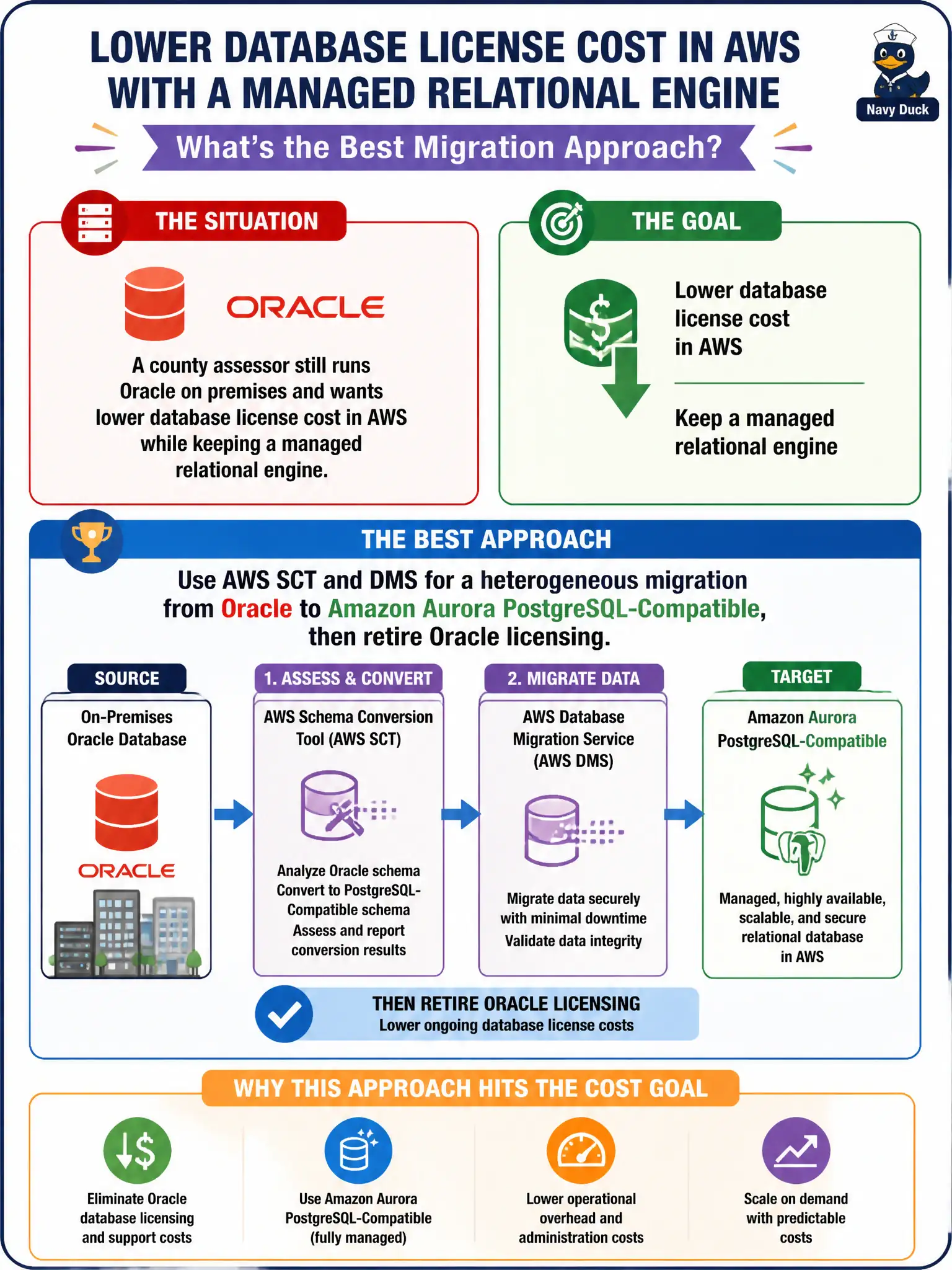
A county assessor still runs Oracle on premises and wants lower database license cost in AWS while keeping a managed relational engine. Which migration approach best targets that cost goal?
Select an answer to reveal the explanation.
Short Explanation
Oracle licenses feel like a tax meter that never sleeps. Move the workload to Aurora PostgreSQL with SCT and DMS and you stop paying that meter. Bigger EC2 Oracle boxes just relocate the bill.
Full Explanation
For a county assessor's office still running Oracle on premises, the primary cost lever is commercial database licensing, not merely relocating the same engine into AWS. A heterogeneous migration using AWS Schema Conversion Tool (SCT) to convert schema objects and AWS Database Migration Service (DMS) to move data into Amazon Aurora PostgreSQL-Compatible Edition keeps a fully managed relational engine while retiring Oracle license exposure. Aurora still provides automated backups, Multi-AZ options, and a familiar SQL model for assessment, valuation, and tax-roll workloads, so the municipality does not abandon relational OLTP—it abandons the license meter. After cutover validation, the county can decommission the on-premises Oracle estate and stop renewing those seats.
Lift-and-shift of the same Oracle edition onto a larger always-on EC2 host fails the cost goal by concept: the commercial engine (and often BYOL or license-included pricing) remains, while you also take on EC2 patching, storage, and HA design. Caching static PDFs in CloudFront leaves the Oracle OLTP system untouched on premises; CDN edge caching helps public document delivery, not database license reduction. Replacing the database with Amazon SQS confuses messaging with durable relational storage—queues cannot enforce assessor schemas, joins, constraints, or reporting semantics, and licensing does not disappear by picking the wrong service.
Exam caveat: heterogeneous migrations are not free of effort—stored procedures, proprietary types, and Oracle-specific SQL may need remediation—so SCT assessment reports matter before committing. Also distinguish Aurora PostgreSQL-Compatible from simply running Oracle on RDS or EC2; only the engine change removes Oracle license pressure.
Operational check: run SCT assessment against the assessor schemas, pilot DMS with ongoing replication into Aurora, compare query plans and data types for critical valuation jobs, measure license and instance spend before versus after, and only retire Oracle after parallel-run reconciliation of parcel counts and assessment totals.