
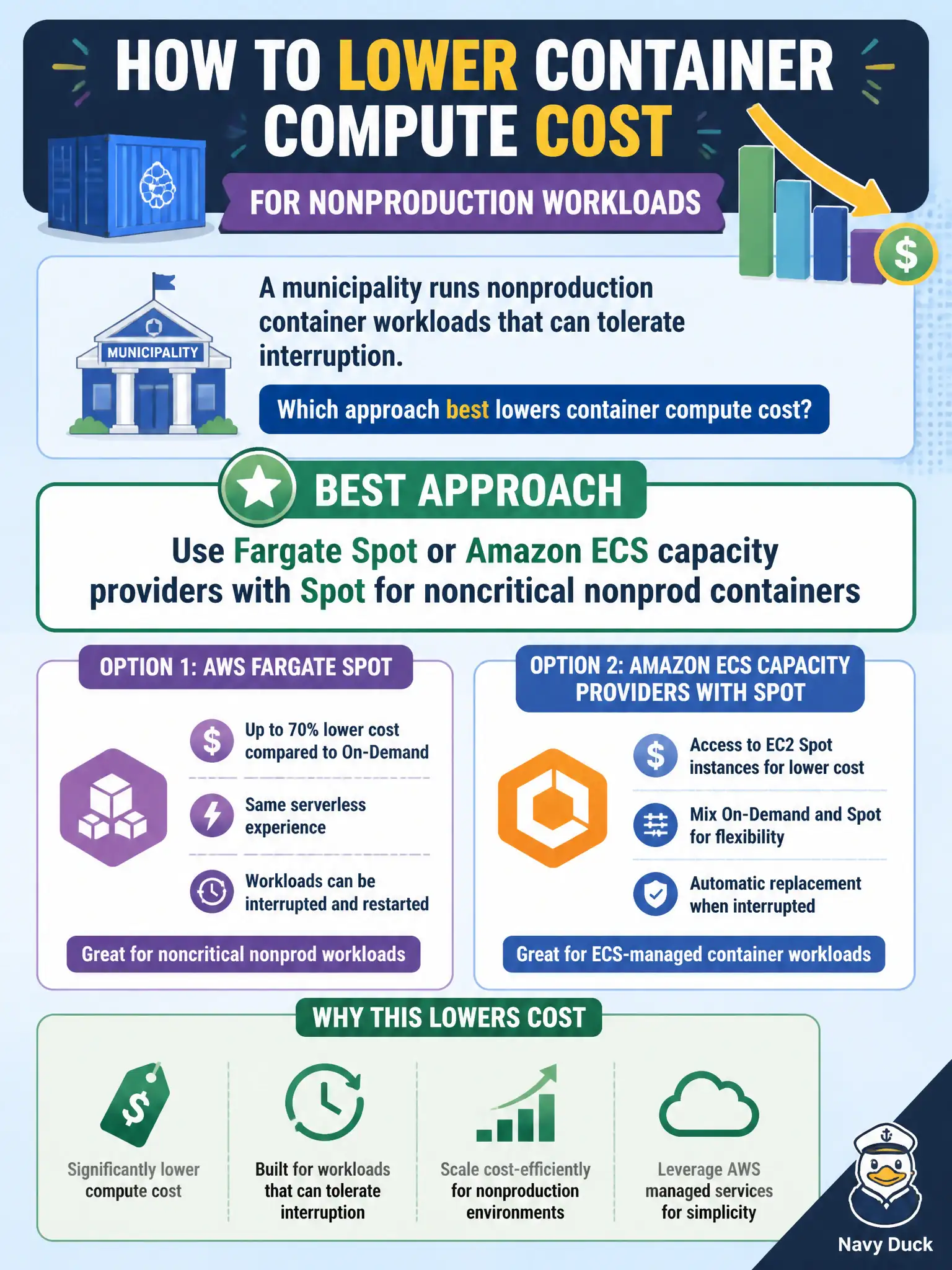
A municipality runs nonproduction container workloads that can tolerate interruption. Which approach best lowers container compute cost?
Select an answer to reveal the explanation.
Short Explanation
Dev and test containers aren't the 911 system—Spot-friendly Fargate or ECS capacity providers can ride cheaper interruptible capacity. Save the always-on On-Demand money for production.
Full Explanation
Using Fargate Spot or Amazon ECS capacity providers with Spot for noncritical nonproduction containers is the correct cost reduction for municipal workloads that can tolerate interruption, because Spot capacity discounts interruptible compute and nonprod sandboxes rarely justify full On-Demand rates. Developer and test containers can restart; production citizen services should keep stronger availability guarantees. Requiring multi-Region active-active for every developer sandbox fails by multiplying infrastructure and data-plane cost far beyond nonprod needs. Pinning every task to the largest On-Demand GPU instances fails because oversized GPU On-Demand maximizes spend without matching typical nonprod container requirements. Disabling Auto Scaling so tasks never stop fails by freezing idle capacity in a permanently running state, the opposite of cost-aware nonprod hygiene. Exam caveat: Spot-backed Fargate/ECS fits interruptible nonprod; do not impose multi-Region HA, max GPU On-Demand, or frozen ASGs as nonprod defaults. Operational check: mark nonprod services eligible for Spot; configure Fargate Spot or ECS Spot capacity providers with sane retries; keep production on On-Demand or mixed strategy; and review monthly nonprod spend versus tagged environments to catch sandboxes that quietly moved back to expensive capacity.