
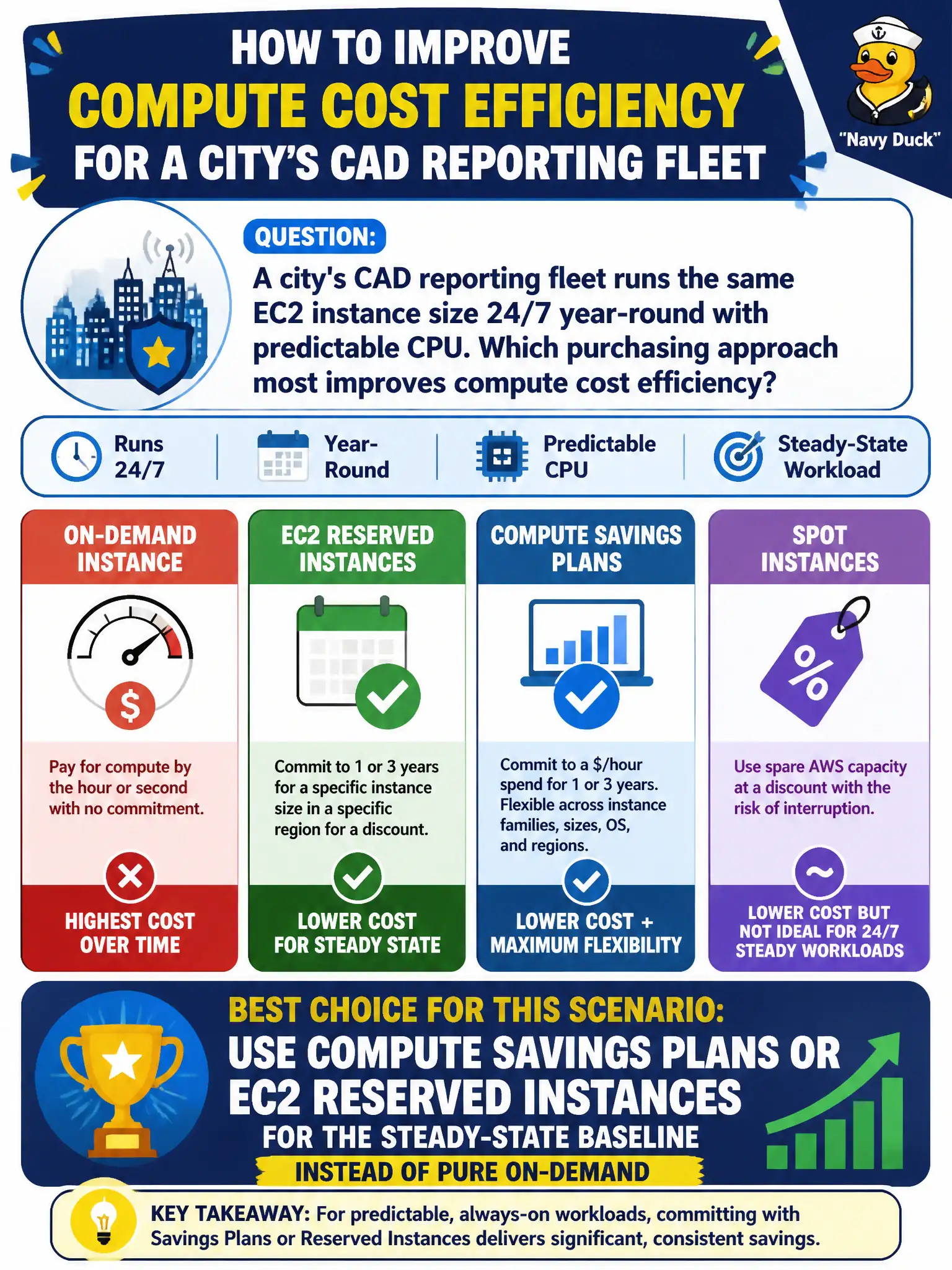
A city's CAD reporting fleet runs the same EC2 instance size 24/7 year-round with predictable CPU. Which purchasing approach most improves compute cost efficiency?
Select an answer to reveal the explanation.
Short Explanation
If those CAD boxes never sleep, On-Demand is paying retail every hour. Lock in Savings Plans or Reserved Instances for the steady baseline—Spot is for interruptible work, not a 24/7 reporting core.
Full Explanation
Compute Savings Plans or EC2 Reserved Instances for the steady-state baseline are the correct purchasing approach for a city’s CAD reporting fleet that runs the same instance size 24/7 with predictable CPU, because committed-use discounts reduce the effective hourly rate versus pure On-Demand for always-on workloads. Municipal reporting cores that never sleep are classic RI/Savings Plan candidates once rightsizing is confirmed. Moving the entire CAD stack to Spot with no interruption handling fails because Spot can reclaim capacity; continuous reporting without interruption handling risks mid-job failure and operational pain that outweighs sticker savings. Buying only Dedicated Hosts because Savings Plans never apply to EC2 fails factually and conceptually: Savings Plans and Reserved Instances are primary EC2 cost tools, while Dedicated Hosts address tenancy/licensing needs rather than being the default discount path. Keeping On-Demand and doubling instance size for headroom fails because upsizing increases On-Demand spend without addressing purchase-model inefficiency for a predictable baseline. Exam caveat: steady 24/7 EC2 baselines favor Savings Plans/RIs; do not substitute unmanaged Spot, Dedicated Hosts-as-default, or larger On-Demand for commitment discounts. Operational check: confirm stable utilization and instance family needs via CloudWatch/Compute Optimizer; cover the baseline with Compute Savings Plans or RIs; leave only true elasticity on On-Demand/Spot with proper handling; and review coverage monthly so the CAD fleet does not silently drift back to full On-Demand.