
A parks department shares CAD drawings on Amazon EFS. Traffic is usually low, with short bursts when planners open large plan sets. How should the architect control EFS throughput cost?
Select an answer to reveal the explanation.
Short Explanation
Leaving EFS stuck on always-max provisioned throughput is like leaving every park sprinkler wide open all winter. Let throughput flex with the bursts—pay for the rush when planners pile on, not for idle hours.
Full Explanation
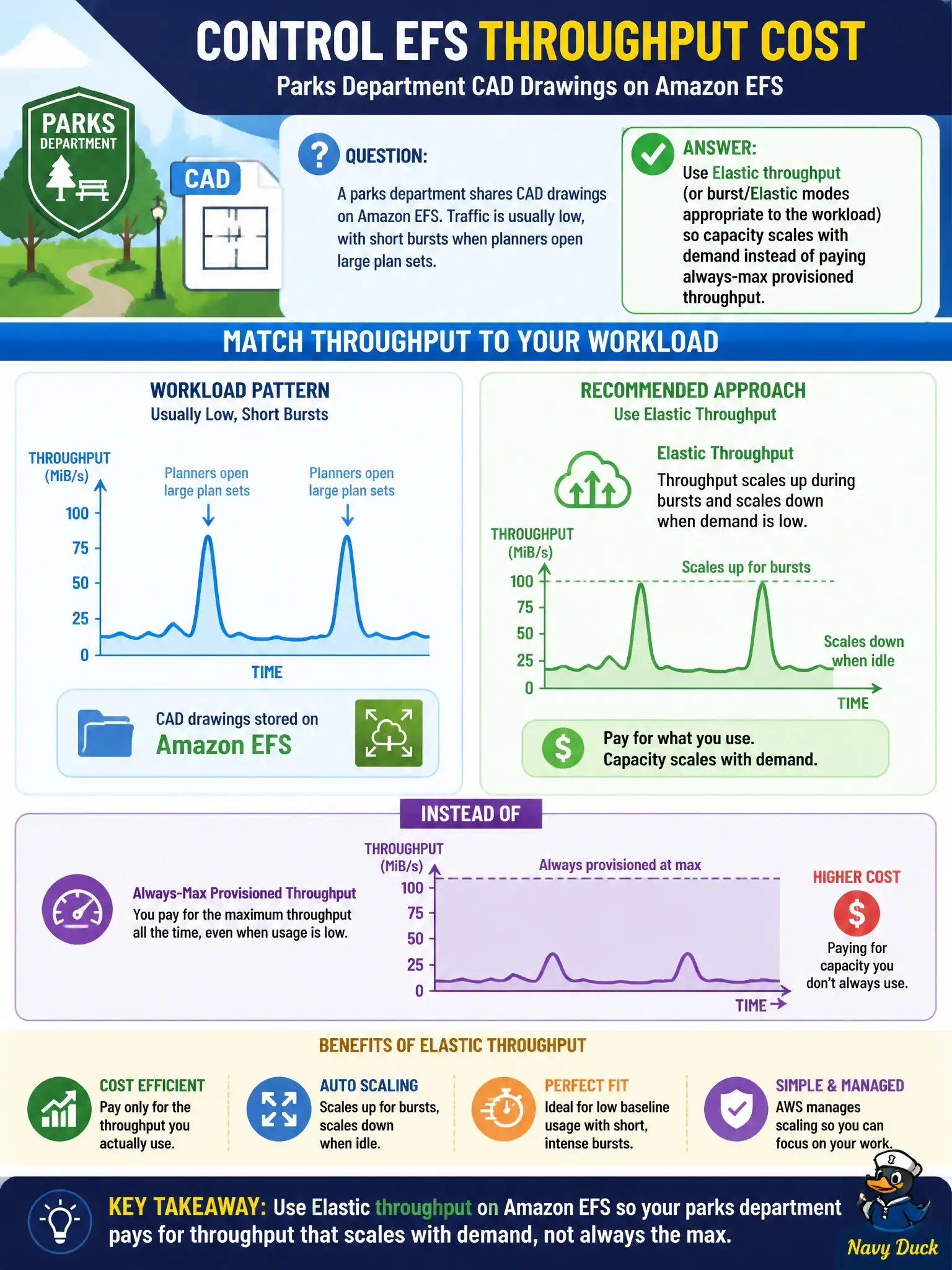
Using Elastic throughput (or burst/Elastic modes appropriate to the workload) is the correct EFS cost control for parks CAD shares that are usually quiet with short bursts when planners open large plan sets, because throughput mode drives spend. Elastic throughput scales with demand so the city pays for the rush without funding always-max provisioned capacity through idle hours. That matches bursty municipal CAD collaboration without changing how applications mount the shared file system. Configuring provisioned throughput at the theoretical maximum every day fails because permanent max provisioned capacity bills for headroom that metrics show is unused most of the time—classic sprinkler-left-on waste. Replacing EFS with instance-store volumes so throughput is free fails conceptually: instance store is ephemeral, host-local, and not a shared multi-instance file system suitable for department CAD collaboration or durable plan sets. Disabling encryption to increase throughput at no cost fails because encryption is a security control, not a throughput cost lever, and turning it off is an anti-pattern that does not legitimately buy EFS performance economics. Exam caveat: for bursty EFS workloads, prefer Elastic/burst-aligned throughput over always-max provisioned, ephemeral local disks, or security shortcuts. Operational check: review EFS throughput mode and CloudWatch IO/throughput metrics for the parks share; switch to Elastic (or right-sized provisioned only if justified); re-test opening large plan sets; and keep encryption enabled while watching cost and burst behavior after the change.