
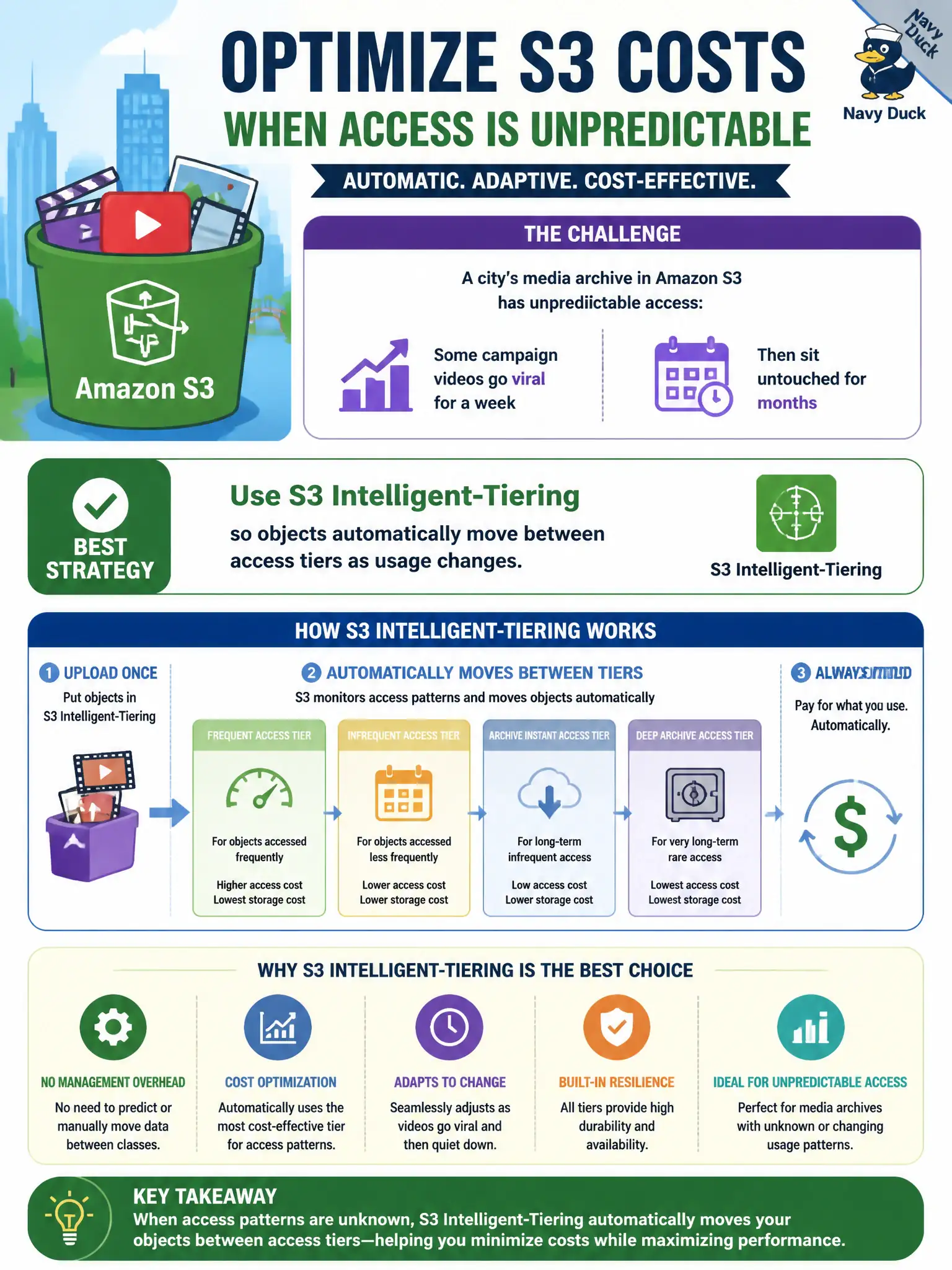
A city’s media archive in Amazon S3 has unpredictable access: some campaign videos go viral for a week, then sit untouched for months. Which storage class strategy best optimizes cost when access patterns are unknown?
Select an answer to reveal the explanation.
Short Explanation
When you can’t predict which clip will go viral next, let the storage class chase the clicks. Intelligent-Tiering auto-moves objects between hot and cooler tiers as access changes. Deep Archive for every view, one EC2 disk, or a DIY io2 object store fight that uncertainty the expensive way.
Full Explanation
S3 Intelligent-Tiering best optimizes cost for a municipal media archive whose access is unpredictable—campaign videos that spike for a week then sit untouched—because it automatically moves objects between access tiers as usage changes without requiring staff to forecast which objects will go viral. That automation matches unknown patterns better than a single static class. Keeping everything in S3 Glacier Deep Archive with mandatory multi-hour restores makes every casual view painful and unsuitable for occasionally hot media. Storing all media only on instance store volumes attached to one always-on EC2 host couples durability to a single instance and loses S3’s object durability model. Purchasing a single large io2 volume and hosting a DIY object store in one Availability Zone creates operational burden, weak durability/availability, and poor economics versus managed object storage classes. Exam caveat: Intelligent-Tiering has monitoring charges and tier-transition behaviors to understand; very tiny objects and certain access patterns may need a cost comparison versus Lifecycle to IA/Glacier. Operational check: enable Intelligent-Tiering on the media prefix, tag/report tier distribution after a campaign cycle, and confirm viral-week retrieval latency remains acceptable for public affairs workflows.