
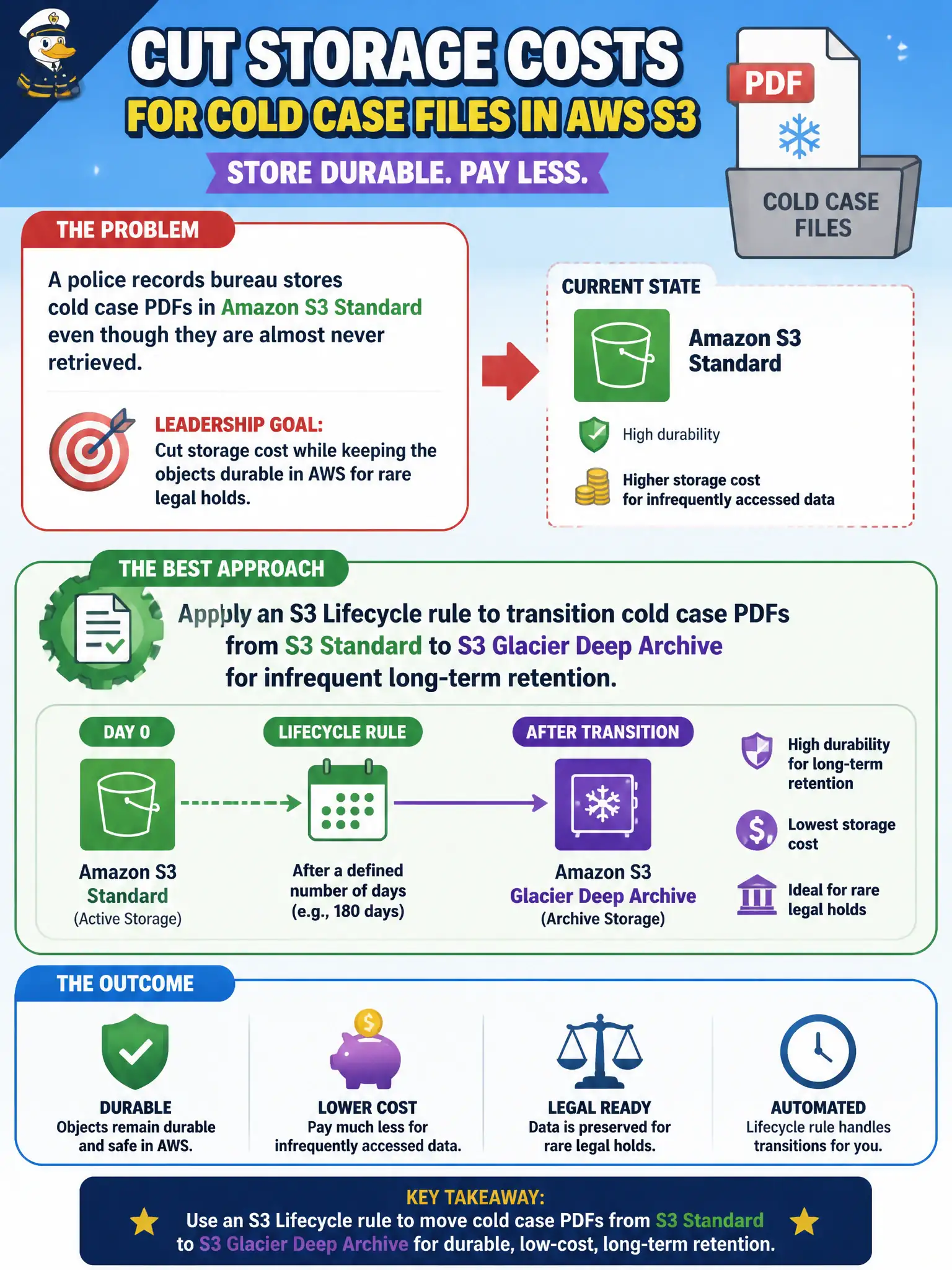
A police records bureau stores cold case PDFs in Amazon S3 Standard even though they are almost never retrieved. Leadership wants to cut storage cost while keeping the objects durable in AWS for rare legal holds. Which approach best reduces cost?
Select an answer to reveal the explanation.
Short Explanation
Cold case files that sleep for years don’t need the “always grab me” S3 Standard rate. Lifecycle them down to Glacier Deep Archive and stop paying hot storage prices for ice-cold PDFs. Deleting against legal holds, triple-Region Standard copies, or bulkier TIFFs move cost the wrong way.
Full Explanation
Applying an S3 Lifecycle rule to transition cold case PDFs from S3 Standard to S3 Glacier Deep Archive reduces storage cost for police records that are almost never retrieved while keeping objects durable in AWS for rare legal holds. Deep Archive is intended for long-lived, infrequently accessed data with restoration lead time—exactly the access pattern of cold case archives. Deleting all objects older than seven days regardless of legal retention requirements may violate legal holds and records policy even if it cuts the bill. Replicating every object continuously to three additional Regions in S3 Standard multiplies hot storage and transfer cost instead of reducing it. Converting every PDF to uncompressed TIFF and keeping them in S3 Standard generally increases stored bytes and does not address tiering. Exam caveat: restores from Deep Archive are slower and separately billed; do not tier objects that need interactive open latency, and verify retention/legal constraints before transition. Operational check: inventory last-access patterns for cold case prefixes, apply a lifecycle rule to a pilot prefix, confirm transition metrics and restore procedures with legal stakeholders, then expand the rule citywide.