
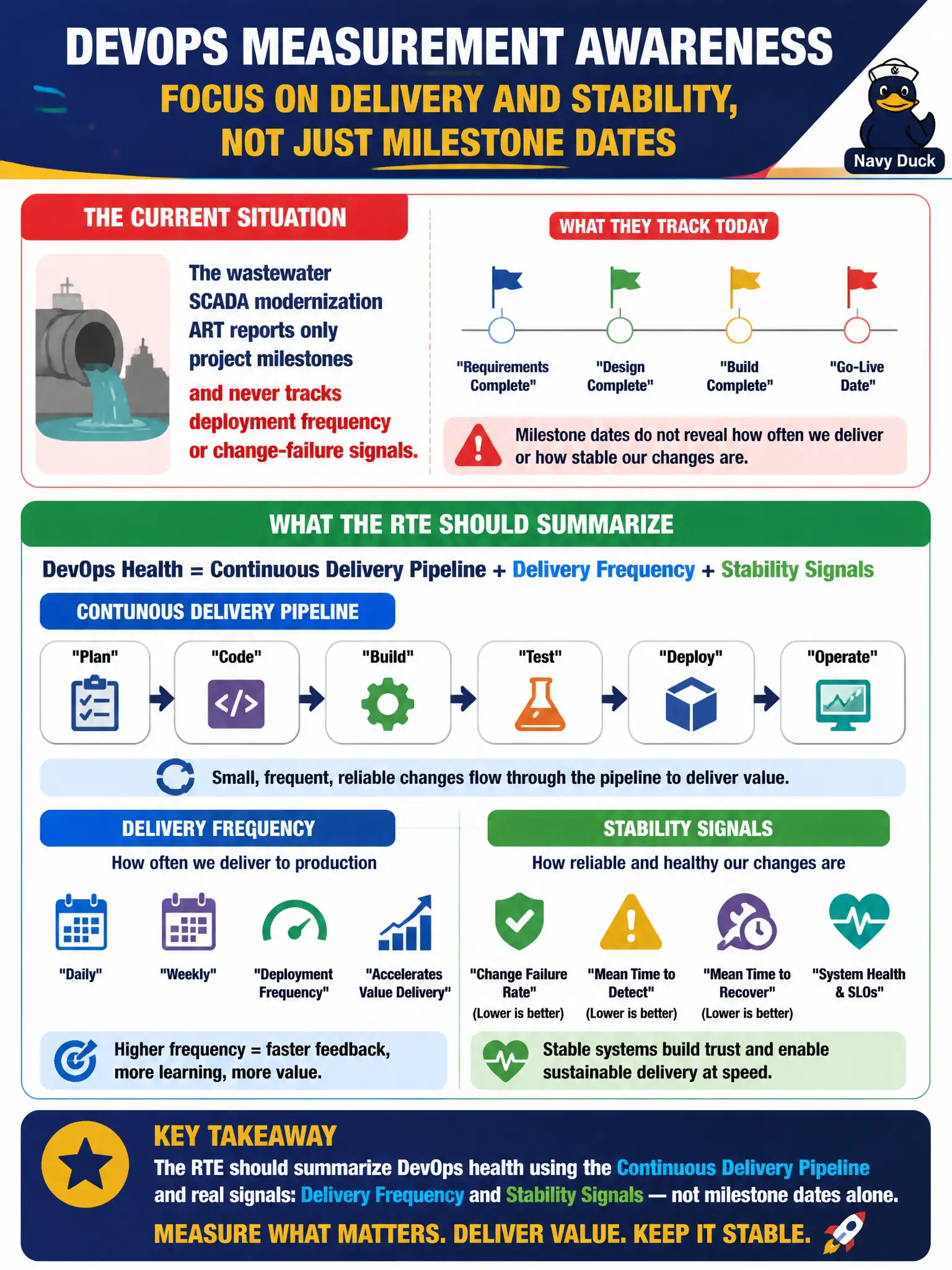
The wastewater SCADA modernization ART reports only project milestones and never tracks deployment frequency or change-failure signals. What DevOps measurement awareness should the RTE summarize?
Select an answer to reveal the explanation.
Short Explanation
A plant that only celebrates groundbreaking dates still does not know how often a safe change actually lands—or how often it breaks. DevOps health on the SCADA ART needs frequency and stability signals, not just milestone stickers. Milestones tell a project story; they do not tell a flow story.
Full Explanation
Continuous Delivery Pipeline and DevOps health includes delivery frequency and stability signals such as change-failure indicators, not milestone dates alone. When a wastewater SCADA modernization ART reports only project milestones and never tracks deployment frequency or change-failure signals, the RTE should summarize that measurement awareness. Claiming milestone charts replace DevOps metrics because SCADA cannot be deployed incrementally often hides feasible incremental technical validation. Claiming change-failure rate is a team-only Scrum metric the RTE must never discuss abandons train-level quality visibility. Claiming deployment frequency is unsafe to measure on operational technology ARTs confuses careful release control with refusing to measure. Wastewater SCADA modernization sponsors need deployability and stability signals alongside milestones; otherwise the board only sees calendar fiction. Exam caveat: OT releases may be infrequent by policy; the ART can still measure deployability, staging frequency, and failure signals on the path to production. Operational check: add deployment frequency and change-failure (or equivalent) to the SCADA ART dashboard beside milestones and review trends each PI. Review frequency and failure trends each PI even when production OT releases remain carefully gated.