
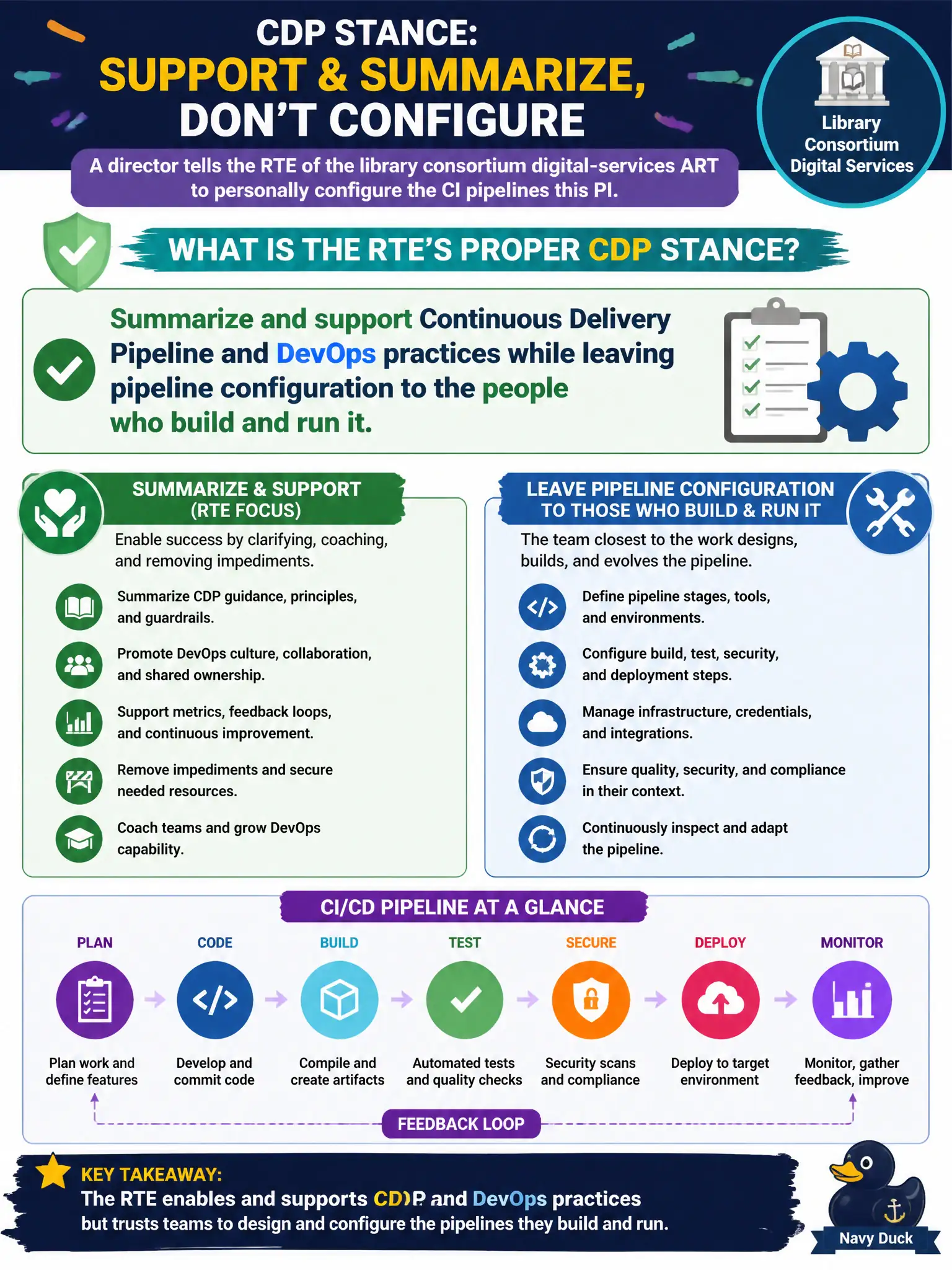
A director tells the RTE of the library consortium digital-services ART to personally configure the CI pipelines this PI. What is the RTE's proper CDP stance?
Select an answer to reveal the explanation.
Short Explanation
The RTE keeps the library train moving; the engineers lay the track automation. Supporting the Continuous Delivery Pipeline does not mean personally wiring every CI job. Drop the facilitation work to become pipeline specialist and the ART loses its coach.
Full Explanation
The RTE summarizes and supports Continuous Delivery Pipeline and DevOps practices while leaving pipeline configuration to the people who build and run it. When a director tells the library consortium digital-services RTE to personally configure CI pipelines this PI, the proper stance is support without taking the pipeline-engineer seat. Taking that seat and stopping ART facilitation until every job is green abandons the RTE role. Rejecting all automation because library catalogs are too unique for a pipeline freezes the ART in manual risk. Handing the entire CDP to an outside vendor and skipping ART quality conversations outsources learning and ownership. Library consortium digital services improve when pipeline enablers are owned by engineers and coached by the RTE—not when the RTE abandons facilitation to write CI jobs. Exam caveat: the RTE may help prioritize pipeline enablers and remove impediments; helping is not personally writing every job definition. Operational check: place CI pipeline enablers on the library ART backlog with engineering owners and track pipeline health in ART sync without the RTE becoming the builder. Keep pipeline health on the ART sync agenda with named engineering owners and RTE impediment support.