
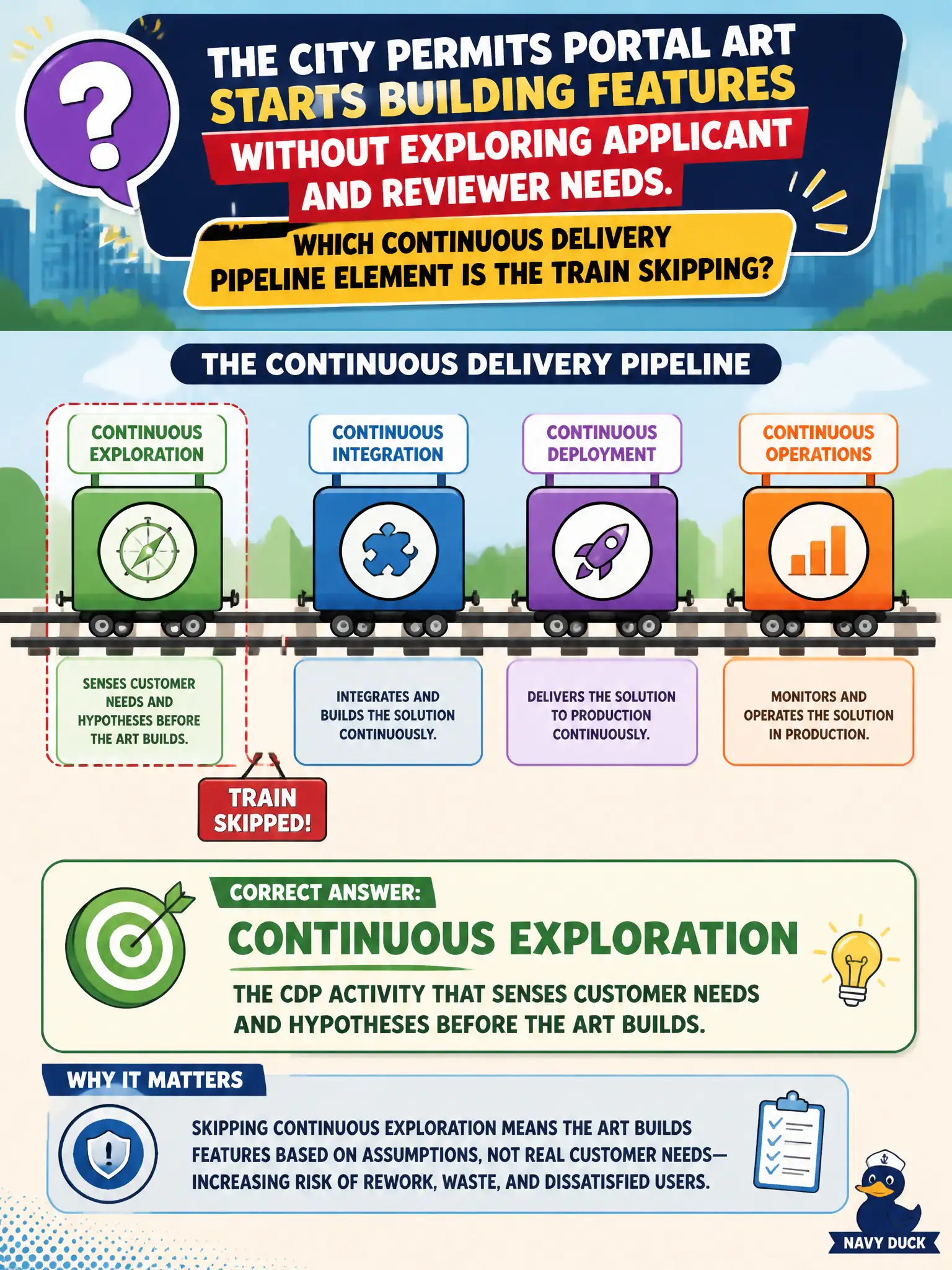
The city permits portal ART starts building features without exploring applicant and reviewer needs. Which Continuous Delivery Pipeline element is the train skipping?
Select an answer to reveal the explanation.
Short Explanation
Pouring a new permit counter without asking applicants or reviewers what stalls them is construction, not delivery. Continuous Exploration is the CDP stage that listens first—needs, hypotheses, then build. Skip it and the portal ships the wrong line.
Full Explanation
Continuous Exploration is the CDP activity that senses customer needs and hypotheses before the ART builds. When a city permits portal ART starts building features without exploring applicant and reviewer needs, Continuous Exploration is the skipped element. Calling the gap Release on Demand because unexplored work cannot be deployed until the mayor signs mislabels a sensing failure as a release-governance issue. Claiming Inspect and Adapt is the only SAFe event allowed to talk to permit applicants confines learning to the end of the PI. Claiming the IP iteration forbids exploration during PI execution is false—exploration is ongoing, with IP as additional innovation capacity. Tax-assessment Continuous Integration failures block assessors and property-data quality; the RTE supports CI health without becoming the build engineer. Exam caveat: exploration produces backlog insights; it does not authorize building without prioritization. Operational check: schedule applicant and reviewer discovery sessions, capture hypotheses on the Program Backlog, and validate them before committing large portal builds. Track red CI trends as ART impediments with engineering owners until the assessment pipeline stabilizes.