
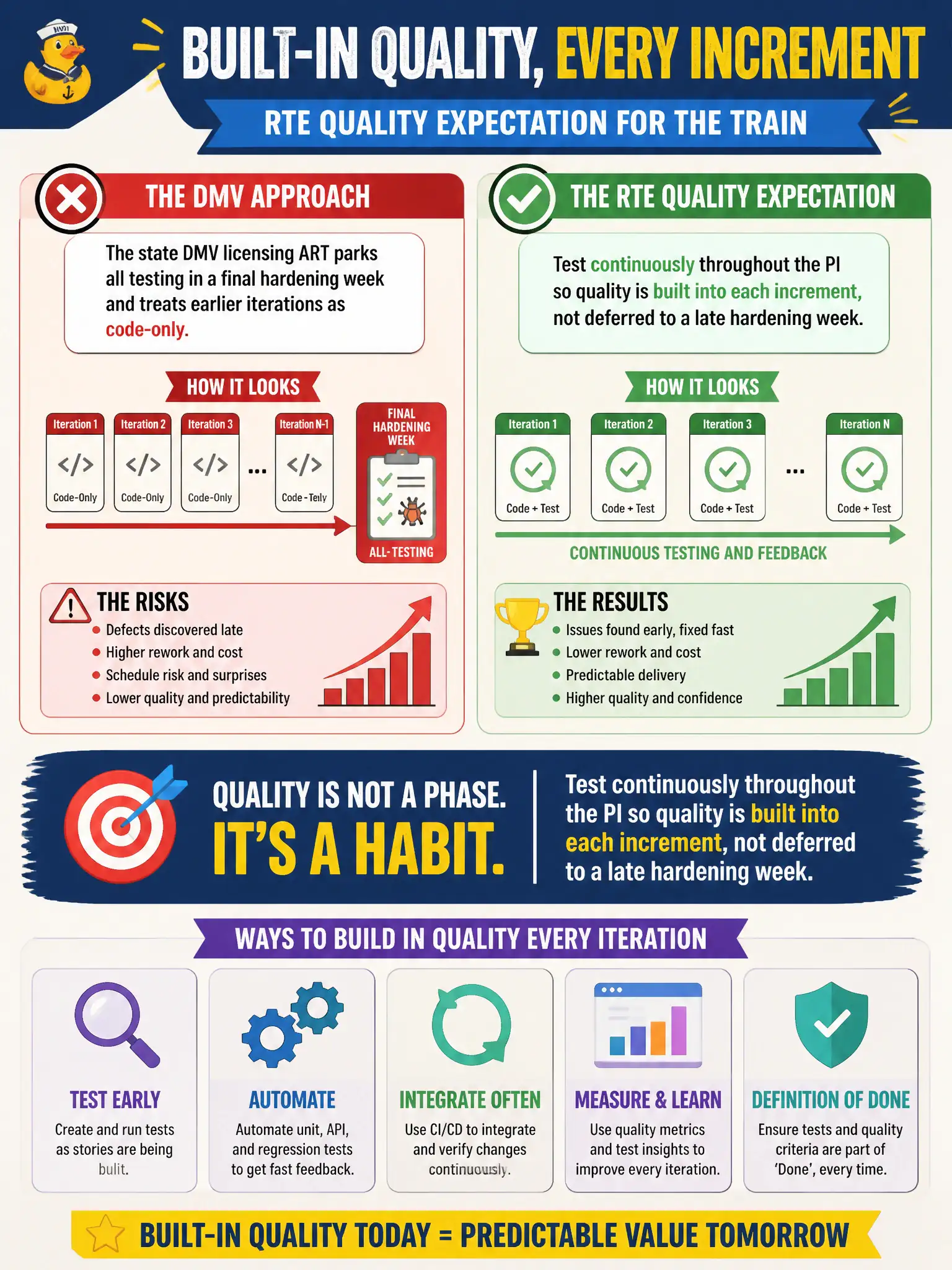
The state DMV licensing ART parks all testing in a final hardening week and treats earlier iterations as code-only. What built-in quality expectation should the RTE summarize for the train?
Select an answer to reveal the explanation.
Short Explanation
Saving every road test for graduation week is how you learn the brakes fail on the last day. Built-in quality means the licensing ART exercises those scenarios as it builds, not in a panic pile at the end. A hardening week is a safety net, not the test plan.
Full Explanation
Built-in quality expects continuous testing throughout the PI so each increment is validated, not deferred to a final hardening week. When a state DMV licensing ART parks all testing late and treats earlier iterations as code-only, the RTE should summarize continuous testing as the quality expectation. Moving the entire PI into one hardening sprint merely enlarges the batch. Replacing System Demos with a written defect log so teams never pause for validation hides integrated quality. Assigning a separate quality phase after PI Planning so Business Owners sign off before any code is written reintroduces waterfall stage gates. Licensing applicants and examiners absorb defect escapes when testing is end-loaded; continuous testing protects the public-facing DMV increment throughout the PI. Exam caveat: some regulated licensing scenarios need specialized test environments, but that constraint argues for earlier scheduling of tests—not exclusive end-loading. Operational check: require each DMV iteration to include planned test capacity and show test progress alongside coding in ART reviews. Spot-check iteration plans for explicit test capacity tied to licensing scenarios, not only coding tasks.