
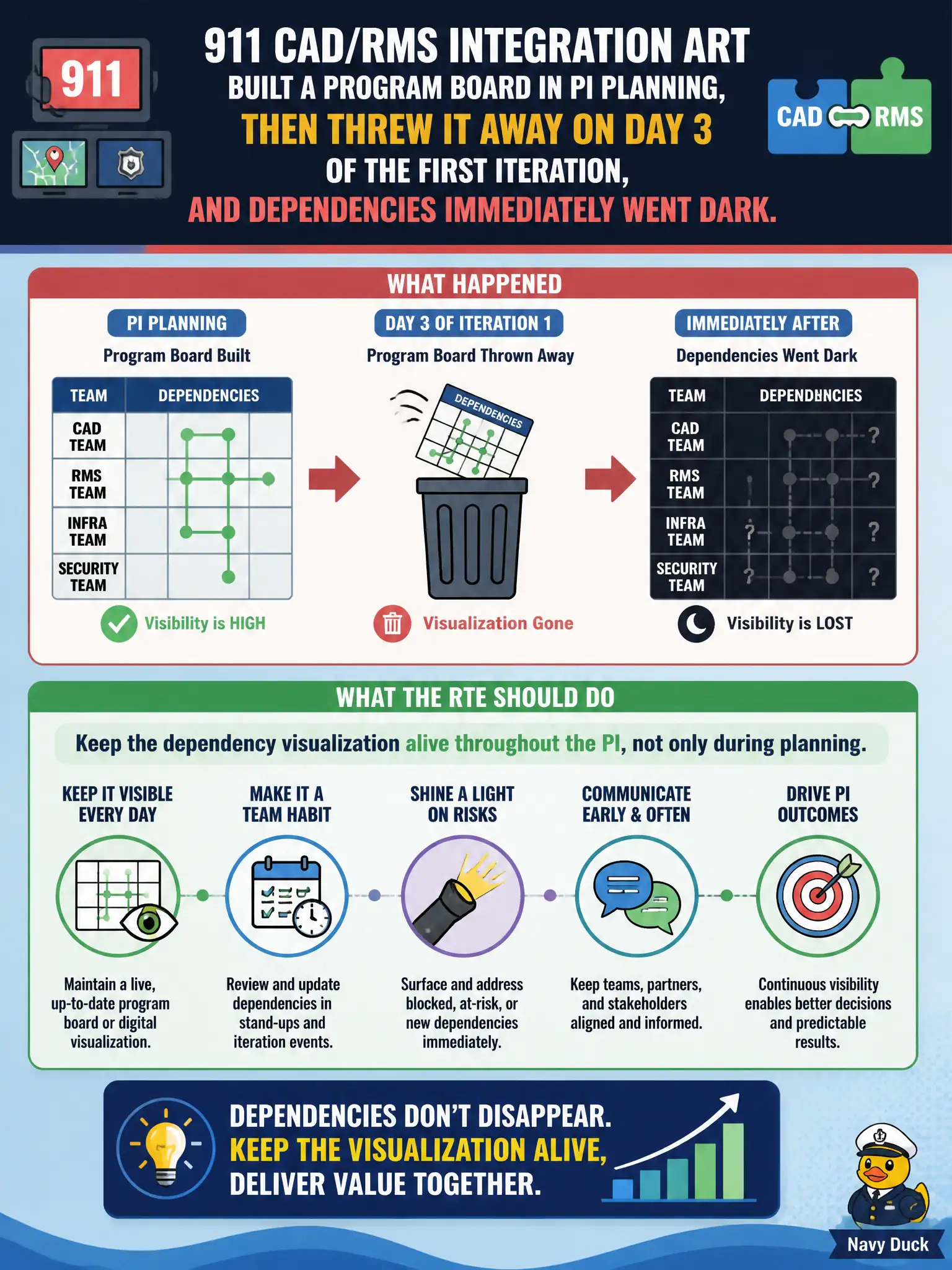
A 911 CAD/RMS integration ART built a program board in PI Planning, then threw it away on Day 3 of the first iteration, and dependencies immediately went dark. What should the RTE do?
Select an answer to reveal the explanation.
Short Explanation
The program board is not party decorations. If CAD and RMS teams toss it on Day 3, the dependencies do not vanish—they just go invisible. Keep the map up for the whole PI.
Full Explanation
Dependency visualization created in PI Planning must stay alive throughout the PI; throwing the program board away after Day 3 of the first iteration makes cross-team links go dark. For a 911 CAD/RMS integration ART, the RTE should keep the dependency visualization current during execution. Recreating the board only on the last day so Inspect and Adapt has a prop is theater. Relying on 911 dispatch radio traffic to communicate software dependencies confuses operational radio with ART coordination. Archiving the board as a planning souvenir and stopping cross-team tracking abandons the purpose of the board. Student-information releases affect schools and families; the ART should make Release on Demand decisions with Product Management and Business Owners, not by silent engineering push. Exam caveat: the living board may be digital and simplified, but abandonment is not simplification. Operational check: review CAD/RMS dependencies on the program board every ART sync and update owners and dates when plans change. Record release decisions and rollback plans where school stakeholders can see them. Hold the civic standard in facilitation notes so the next RTE inherits the same expectation for resident-facing outcomes.