
Stakeholders on a wastewater SCADA modernization ART cannot tell which features are in development, test, staging, or production, because team boards show stories rather than feature delivery state. What should the RTE add?
Select an answer to reveal the explanation.
Short Explanation
Stories are bricks; features are the pump house. If stakeholders cannot see which SCADA feature is in test versus production, they will invent a status. Show the pipeline stages.
Full Explanation
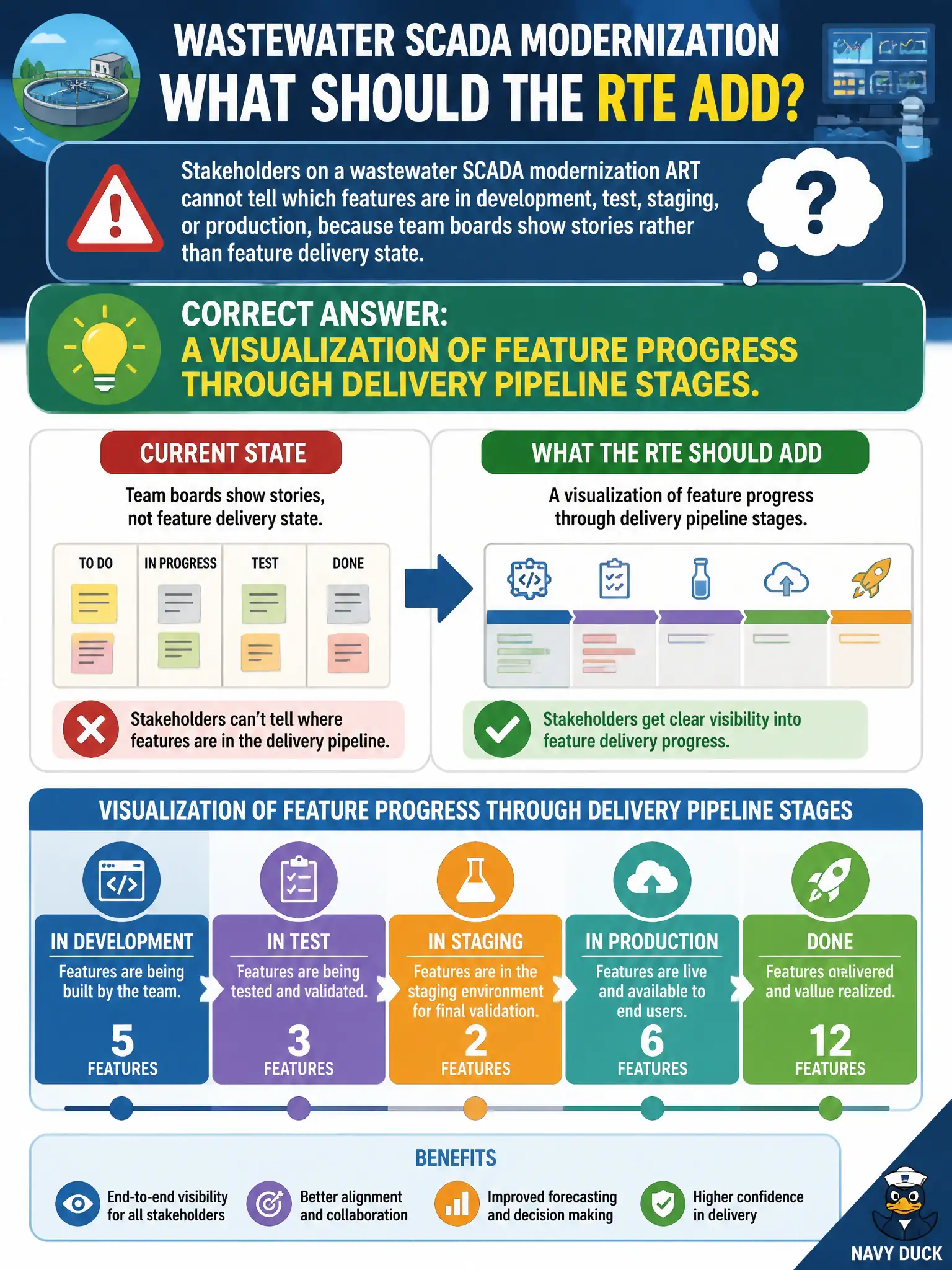
Stakeholders need a visualization of feature progress through delivery pipeline stages—development, test, staging, production—not only story-level team boards. On a wastewater SCADA modernization ART, when team boards show stories rather than feature delivery state, leaders cannot see where features sit in the pipeline that protects plant operations and regulatory compliance. A narrative status memo each quarter with no pipeline states is too slow and too coarse for operational technology risk that plant operators feel daily. Story-point totals alone do not show state or which SCADA features are blocked before production. A confidential vendor punch list teams cannot see recreates opacity and prevents ART-level problem solving across integrators and city staff. Exam caveat: operational technology release controls may gate production, but those gates should still appear as visible states rather than invisible black boxes. Operational check: add a feature-level pipeline view for SCADA modernization, review stage counts with stakeholders each sync, and name OT gates as pipeline states. Keeping wastewater sponsors and operators on one shared pipeline picture preserves accountability for civic infrastructure outcomes throughout the PI.