
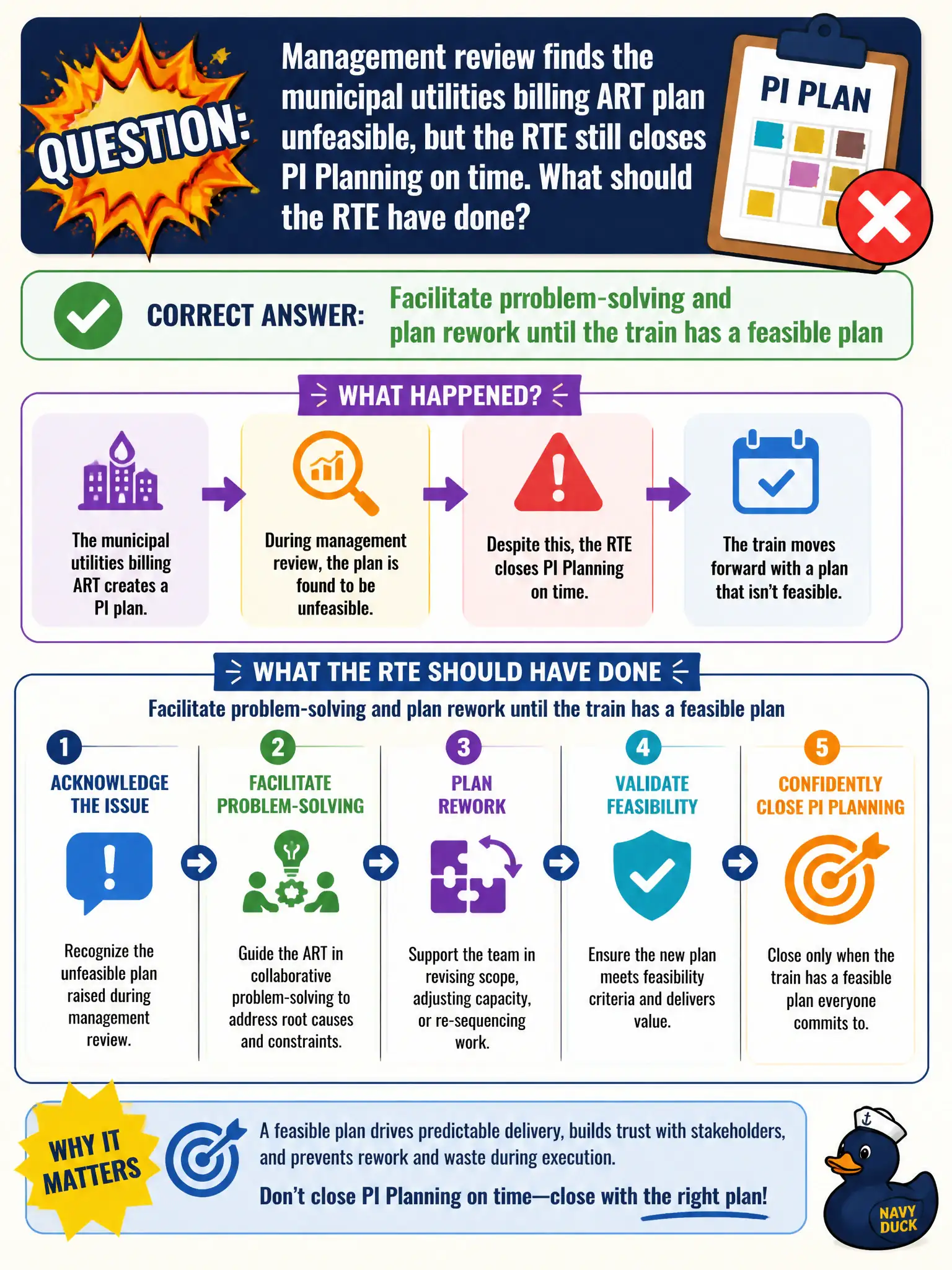
Management review finds the municipal utilities billing ART plan unfeasible, but the RTE still closes PI Planning on time. What should the RTE have done?
Select an answer to reveal the explanation.
Short Explanation
If management review says the billing plan cannot work, stopping the clock is not servant leadership. That review exists to force problem-solving and rework. Stay in facilitation until the train has a plan it can actually run.
Full Explanation
Day 1 management review and later confidence-driven rework exist to expose unfeasible ART plans. When management review finds the municipal utilities billing plan unfeasible, the RTE must facilitate problem-solving and planning adjustments rather than ending on time with a known-bad plan. Ending on the clock and hoping iteration 1 absorbs the infeasibility merely postpones failure into execution. Asking executives to sign the unfeasible plan to create urgency weaponizes commitment without fixing capacity or dependency collisions. Canceling the PI and waiting for a new fiscal year abandons cadence and leaves billing modernization without a near-term plan. Facilitating rework until the train has a feasible plan is the correct response. Exam caveat: feasibility rework may drop scope, split features, or renegotiate stretch items—it is not a mandate to force the original backlog through unchanged. Operational check: capture review objections as concrete board adjustments, assign owners, and do not close PI Planning while the billing plan remains marked unfeasible. Keeping the civic ART's planning artifacts visible to Business Owners and teams after the event preserves continuity from preparation into execution.