
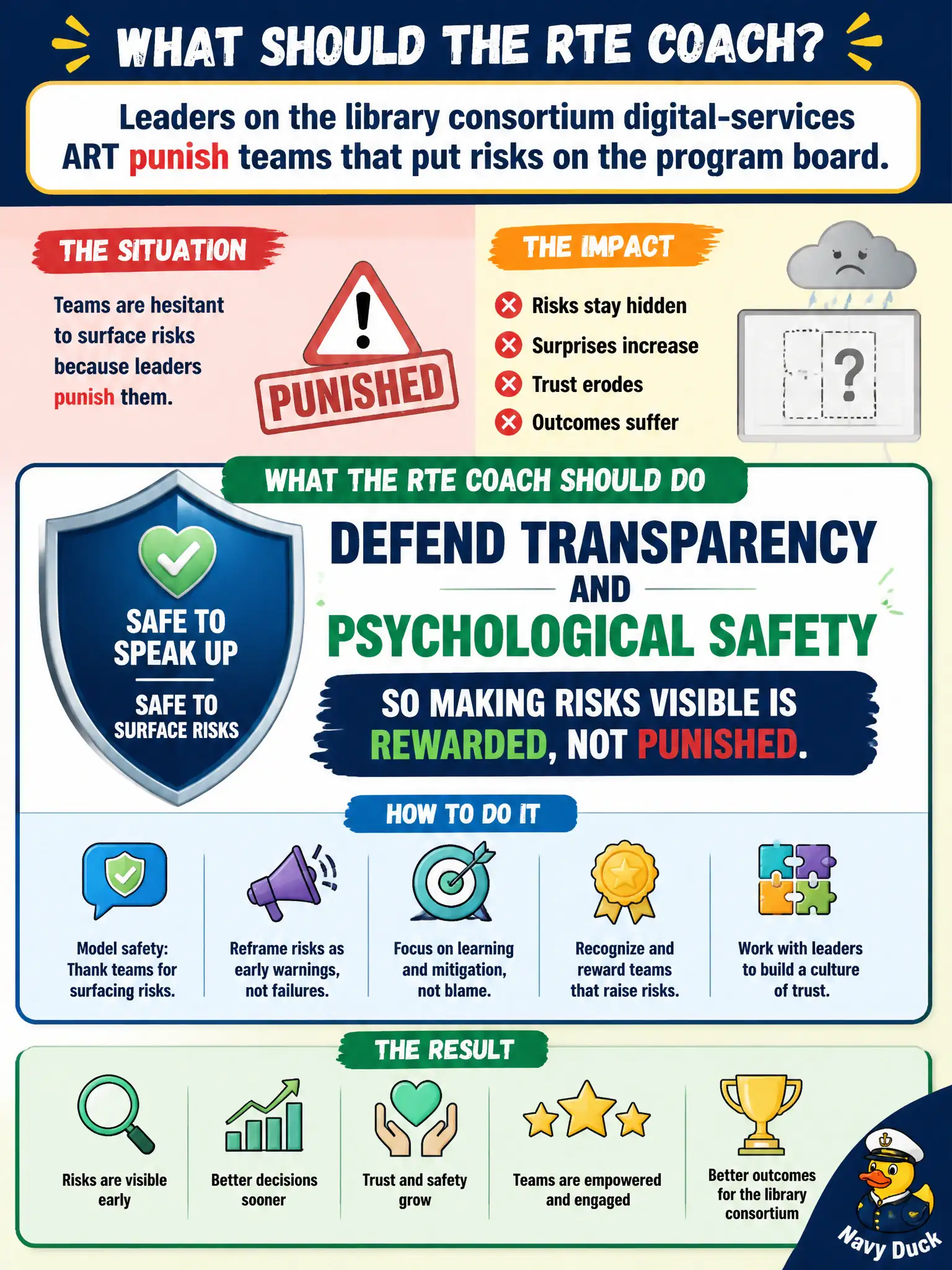
Leaders on the library consortium digital-services ART punish teams that put risks on the program board. What should the RTE coach?
Select an answer to reveal the explanation.
Short Explanation
Punishing a raised risk is yelling at the librarian who found mold in the stacks. The RTE's job is to make it safe to point at the mold so the consortium can fix it.
Full Explanation
Defend Transparency and psychological safety so making risks visible is rewarded, not punished. When leaders on a library consortium digital-services ART punish teams that put risks on the program board, they train silence—and silent risk is how member-library outages become public surprises. The RTE must coach leaders to thank risk visibility and help mitigate rather than shoot the messenger. Teaching teams to keep risks verbal only so leaders never see a red card recreates hidden risk and voids ROAM as a planning tool. Removing ROAM from PI Planning because visible risks upset sponsors protects sponsor comfort at the expense of delivery honesty for patrons. Scoring teams on how few risks they raise so the board stays green incentivizes concealment and false confidence. Exam caveat: Risk quality still matters—vague fear-mongering is not the goal—but punishing legitimate risks is the Core Value failure. Operational check: In the next library PI Planning, publicly thank a team for a material red risk, assign mitigation ownership, and ask leaders to reinforce that behavior in their own words. In municipal settings, pressure to look busy, compliant, or politically safe is constant; the RTE earns trust by holding the principle through that pressure and verifying the next cadence event shows improved civic delivery, not just a quieter meeting.