
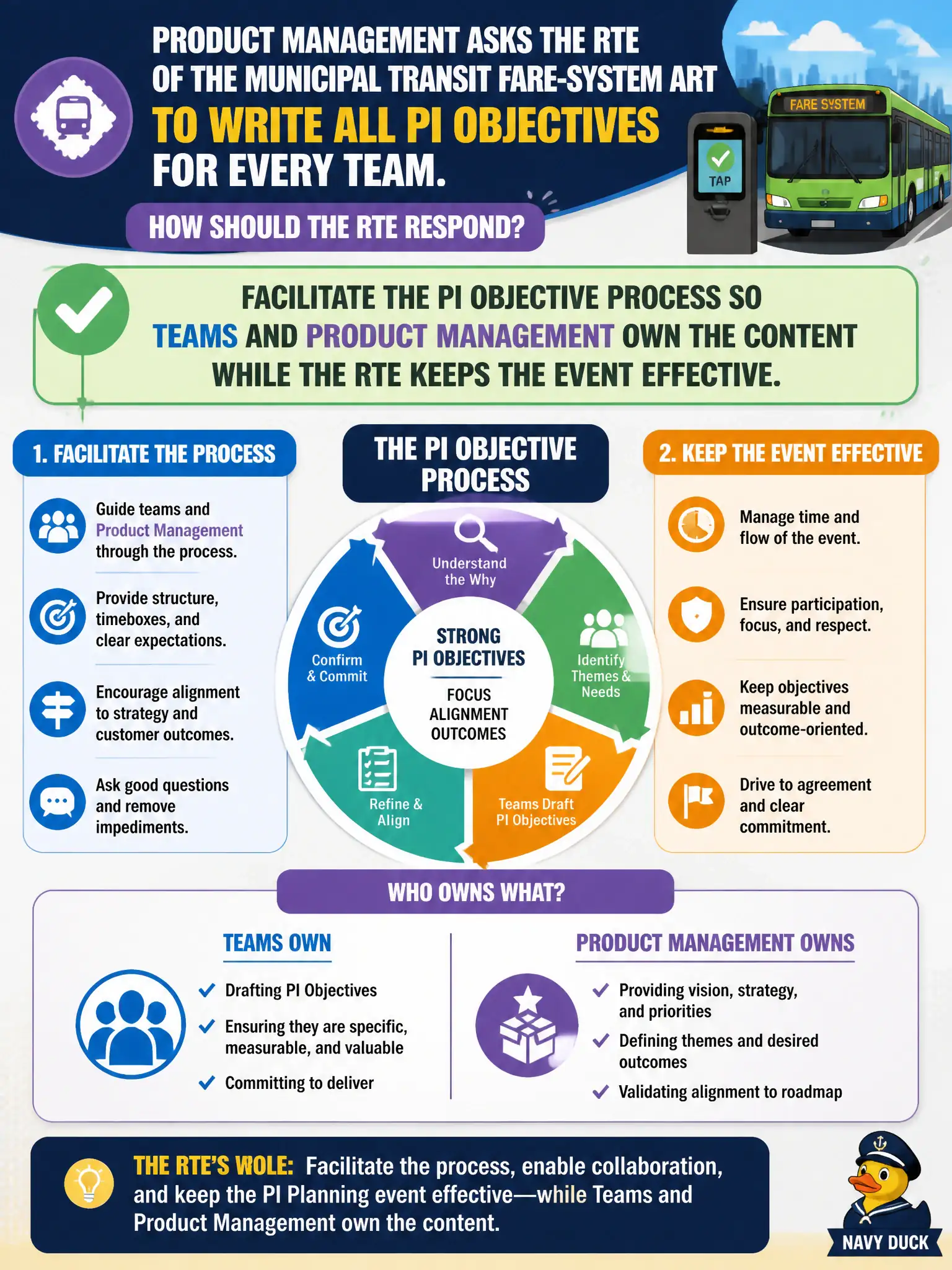
Product Management asks the RTE of the municipal transit fare-system ART to write all PI Objectives for every team. How should the RTE respond?
Select an answer to reveal the explanation.
Short Explanation
PI Objectives are not a memo the RTE authors in a quiet office. Teams and Product Management shape what the fare-system ART will actually try to deliver; the RTE runs the room so that happens well. Writing them all is overreach; ignoring them is the other ditch.
Full Explanation
PI Objectives are co-created by teams and Product Management, with Business Owners engaging on business value; the RTE facilitates the process so the event is effective. On a municipal transit fare-system ART, writing every objective for every team would steal content ownership and produce commitments the doers never owned. The correct response is to keep facilitation—agenda, timeboxes, clarity of decision rules, and coaching—while teams and Product Management own what the fare ART will try to deliver. Drafting every team's objectives overnight so Product Management can skip breakouts recreates waterfall mandate planning and weakens commitment quality. Converting requested objectives into a Gantt chart and assigning each line to a named engineer abandons Lean-Agile planning for traditional task assignment and utilization control. Refusing to discuss PI Objectives at all because they are "a Product Owner artifact only" is incorrect: Team and ART PI Objectives are central planning outputs, and the RTE must facilitate that work even though the RTE does not author the content alone. Exam caveat: Facilitation can include teaching the format and quality bar for objectives without ghostwriting them; coaching the method is allowed, owning the commitments is not. Operational check: During the next fare-system PI Planning, spot-check that draft PI Objectives originate in team breakouts with Product Management input, while the RTE is running the room clock, dependencies, and confidence vote—not typing objectives in isolation.