
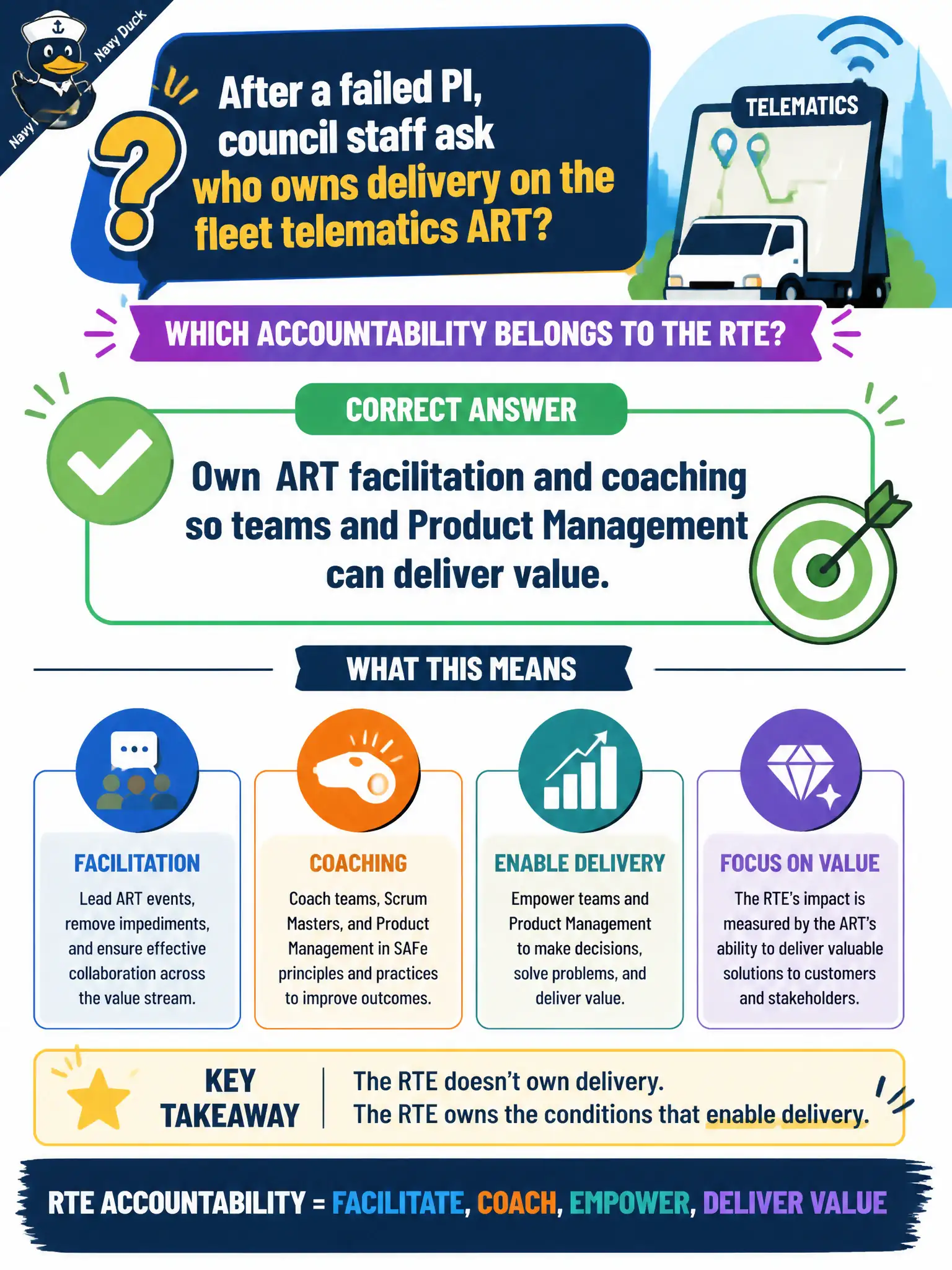
After a failed PI, council staff ask who owns delivery on the fleet telematics ART. Which accountability belongs to the RTE?
Select an answer to reveal the explanation.
Short Explanation
When a PI slips, people hunt for a boss. The RTE is not the product owner of fleet gadgets and is not the person writing GPS code. The job is to keep the train facilitated and coached so the people who do own content and delivery can actually deliver.
Full Explanation
Delivery accountability on an ART is a shared system, not a single executive throat to choke. After a missed PI on a fleet telematics train, the RTE's owned lane remains facilitation and coaching so Product Management, Agile teams, and Business Owners can deliver value. The RTE improves the planning, sync, dependency, and improvement mechanisms that make civic outcomes possible; the RTE does not absorb every other role under pressure. Owning the telematics feature backlog and accepting or rejecting stories as Product Management would conflates content authority with train facilitation and leaves the ART without a clear product voice for vehicle and operations stakeholders. Personally coding remaining GPS stories may feel heroic after a slip, yet it pulls the RTE out of the coaching lane, creates a bottleneck, and still fails to fix the systemic causes of the miss. Signing every vendor invoice so finance treats the RTE as the single delivery owner confuses commercial signature authority with Lean-Agile delivery accountability and invites the organization to stop fixing Product Management and team ownership. Exam caveat: After a failed PI, Inspect and Adapt and honest re-planning are required; facilitation ownership does not mean the RTE is blameless for poor event design or ignored risks. Operational check: In the next leadership briefing, map who owns backlog content, who builds and tests, who assigns business value, and what the RTE facilitated or coached—then confirm the telematics ART is not asking the RTE to replace those roles.